



AI in SAP: What Joule Really Delivers – and What to Prepare First

AI in SAP is no longer a demo. Artificial intelligence has reached the heart of the enterprise: the ERP. For companies running SAP, this is no longer a distant trend. In fact, SAP embedded its own AI, Joule, inside S/4HANA. Moreover, assistants such as ChatGPT and Claude have already entered the daily routine. They serve the people who operate, develop, and analyze data in the system.
In this article, therefore, we explain AI in SAP from scratch. First, what Joule is and where AI creates real value. Then, what you must prepare before switching it on. Finally, why the foundation — security, infrastructure, and cost — decides whether the project succeeds.
In one sentence — AI in SAP is like hiring an assistant. That assistant has already read every manual and every document in your company. It answers instantly, prepares the repetitive work, and suggests the next step. However, you still need to decide what it can see and how much it can spend.
What Joule is (and what the other assistants are)
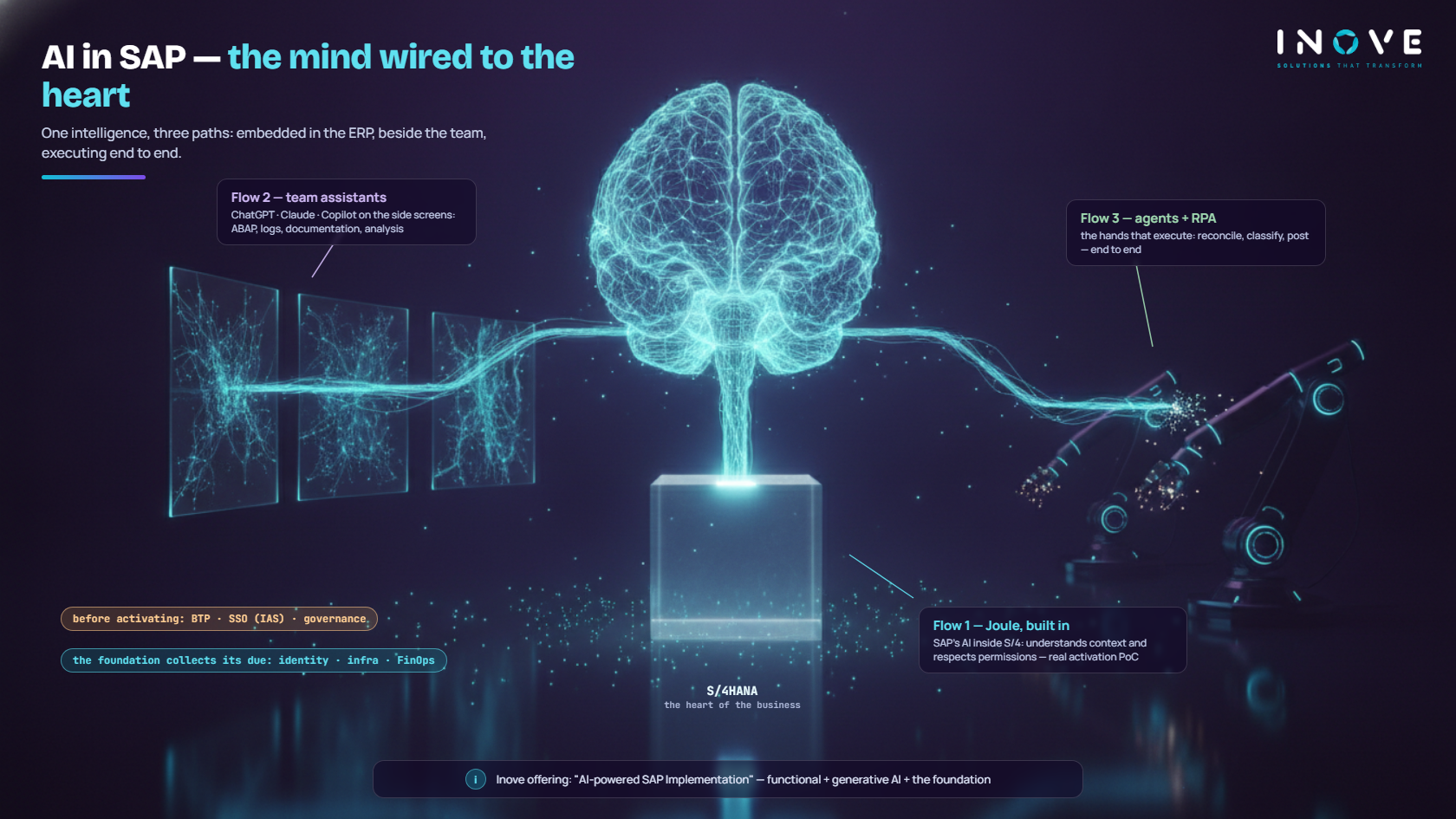
Joule is SAP’s own AI copilot. It lives inside the screens of S/4HANA and other SAP products. In addition, it understands the context of what you are doing. Then it answers in natural language: “show me the blocked orders”, “create the requisition”, “explain this error”. Moreover, because it runs inside SAP, it respects each user’s permissions.
General-purpose assistants — ChatGPT, Claude, Copilot — are, in contrast, the team’s “second screen”. They help write and review ABAP code and analyze logs. Likewise, they draft documentation and investigate issues. They do not live inside SAP; nevertheless, they accelerate everyone who works with it.
In addition, there is a third front: AI-powered automation (RPA + agents). It executes repetitive tasks end to end — reconciling, classifying, posting.
Where AI in SAP creates real value
- Application support. Ticket triage, log reading, and fix suggestions. As a result, the team spends less time firefighting.
- ABAP development. Generating, reviewing, and documenting code. Consequently, projects move faster, with less rework.
- Analysis and decision-making. Natural-language questions about procurement, finance, and supply chain — without waiting for a new report.
- Processes. In addition, automation of repetitive tasks (reconciliations, classifications, postings) with RPA + AI.
What you must prepare before switching it on
Here we speak from the experience of having led a real Joule activation PoC in a corporate environment. Activation is not a button; on the contrary, there are concrete prerequisites —
- Version and licensing of S/4HANA compatible with Joule;
- SAP BTP (SAP’s cloud platform, where Joule runs) configured, with the right account and integrations;
- Identity — the SAP user and the cloud user must be the same person (SSO via IAS). Otherwise, the AI does not respect permissions;
- Data governance — deciding what the AI can see, log, and answer.
Critical point — AI amplifies whatever exists. If access governance is loose, it exposes you faster. Likewise, if the infrastructure is tight, it saturates sooner. Finally, if nobody controls consumption, the cloud invoice surprises you. The foundation always sends the bill.
How Inove helps
We built the “AI-powered SAP Implementation” offering exactly for this moment. It combines SAP functional expertise with generative AI and analytics. It also brings the layer that sustains everything: cybersecurity and identity governance, infrastructure and cloud, and FinOps to control consumption. Finally, development integrates the use cases.
Our long-standing vision: we want our clients to be happy and free of IT headaches. In practice, that means enjoying AI without inheriting security or cost surprises.
Where to start
- Assessment — S/4HANA version, BTP, identity, and governance maturity.
- Use cases — start with low risk and high return (application support and development usually come first).
- Foundation ready — security, infrastructure, and FinOps before scaling.
- Pilot → production — with measured gains and governance.
Read next
- RISE with SAP: what remains your responsibility
- Brazilian tax reform and SAP: what IT must prepare
- AMS for SAP: support that frees the team to innovate
Want to explore AI in SAP securely in your environment? Talk to Inove Solutions.