



S/4HANA Migration: Three Paths, One Deciding Factor

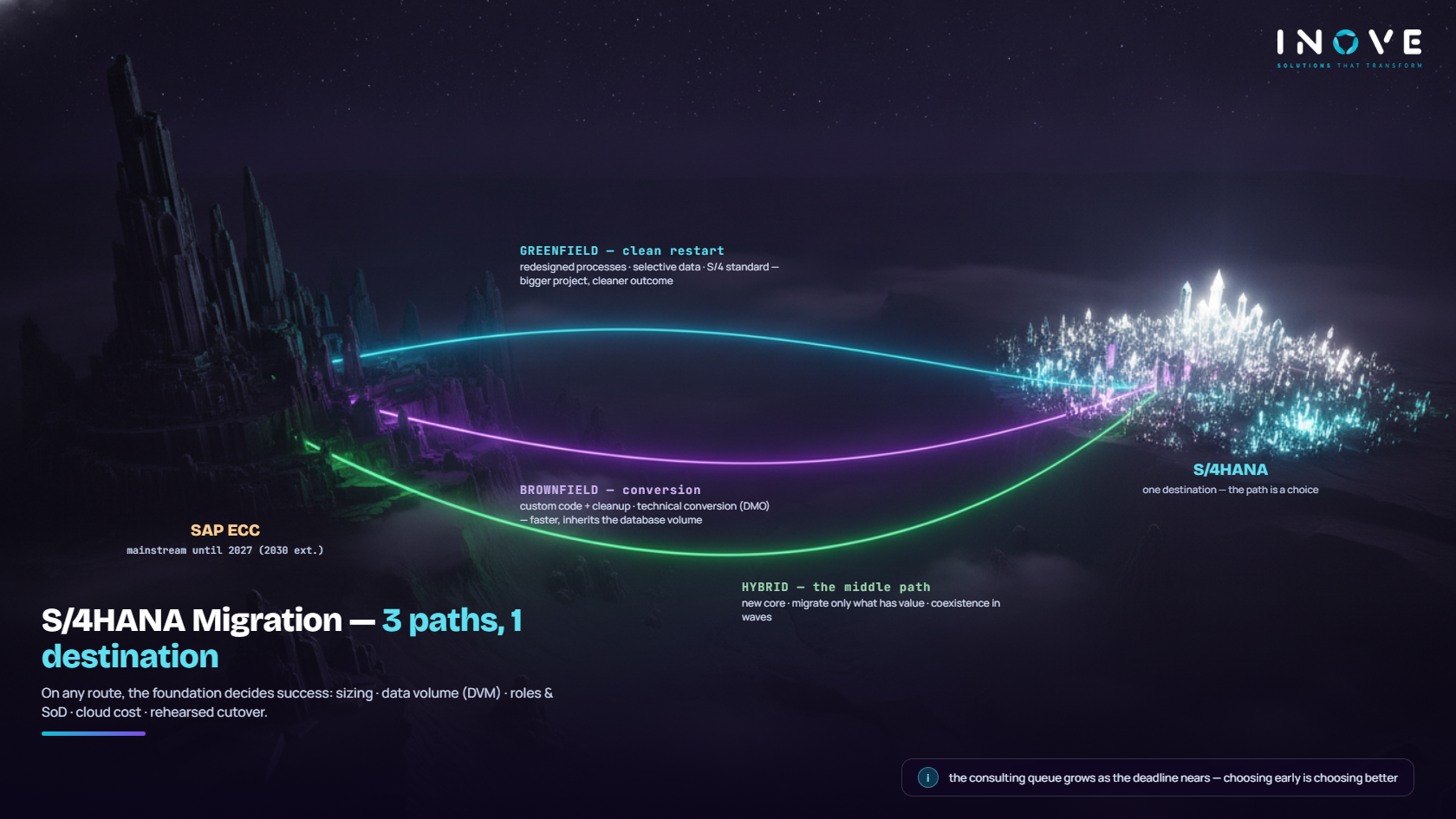
First of all, the ECC clock is ticking: SAP’s mainstream support ends in 2027 (with paid extension until 2030). Therefore, the SAP S/4HANA migration has left the “someday” bucket. In fact, it is now in the actual planning of almost every company running SAP in Brazil. However, there is a truth that projects discover too late. Success is not decided in the functional workstream alone. Instead, it is decided in the foundation.
In this article, therefore, we explain the migration paths in plain language. In addition, we cover what really changes. For example, we share the lessons of people who have lived through large projects from the inside.
In one sentence — an S/4HANA migration is like moving house. For example, you can renovate the current one (brownfield) or build a new one (greenfield). In addition, you can move room by room (hybrid). In every case, however, three things decide whether the move succeeds. They are the foundation, the truck, and what you keep or throw away.
The three paths, without jargon
- Brownfield (renovating the house). In practice, it converts the current system: it preserves history, customizations, and the way of working. It is faster; however, it carries the legacy — including the parts that are worthless.
- Greenfield (a new house). Instead, implementation starts from scratch: redesigned processes, a clean system (“clean core”). It is more transformative, yet longer and more expensive.
- Hybrid / selective (moving room by room). Meanwhile, it migrates in parts — selected companies, modules, or data. As a result, it balances risk and transformation.
Why the foundation decides the S/4HANA migration
- Infrastructure and sizing. HANA is an in-memory database. For example, it keeps data in RAM to be fast. However, RAM is expensive. Consequently, poorly sized development, test, and production environments stall the project.
- Data volume. For example, every conversion test processes the entire database. Therefore, archiving before migrating shortens windows, cuts cost, and reduces risk — it is the project’s first saving.
- Security and roles (SoD). SoD means “segregation of duties”. For example, whoever buys does not approve, and whoever pays does not create master records. Therefore, the migration is the moment to fix this — not to copy the problem into the new house.
- Cloud cost (FinOps). In addition, parallel environments and test cycles drive up consumption. As a result, without control the invoice arrives before the go-live.
Field experience — we lived through large implementation and migration projects from the inside. There, the items that most delayed the schedule were not functional. For example, one of them was disciplined transport control, with every change tracked across environments. In addition, a role × activity access matrix defined early avoided go-live access chaos. Finally, a rehearsed cutover plan mattered just as much. It carried roles, timings, and a plan B written down before the switchover weekend.
How Inove helps
We are the partner for the foundation of the S/4HANA migration. For example, we handle infrastructure and cloud sizing and operation. In addition, we deliver volume reduction with archiving, access governance, and SoD. Likewise, we cover project FinOps and post-go-live support. Above all, we bring the experience of people who know the SAP landscape from the inside.
Our long-standing vision: we want our clients to be happy and free of IT headaches — including during an S/4HANA migration.
Where to start
- Assessment — legacy, customizations, and the right path (brownfield, greenfield, or hybrid).
- Volume reduction — archiving before the conversion.
- A sized foundation — infrastructure, cloud, environments, and FinOps.
- Roles and SoD from the start — not at the end.
- A rehearsed cutover — and support ready for the day after.
Read next
- SAP archiving: the cheapest way to speed up the migration
- RISE with SAP: the cloud path — and what stays with you
- SAP implementation: why the foundation decides
Planning your S/4HANA migration? Talk to Inove Solutions — we take care of the foundation so the project never stalls underneath.