



Types of RPA: Attended, Unattended, and Hybrid Automation

Despite the name, RPA (Robotic Process Automation) involves no physical robot at all. It is software programmed to execute repetitive tasks in a person’s place: filling in tax documents, migrating data between systems, checking invoices, updating inventory. In 2026, the news is not the technology — it is how to choose the right model, now that generative AI has entered the equation.
So before licensing a platform, it pays to understand the classification that really matters: attended, unattended, or hybrid automation. The difference lies in how much the process depends on human judgment — and getting that choice wrong is the most common reason an automation project fails to pay for itself.
Where RPA applies (and what changed with AI)
RPA’s classic ground is structured, high-volume processes: billing, accounts payable, customer and employee onboarding, data migration and validation, compliance, inventory updates. The rule of thumb still holds: if the task always follows the same step-by-step, it is a candidate.
What changed is the ceiling. Traditional RPA is non-cognitive — it follows fixed rules and breaks when the layout changes. Combined with OCR, machine learning and, more recently, generative AI models, it now handles non-standardized documents, natural-language emails, and simple classification decisions. This is so-called intelligent automation: the bot executes, the AI interprets.
Attended automation: the employee’s copilot
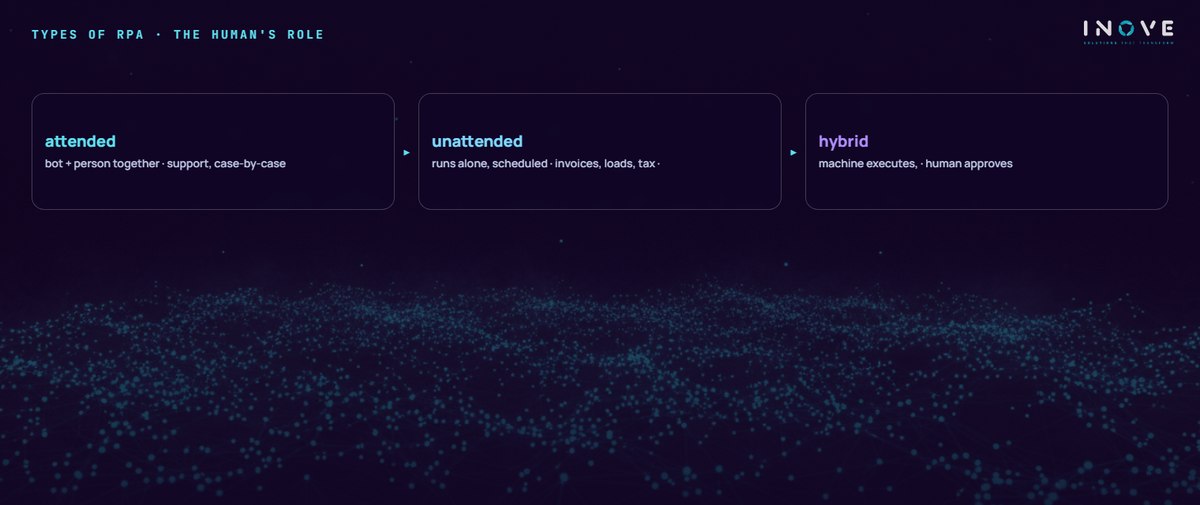
In attended automation, the bot runs on the workstation and acts together with the person. It executes the mechanical part — looking up records, filling in screens, consolidating data — and hands control back when something requiring judgment appears. It can also raise alerts asking for intervention when it hits a situation outside the pattern.
In practice, it is the natural model for customer service (the bot resolves duplicate invoices and recurring questions; the agent takes the complex case) and for areas where human verification is part of the control. It also works as a rite of passage: teams resistant to automation accept an assistant better than a replacement.
Unattended automation: the overnight shift
Here the flow runs end to end without intervention, on a server, usually scheduled or triggered by an event. It is the right model for fully structured, fully mapped processes with no route deviations: invoice processing, tax-filing preparation, data loads between systems, reconciliations.
The gain is twofold: besides freeing people, it eliminates typing and fatigue errors — decisive when the data feeds business decisions. On the other hand, it demands exception discipline: whatever the bot cannot handle must land in a monitored queue, not in limbo.
Hybrid RPA: the best of both worlds
The hybrid model combines the previous two in the same process. A typical example from Brazil’s tax reality: the unattended bot collects data from the tax authority and from customers, fills in and organizes the documents; before submission, a person checks and approves. The volume stays with the machine and the compliance risk stays under human control.
How to choose the right model
- Does the task require human interaction? If customer satisfaction or case-by-case judgment matters, start with attended.
- Is the process 100% mapped? A fully structured flow with no known deviations is unattended territory.
- Is there regulatory or tax risk? Prefer hybrid: automated volume, human approval at the critical point.
- Is the goal team performance? Automate the mechanical part and keep the person on verification and strategy — the gain shows up in any of the three models.
From choice to operation
Finally, remember that RPA is software in production: it needs versioning, monitoring, and maintenance — system screens change, tax rules change, and the bot has to keep up. This full cycle, from flow design to ongoing support, is what we cover in our software development and IT support practices.
In short, the types of RPA do not compete with each other — they solve different problems. Classify each process by its need for human judgment, start with the highest-volume, lowest-risk one, and evolve based on measured results. Good automation is the kind nobody notices: the work simply flows.