



Pentest: Why It Is Essential for Selling on Your Website

Selling online means running a storefront that is open 24 hours — to customers and to criminals. Checkout, sign-up, payment API, third-party scripts: every point of your site is a door someone, at some moment, will try to force. A pentest (penetration test) exists so that the first one to force it is a specialist hired by you, not a real attacker.
That is why, in this article, we explain what a pentest is in practice, why it is decisive for anyone selling through their site and how to build a testing routine that protects the highest-revenue dates — Black Friday and Christmas first among them. This is the work Inove performs on e-commerce platforms and on the systems behind them.
What a pentest is, in practice
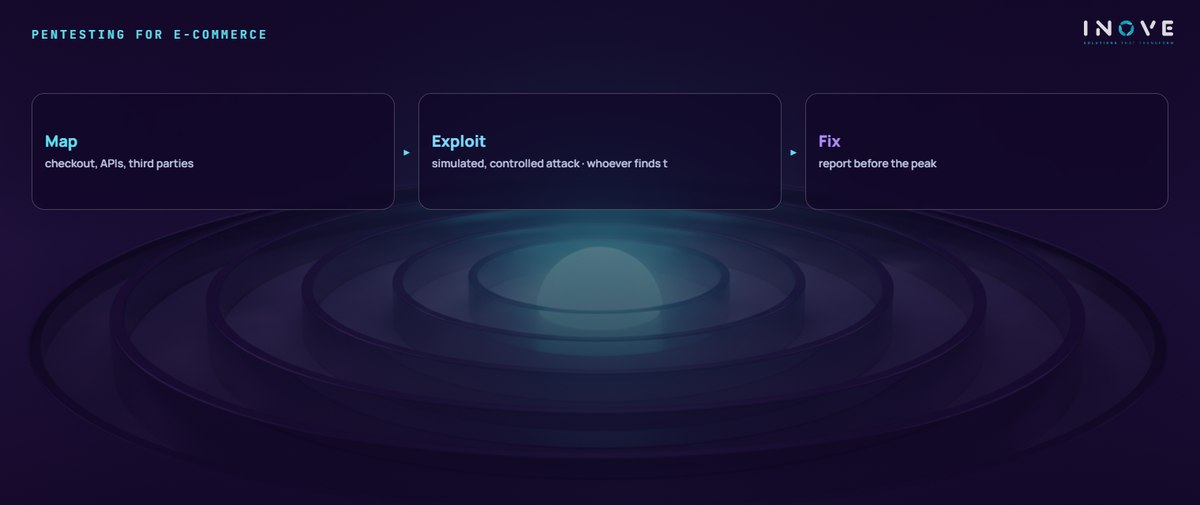
A penetration test is a controlled assessment in which specialists simulate a real attack against systems, networks or applications. Unlike a simple automated scan, a pentest exploits the flaws it finds — it proves what an intruder could actually do with them.
The outcome is a report with vulnerabilities ranked by criticality and remediation recommendations. The security team stops working in the dark and starts fixing in the right order, beginning with whatever gives access to customer data and payments.
Why e-commerce needs it
- Payment security — checkout concentrates the store’s most valuable data. Malicious scripts injected into the page capture card numbers silently; the test verifies gateway integrations, the PIX flow (Brazil’s instant-payment system) and the third-party scripts the page loads.
- Personal-data protection — with LGPD, the Brazilian data-protection law, now mature and its regulator actively enforcing, a leak brings economic damage, mandatory notification and the risk of sanctions. Finding the gap first costs a fraction of that.
- Continuity on peak dates — the tests reveal the systems’ limits under overload, whether malicious or a legitimate demand spike. Instability on Black Friday is a direct loss in sales.
- Catalog and inventory integrity — today’s ransomware encrypts and also copies data. Losing your inventory on Christmas Eve is the worst possible scenario; immutable, tested backup is part of the answer.
- Bot abuse and customer accounts — credential-stuffing bots try leaked passwords against your customers’ accounts. The pentest assesses whether login, APIs and recovery flows hold up.
The types of pentest
The term is broad, and each modality answers a different question:
- Internal and external infrastructure — firewalls, the corporate network and internet-facing services.
- Web application and APIs — the heart of e-commerce; a large share of today’s flaws lives in the integration layer.
- Mobile applications — the store’s Android and iOS app, including what it stores on the device.
- Cloud and supply chain — cloud environment configuration, plugins, gateways and the third-party scripts the page loads.
- Wireless network — the WLAN of the physical operation, when there is a store or distribution center.
- Social engineering — the team’s response to phishing that now arrives written by AI, flawlessly worded, and even with cloned voice.
The ideal testing routine
A pentest is not a one-time event. The practical recommendation: at least one full assessment per year, repeated after any relevant change — a gateway swap, a new integration, a platform migration. For retail, moreover, the calendar rules: test completed and fixes applied before September, so you reach Black Friday with the house in order. It is the same preparation logic we apply in our retail technology projects.
In short, anyone selling through their site lives on consumer trust — and trust does not survive a card leak or a store down on peak day. A pentest is the cheapest way to buy that peace of mind: a fake attack, run by people on your side, so the real one finds no open door. Building that routine is part of what we deliver in cybersecurity.