



SAP NFE to DRC Migration: The Clock Has Already Run Out

If your company still issues NF-e (the Brazilian electronic invoice) through SAP GRC NFE, this article is urgent: SAP’s support for the product ended on December 31, 2025. Consequently, anyone who has not migrated is running fiscal document issuance — the heart of billing — without vendor support, precisely when the Brazilian Tax Reform starts taking effect. The official successor is SAP Document and Reporting Compliance (DRC), and therefore the SAP DRC migration is no longer an improvement project: it has become risk management.
In this article, we explain the SAP NFE to DRC migration in plain language: what each product is, why the deadline matters, what changes in practice, and how to plan the SAP DRC migration without stopping your billing.
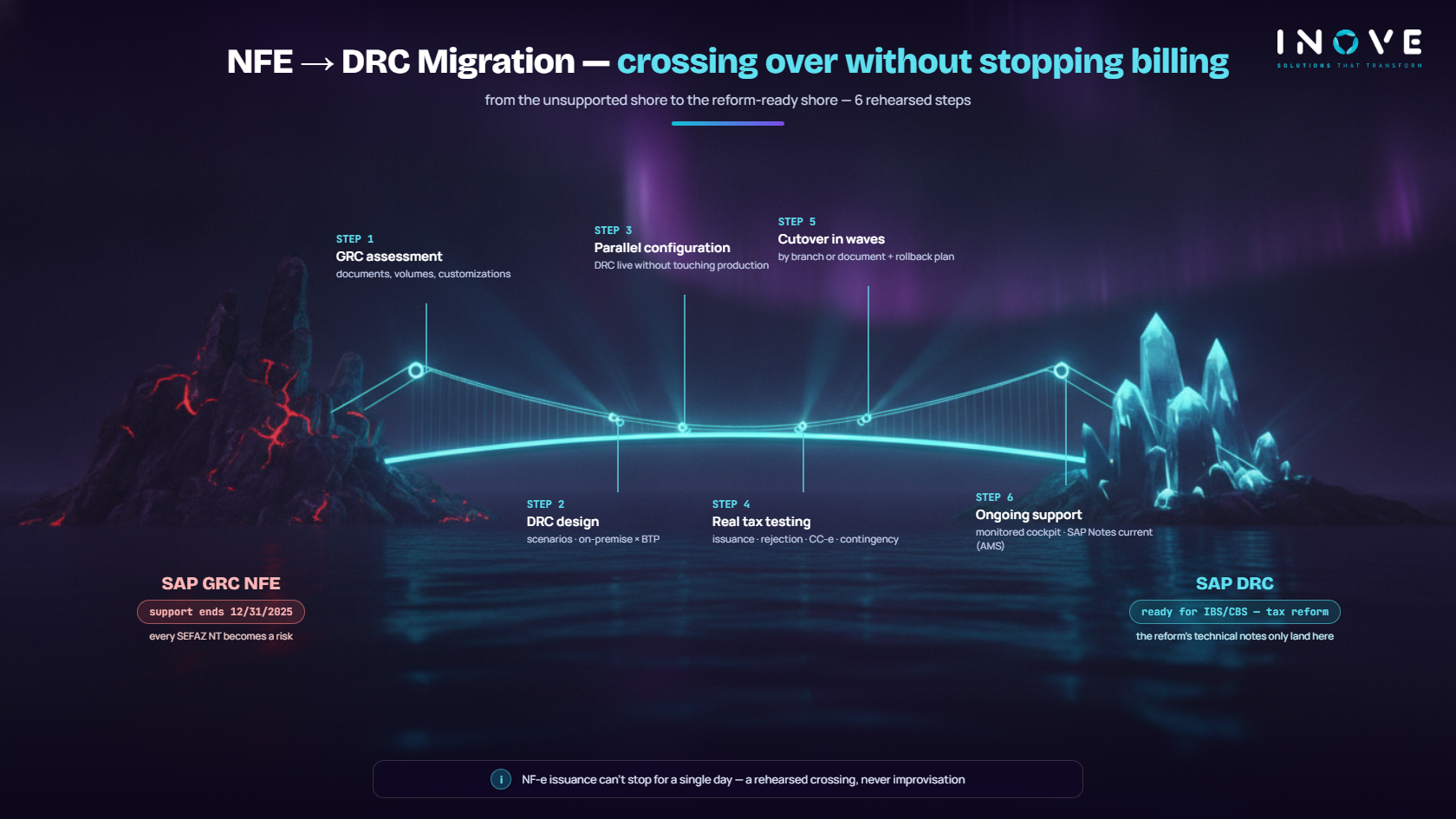
In one sentence — it is like replacing a car’s engine while it is moving: invoice issuance cannot stop for a single day, so the migration from GRC to DRC needs a plan, a test environment, and a rehearsed cutover — not improvisation.
What is what (without jargon)
- SAP GRC NFE — the classic solution (on-premise, on NetWeaver Java) that for more than a decade handled the communication of NF-e, NFS-e (Brazilian electronic service invoice), and CT-e (Brazilian electronic transport document) with SEFAZ (the Brazilian state tax authorities): signing, submission, response handling, contingency.
- SAP DRC (Document and Reporting Compliance) — the successor. It unifies electronic documents (NF-e, CT-e, NFS-e…) and statutory reporting (fiscal reports) in a single platform, integrated with S/4HANA (and compatible with ECC), with the option of running the communication services in the cloud (BTP).
The strategic reading: SAP has consolidated everything related to fiscal compliance — worldwide, not only in Brazil — inside DRC. As a result, GRC NFE stayed in the past, along with the Java platform it runs on.
Why now (two clocks ticking)
- Clock 1 — support has ended. Since 12/31/2025, there are no fixes and no legal updates for GRC NFE. Consequently, every SEFAZ layout change becomes operational risk: if something breaks, there is no one to escalate to.
- Clock 2 — the Brazilian Tax Reform. Starting in 2026, electronic documents must carry the new taxes (IBS, CBS, and the Selective Tax). Moreover, SAP delivers the reform’s technical notes in DRC — not in GRC. In other words: staying on GRC means falling behind on the reform.
- Clock 3 — the end of SAP ERP (ECC) itself. Mainstream maintenance for ECC ends in 2027, with paid extension until 2030. Anyone still on ECC will face the migration to S/4HANA anyway — and migrating fiscal compliance to DRC first simplifies that path: DRC is already the S/4HANA standard. Therefore, it is a step on the journey, not a detour.
What changes in practice
- Architecture. The dedicated Java server goes away; in its place comes DRC embedded in S/4HANA/ECC, with the SEFAZ communication service able to run in SAP’s cloud (BTP) — therefore, less infrastructure to support.
- Broader scope. In addition, DRC is not only NF-e: it covers CT-e, NFS-e, events, and statutory reporting — one single place for compliance.
- Issuance process. New monitoring (the DRC cockpit), rejection handling, and contingency with different screens and flows — as a result, both the tax team and IT need onboarding.
- Custom developments. Finally, everything built on top of GRC (validations, enrichments, integrations) must be reassessed: part becomes standard DRC configuration, part is redesigned.
Field experience — we have configured DRC outbound end-to-end in a large S/4HANA environment: from Business Scenario Design to the complete issuance configuration, including the tax team’s access profiles in Fiori. The lasting lesson: the technical work is only the visible half — success lives in exhaustively testing the company’s real fiscal scenarios (every CFOP, every contingency) before the cutover.
How to plan the SAP DRC migration (without stopping billing)
- Assessment — an inventory of what GRC does today: documents, volumes, custom developments, integrations, and contingencies.
- DRC design — next, business scenarios, architecture (on-premise vs. cloud communication/BTP), and access profiles.
- Configuration and integration — DRC activated in parallel with GRC, without touching production.
- Real fiscal tests — issuance, rejection, cancellation, correction letters, and contingency, with the scenarios of YOUR operation.
- Cutover in waves — by branch or by document type, with a coexistence window and a rollback plan.
- Ongoing support — finally, cockpit monitoring, legal notes kept current, and AMS taking care of the day-to-day.
How Inove helps
We handle the SAP DRC migration end-to-end in the layer that guarantees the result: DRC design and configuration, integration with S/4HANA/ECC and BTP, tax team profiles and access, environments and testing, a rehearsed cutover, and ongoing support — with the experience of a team that has already configured DRC in production and that works inside Brazilian Tax Reform projects in SAP.
Our long-standing vision: we want our clients to have zero IT headaches and be happy — with invoices going out, every day, without surprises.
Read next
- Brazilian Tax Reform and SAP: the program that has already started
- Migration to S/4HANA: the three paths
- AMS for SAP: managed support with SLAs
Still on GRC NFE? Every month counts. Talk to Inove Solutions — we will run the assessment for your SAP DRC migration.
Migrating from GRC NFE to SAP DRC is precisely the scope of the Virada Fiscal offer, with a fixed price per complexity band.