



IT support: how to serve multiple users at once

Every growing company hits the same dilemma: users multiply — hybrid employees, stores, digital customers — and the IT support team does not multiply with them. Hiring at the same rate does not add up. Letting the queue grow is even worse: a stalled ticket is a stalled person, and a stalled person is money evaporating.
The way out is not choosing between cost and quality. It is designing the support operation in layers, with automation and AI absorbing the volume while people handle what requires judgment. In this article, we show how to serve multiple users at the same time without inflating the structure — and why it starts with a change of mindset.
First, the change of view: IT is not an expense
Many companies still treat IT as a cost center — and cut it first. The result is familiar: suffocated support, unhappy users, and strategic projects on hold. The view that works is different: IT is the foundation of the house. Done well, there is flexibility to build on top; improvised, every new floor becomes a risk.
In practice, support is the most visible face of that foundation. It is how employees and customers feel, every day, whether the company’s technology works. Failing on user experience exacts a steep price: brand image, productivity, and even deals that never close without anyone being able to measure it.
The layered operation
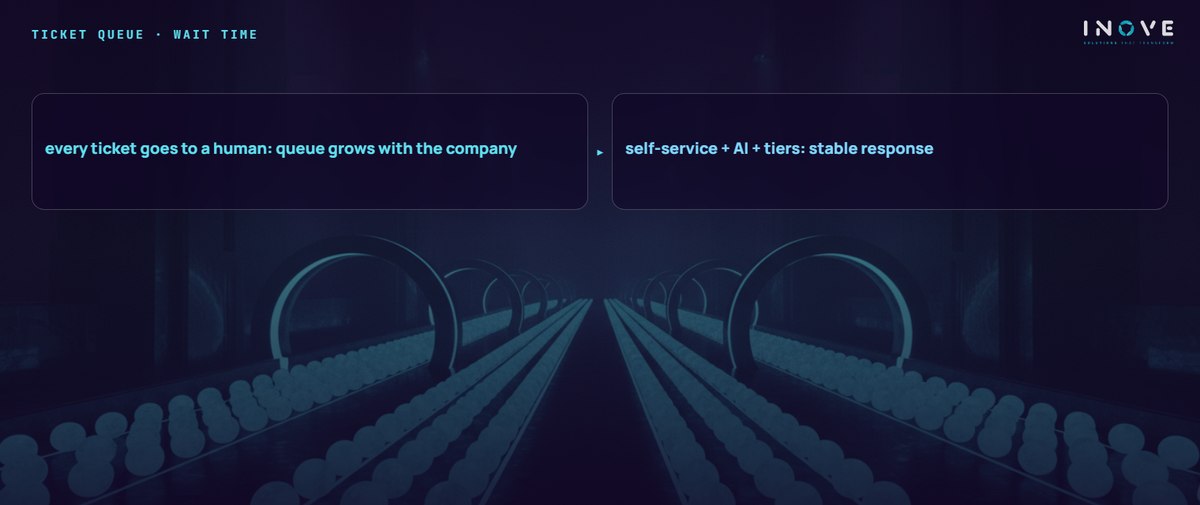
The model that scales organizes service by complexity:
- Self-service — a searchable knowledge base and automated actions (password reset, access provisioning). Resolves without opening a ticket.
- AI in triage and L1 — AI assistants classify, prioritize, and already resolve a large share of first-level requests, at any hour.
- Human L2 and L3 — technicians handle what requires diagnosis, context, and decisions. With a filtered queue, there is time to fix root causes instead of fighting fires.
Automating the repetitive work also has a valuable side effect: it reduces human error exactly in the tasks where it happens most.
Measure the experience, not just the stopwatch
A classic SLA measures response and resolution times — necessary, but insufficient. A ticket can be closed “on time” with the user still stuck. That is why mature operations also track user experience: satisfaction per interaction, reopen rate, recurring tickets on the same topic.
Likewise, a recurring ticket is a symptom, not a routine. If the same failure returns every week, the problem is root cause — and fixing it once saves dozens of interactions. The right question in support management is not “how many tickets did we close?” but “how many tickets did we stop needing?”.
The architecture that sustains growth
None of this stands without a technical foundation. A ticketing tool integrated with the asset inventory, proactive monitoring that detects the failure before the user does, and device management through the cloud — essential now that hybrid work is the norm — form the basic tripod. With observability (correlated logs, metrics, and alerts), support stops learning about problems over the phone.
The architecture also has to respect the company’s culture. Support that works in a three-shift factory is different from what works in a project office. The design starts with the business, not with the tool.
Where to start
- Photograph the current operation — volume, recurring topics, average time, and satisfaction.
- Attack the top of the curve — next, automate the five topics that generate the most tickets.
- Deploy tiers and AI with governance — always with an easy escape to human service.
- Measure and adjust every month — finally, the goal is a shrinking queue while the company grows.
Serving multiple users at once, then, does not require an army — it requires method. It is what we design every day in our IT support practice: operations where technology absorbs the volume and people deliver the value.