



Why testing your e-commerce performance is essential

Testing e-commerce performance is not a backstage technical chore: it is revenue strategy. A slow site loses conversion page by page; a site that crashes at peak loses the most important day of the year. And the 2026 shopper — used to instant PIX payments and tracked delivery — gives no second chance to an error screen.
In this article we show why performance testing must be routine, not an event. We also organise the checklist of what to test — from load to checkout — and how to turn results into real readiness for dates like Black Friday and Christmas.
When the site goes down, the brand pays
Large retailers around the world have already booked multi-million losses from system failures on peak dates — cases where customers simply could not complete a purchase. The direct damage is the sale lost at the moment of highest demand. The indirect one is worse: reputational damage, frustrated customers moving to a competitor and paid media wasted driving traffic to a site that is down.
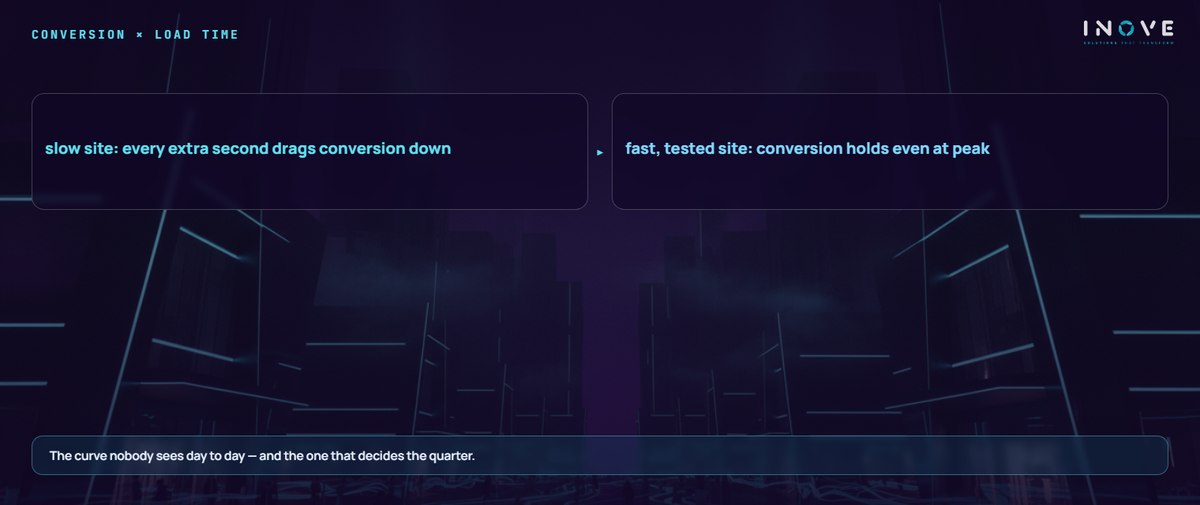
Slowness also charges its toll without any outage. Every extra second of load time drops conversion measurably — typically a few percentage points per second. In other words, performance is money even when the site is technically “up”.
The e-commerce performance checklist
- User experience — load time, page errors and navigation smoothness, measured on a real phone, where the purchase actually happens.
- Conversion rate — speed and conversion move together. Test the pages that sell: listing, product, cart.
- SEO and visibility — search engines penalise slow sites. Poor performance costs organic traffic before the first visit even happens.
- Scalability — load and stress tests reveal the real limit: how many concurrent users can the site take before degrading? Is the bottleneck the database, the search engine, an integration?
- Security and stability — testing also exposes vulnerabilities and single points of failure. Stability without security is a last-minute illusion.
- Payment methods — PIX, cards and digital wallets must respond under load, from authorisation to confirmation. A payment that hangs is the most expensive drop-off in the funnel.
How to test the right way
First, continuously: a test on the eve only confirms the problem too late. Periodic simulations throughout the year follow every change to the site. Second, realistically: scenarios based on traffic history and human behaviour — the real time a customer takes between browsing, deciding and paying. Third, with observability: correlated logs, metrics and traces turn “the site is slow” into an actionable root cause.
Likewise, test results must become action: infrastructure tuning, calibrated autoscaling, caching and code optimisation. Testing without fixing is merely documenting the next incident.
Mind the calendar too: the full cycle — test, fix, test again — must finish before the change freeze that precedes the peak. That means the decisive Black Friday test happens mid-year, not in November. And simulate genuine human behaviour, with real pauses between viewing a product, deciding and paying; a bot that clicks without pause creates an unrealistic scenario and leads to oversized — or, worse, undersized — infrastructure.
The role of a specialised partner
Building this pipeline in-house takes tools, people and on-call rotation. That is why many operations delegate it to specialists. Inove simulates high traffic volumes with advanced tooling, identifies failure points before they reach the customer and sustains the fixes with continuous support — readiness that proves itself in critical demand periods.
In short, testing e-commerce performance is the difference between discovering your site’s limit in a report or in a crisis. Make testing routine, fix what it points out, and reach the peak with the confidence of someone who has already rehearsed.