



Automation in Public Administration: Fewer Lines

The Brazilian citizen of 2026 files income tax through an app, pays taxes with PIX (the country’s instant-payment system), and reaches hundreds of services through the gov.br portal. At the same time, they still stand in line to enroll a child in the municipal school and take a paper ticket at many public health clinics. Automation in public administration has advanced — but unevenly, and it is in that unevenness that the opportunity lies.
This article shows where automation truly transforms public service: in citizen services, in the back office, and in tax administration — which, with Brazil’s tax reform in the test year of the new CBS and IBS taxes, has become a priority for governments as well. And it shows what needs to exist underneath: integrated data, infrastructure, and security.
Why the public sector moves more slowly
It is not for lack of examples. The public sector carries constraints private enterprise does not: rigid budgets, procurement rules, legacy systems scattered across departments that do not talk to each other, and the obligation to serve everyone — including people without a smartphone. On top of that, every change of administration threatens project continuity.
Even so, the Brazilian federal standard has proved it is possible to move fast: gov.br, PIX, and the electronic invoice are global references. The 2026 challenge is bringing that bar to states and municipalities.
Where automation changes the service
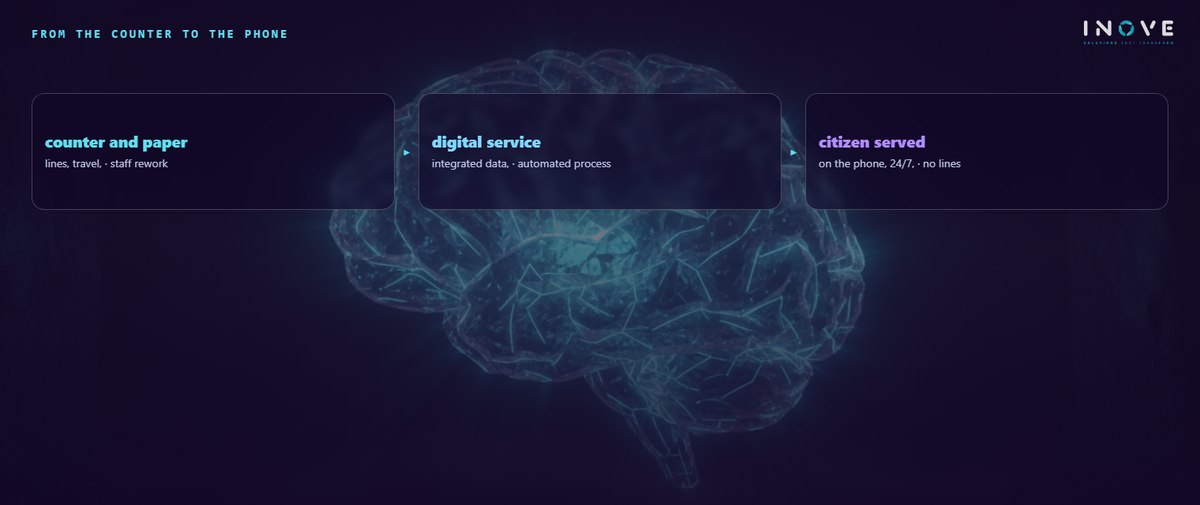
- Citizen services. Appointment scheduling, school enrollment, permits, and certificates can be born digital, with AI assistants answering recurring questions and routing anything unusual to a civil servant. Less travel, fewer lines, 24-hour service.
- Back office. Payroll, budget commitments, procurement, and accountability reporting involve repetitive checks that process automation (RPA) executes without fatigue — and with a complete audit trail, which in public administration is worth gold.
- Tax administration. Automatic cross-checking of databases detects inconsistencies, reduces evasion, and prevents wrongful collection. With the tax-reform transition under way, the tax authorities that automate CBS and IBS reconciliation will suffer less through the most complex period.
- Smart cities. Sensors and urban data optimize traffic, lighting, and safety — as long as someone analyzes and acts on the data collected.
The positive side effect: trust
Public services that work change the citizen’s relationship with government. Surveys by international consultancies consistently show that satisfaction with services multiplies trust in institutions — and the effect runs both ways. The internal impact is real too: staff freed from mechanical tasks serve better, make fewer mistakes, and find room to improve the process instead of merely executing it.
What needs to exist underneath
Facade automation — a beautiful portal sitting on manual processes — only moves the line somewhere else. Real transformation requires three foundations:
- Data integrated across agencies. The citizen’s record must be a single one, with interoperability across departments and levels of government. It is the hardest step and the most valuable.
- Reliable infrastructure. An unavailable digital service is worse than a closed counter: it erodes the trust already earned. Networks, servers, and cloud sized for the peak — as we design in our infrastructure practice — are a prerequisite, not a detail.
- Security and the LGPD. Government holds the most sensitive data there is — health, income, family — and has become a preferred ransomware target. Data protection and incident response enter the project at the design stage, a discipline we handle in our cybersecurity practice.
Where to start
The recipe that works for municipalities and agencies of any size is the same as in the private sector, adapted to public procedure: pick the service with the highest volume and the biggest pain (scheduling and taxes usually lead), digitize it end to end — not just the form —, measure service time before and after, and use the result to politically fund the next stage.
In short, automation in public administration has stopped being a technology question: the tools exist and the reference models are Brazilian. What separates analog government from digital government today is a management decision — and the discipline to build the data, infrastructure, and security foundations in the right order.