



How to launch and distribute a mobile app
Most of people’s screen time happens inside apps — and the stores hold millions of titles fighting for that attention. In this scenario, app launches stopped being the moment you press “publish” and hope. They became a process with method: validation before building, testing with real users, and gradual release with a hand on the brake.
In this article, we organize the step-by-step that separates successful debuts from apps that vanish from the store within a week. The playbook applies to product apps, internal company apps, and projects starting now — and it incorporates what has changed in the stores: stricter privacy rules, tougher review, and ASO as a permanent discipline.
Before writing code: validate
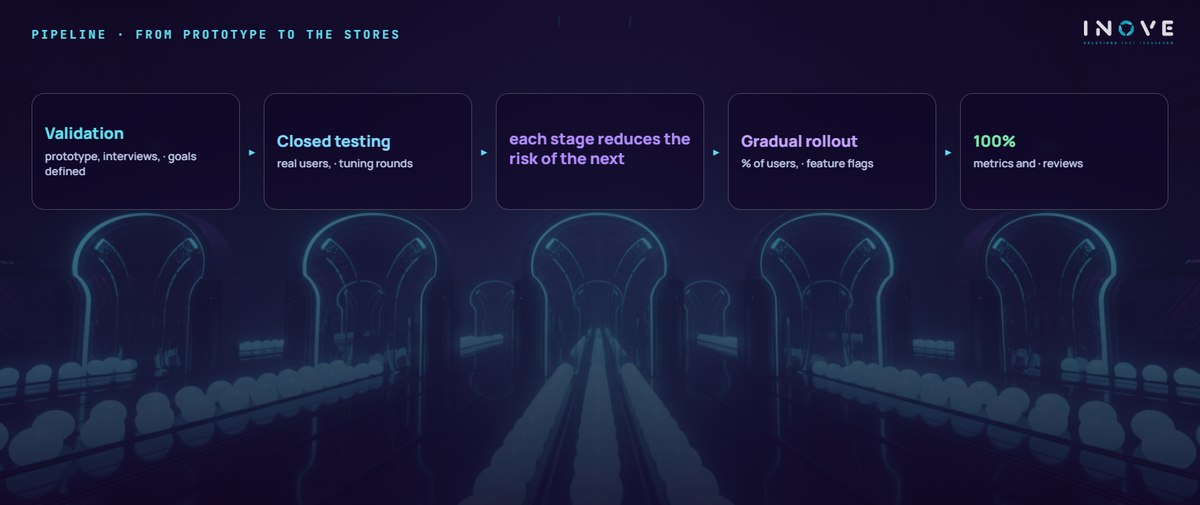
The most expensive mistake in the mobile market is building a feature no one asked for. Before full development, validate the idea with clickable prototypes, interviews, and tests with real users. Measure something simple: do people complete the core task without help?
Also study the terrain. Analyze the competitors already published — and above all read their negative reviews: they are a free map of the gaps your app can exploit. Then define the goals that will guide everything: downloads, activation, seven-day retention, and crash-free sessions. Instrument the app to collect those numbers from the very first version.
Test with real people
User experience is decided in the details: launch time, battery consumption, accessibility, and, above all, stability — users do not forgive crashes. Before the debut, use the closed and open testing tracks the stores themselves offer. Successive rounds with a limited group find the bugs the internal team would never catch.
Store submission: privacy is not an attachment
Publishing rules have grown stricter, especially on privacy. You must declare, in each store’s data labels, what you collect and why — and the review checks it. The process can also send the version back with change requests; so budget time for one or two correction rounds before the debut date.
Choose your channels strategically, too. Beyond the Play Store and the App Store, there are manufacturer stores and, in some markets, alternative distribution. Every extra channel is extra maintenance cost — weigh whether it pays off. And do not underestimate the basics of ASO (store search optimization): title, subtitle, screenshots, video, and the right category. Reviews and the page’s conversion rate also weigh on ranking.
Launch gradually, with a hand on the brake
A mature debut is not a big bang. Prefer a staged rollout by percentage of users: release to a small slice, watch crashes and metrics, and only then expand. Also use feature flags — switches that turn features on and off without shipping another version. If something goes wrong, you disable the feature in minutes instead of waiting for another store review.
After the debut: the work that never ends
Publishing is the halfway point. From there, two routines decide the app’s future. First, the reviews: they point to real bugs and friction — and today AI helps cluster thousands of comments by theme and priority, and even drafts responses for a human to review. Second, the metrics defined at the start: retention, activation, and stability tell you, dispassionately, whether the product is working.
An app launch, then, is less an event and more a cycle: validate, test, release gradually, measure, and evolve. It is the method we apply in our software and application development practice — because a truly good app is the one that is still good at version twenty, not just on opening day.