



Big Data in Agribusiness: Data That Raises Productivity
Brazilian agribusiness is a global production powerhouse — and, increasingly, a data powerhouse. Sensors in the field, telemetry on the tractor, satellite imagery, weather stations, scales in the feedlot: the modern farm generates information inside the gate all day long. The question is what gets done with it. That is where big data in agribusiness comes in.
In practice, the difference between collecting data and using data is the difference between a connected farm and a smart farm. In this article, we show how data management and analytics support better decisions in the field — from planting to logistics — and what infrastructure needs to exist for it to work.
Why data became an input
The pressure is well known: a growing population, limited land and water, margins sensitive to exchange rates and weather. Producing more with the same resources has therefore stopped being an ambition and become a survival requirement. Precision agriculture answers with a simple principle: treat each plot as its own case, not the whole farm as an average.
Beyond that, Brazilian producers arrive in 2026 with an advantage: the country is at the forefront of digital agriculture. Technology embedded in machinery and access to satellite imagery have made collection cheap. The bottleneck has moved — today it sits in managing and analyzing what gets collected.
What data analytics delivers in the field
- Tailored planting — yield maps and aerial imagery guide variety, density, and fertilization by management zone, not by average.
- Site-specific input application — crop protection and fertilizer only where the data says so, cutting cost and environmental impact.
- Weather and irrigation — local stations and forecasts calibrate the planting window, irrigation, and harvest.
- Precision livestock farming — weight-gain, nutrition, and health history per animal, with deviation alerts.
- Machinery and telemetry — fuel consumption, predictive maintenance, and operating routes optimized for each work front.
- Marketing and logistics — harvest and freight history supporting the decision of when to sell and which route to ship through, in a continental-sized country.
From raw data to decision: the role of data management
Having sensors is not having intelligence. Value appears when machinery, soil, weather, and market data meet in an organized foundation and become history. It is that history that enables prediction and scenario simulation: what happens to the margin if the rain is two weeks late? What if freight rates rise during the shipping window?
That is why the technical foundation matters as much as the agronomist. Connectivity in the field, integration across platforms (every manufacturer has its own), and a storage and analytics layer — usually in the cloud, which scales at harvest peak and costs little in the off-season. It is the kind of architecture we design in Inove’s cloud practice, with an eye on cost: data nobody queries does not need expensive storage.
Technology with a farm accent
Data projects in agribusiness also have particularities the office does not. Intermittent connectivity demands collection that works offline and syncs later. Seasonality concentrates usage — and the investment has to pay for itself within the cycle. And the operation involves people in the field, so information has to arrive simply: an alert on the phone is worth more than a dashboard nobody opens.
We know this reality up close from serving the sector — the fronts we apply are described on our technology for agribusiness page.
Where to start
- Inventory what is already collected — current machinery, sensors, and systems. There is almost always more data available than gets used.
- Pick one decision to improve — zone-based fertilization or the selling window, for example. One, not ten.
- Integrate and build the history — without a historical series there is no prediction.
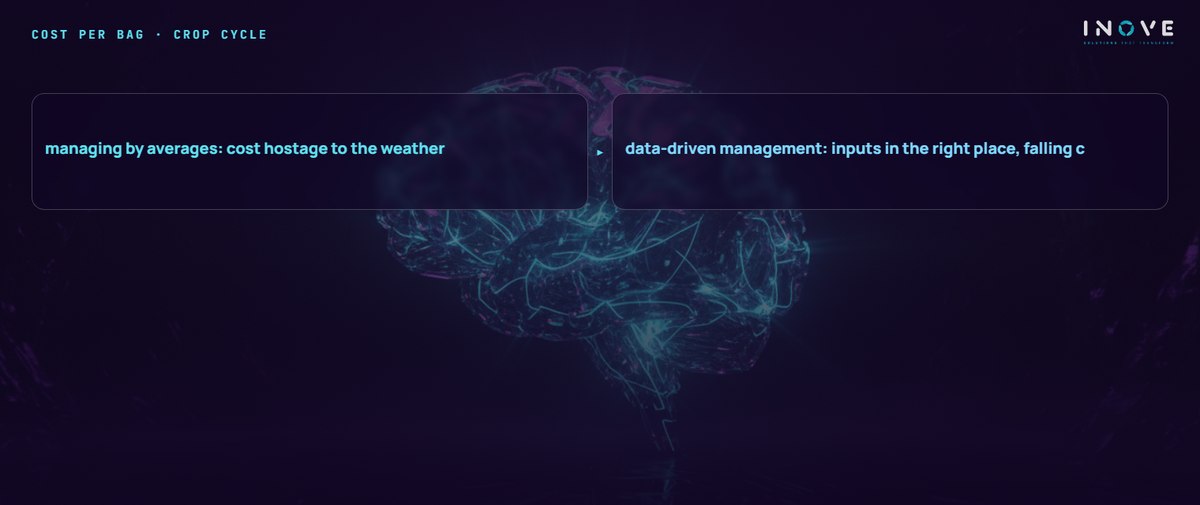
- Measure the result per season — cost per bag and yield per plot are the final judges.
In short, big data in agribusiness does not replace the experience of those who know the land — it multiplies it. Whoever turns data into history, and history into decisions, harvests twice: in yield and in cost.