



AI over your company’s documents: why dumping everything into the model fails
When we finish scanning a file server, we hand over an answer the company did not have: what exists in there. How many files, of what type, in which folder, carrying what risk, under whose responsibility.
It is a great relief and it lasts a short time. Because the next question arrives within days, and it is of a different nature: why does this spreadsheet exist? Who decided the calculation works this way? Which version did this one replace? Have we tried this before?
The holdings keep the data. They never kept the context — and context is what makes data usable by somebody who was not there.
Where the context sits today
In no system at all. It is scattered across an email from three years ago, minutes nobody reread, a chat conversation that has long since scrolled away and — above all — the heads of two or three people.
That has two expensive consequences everybody recognises. The first is dependence on a person: when they go on holiday, decisions stop; when they leave the company, the knowledge leaves with them. The second is rework: the company tries again, at full cost, something it already tried and discarded for a good reason nobody wrote down.
Migrating a file server exposes this brutally, because it forces you to answer “is this still valid?” thousands of times in a row — and it reveals that, for much of the archive, nobody knows the answer.
The tempting mistake: send everything inside
The first idea anyone has on discovering the corporate brain concept is to dump the whole archive into a knowledge repository and let the AI sort it out. It does not work, for three practical reasons.
Volume is not knowledge. Three hundred gigabytes of spreadsheets remain three hundred gigabytes of spreadsheets once indexed. The assistant starts retrieving plausible passages from files nobody validated — and answering confidently from a 2017 draft is worse than not answering.
The archive has no curation. There are three versions of the same calculation, two of them wrong. Without someone saying which one counts, the AI chooses by similarity — which is the wrong criterion.
It multiplies exposure. Copying sensitive data to one more place means one more place to protect, audit and erase when somebody asks.
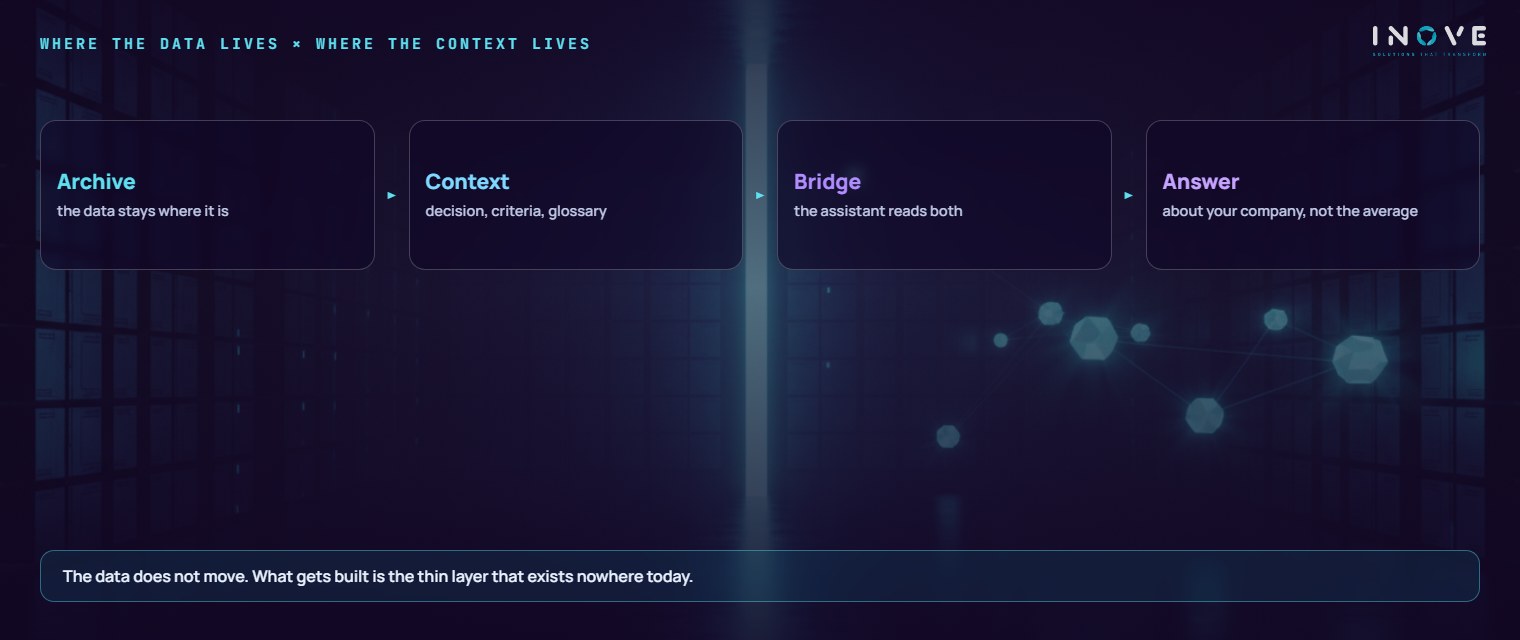
The approach that works is the opposite, and far less glamorous: the archive stays where it is, and the corporate brain keeps a thin layer that points to it.
What goes into the corporate brain
Short notes, written by people, linked to one another. This is not system documentation nor a manual — it is the record of what was decided and why. Five types cover almost everything:
Decision. What was decided, when, by whom, which alternatives were discarded and for what reason. It is the most valuable note and the one nobody writes. A recorded decision spares you the meeting that reopens it a year later.
Criterion. The rule the area uses that sits in no system: how a borderline case is classified, what defines an exception, which rounding applies.
Map of the archive. Where each data set lives, who is answerable for it, how often it is updated and what is official versus draft. The file-server scan delivers the raw material for this ready-made.
Runbook. How to do what gets repeated: the close, the load, the known fix. It is what turns “call the person who knows” into “follow the procedure”.
Glossary. What the company calls what. It sounds trivial and it is the origin of half the misunderstandings between areas — and of almost every error made by an assistant that does not know the house vocabulary.
Note the size: this is hundreds of short notes, not gigabytes. It fits in a repository of plain text files, versioned, that anybody can edit without training.
The bridge, and what changes in the answer
A knowledge base nobody consults is a better-organised cold archive. What changes the game is the bridge: the mechanism that lets the assistant read those notes — and only those — at the moment of answering.
The difference shows up on the first real question. Without the bridge, “how do we calculate the provision for this product?” gets a generic answer about market practice. With the bridge, it gets: the criterion the area defined in a given meeting, the official spreadsheet that implements it, who is answerable for it, and the earlier decision that was discarded for a given reason — with links to the note and to the file.
It is the difference between an assistant that knows about your sector and one that knows about your company. We cover the architecture of that bridge in Obsidian as a corporate brain, and the layers that hold it up in enterprise AI: the challenge is not the model.
Why the migration is the right moment to start
Nobody has time to “document the company’s knowledge”. That is why this initiative never starts: it has no deadline, no immediate pain, and it competes with the urgent.
A file server migration changes that, because it forces exactly the right conversations, with the right people, to a deadline. In deciding the destination of each set, somebody has to answer what it is, whether it is still valid and who is answerable for it. Those answers are already being given — they are simply lost as soon as the project ends.
Recording them while the conversation is happening costs almost nothing. Reconstructing them later costs another project.
In practice, the sequence that works is short:
- The scan becomes the map. The inventory by area, with owner and criticality, is the first batch of notes — and it arrives ready-made.
- Each destination decision becomes a note. “This folder goes to the cloud; that set stays on the network because it has macros with fixed paths; this goes to cold archive.” Two lines, with the reason.
- Whatever the area explains gets written down. When you ask “is this still valid?”, the criterion comes with the answer. That is the moment to record it.
- The bridge comes last. Only once there are notes worth consulting — connecting an assistant to an empty repository produces disappointment and buries the initiative.
How to tell whether it is working
Two simple measures, and neither of them is the number of notes.
Questions answered without escalating. How many queries were resolved by somebody who is not the specialist. That is the entire objective.
Notes created during the work. If notes are only born in documentation drives, the practice has not taken hold. When they are born at the end of a meeting or alongside a fix, it has.
And the usual warning applies: an out-of-date corporate brain is worse than none at all, because it lends confidence to a wrong answer. A note that is no longer maintained needs to be marked as historical — not deleted, because knowing what the company used to think is also context.
What lasts
The gain that appears first is reduced dependence: more people able to answer more things without interrupting the same specialist every time.
What lasts is institutional memory. A recorded decision is not reopened from scratch, and a discarded attempt is not repeated at full cost. In a company whose people change every few years, that is the difference between accumulating experience and starting over.
The honest limit: this is not solved with a tool. It depends on a practice — writing the decision down when it is taken — that has to be agreed, chased and sustained by somebody. Technology makes it cheap to store and easy to find. Recording remains a human choice.
If your starting point is the file server, begin with the measurement: the risk list frightens, the verification decides. And for the layer that applies this to the operation, see applied AI.
Frequently asked questions
What is the difference between keeping the data and having the context?
Is it enough to throw every file at an AI?
Why is a migration the right moment to start?
The starting point is knowing what exists today — which is what the IT diagnostic delivers.