



Smart Home Under Attack: How to Protect Your Connected Home

The smart home is no longer a novelty: lights, locks, cameras, curtains and voice assistants talking to each other are already routine in Brazilian homes — including older houses, adapted bit by bit. The comfort is real. So is the risk: every connected device is one more door into your home, and many of them leave the factory unlocked.
That is why, in this article, we explain why smart homes have entered criminals’ sights, where the real risk lives and which habits shield the home without giving up automation. The logic is the same one we apply when protecting companies — except that, at home, there is no security team on call.
What a smart home controls
The home-automation menu has grown — and with it, what an intruder can reach:
- Lighting and climate — smart bulbs, switches and thermostats;
- Physical security — cameras, motion sensors and locks opened by biometrics, PIN or smartphone;
- Curtains, gates and appliances — from the coffee maker to the air conditioner, all driven by app;
- Entertainment — audio and video controlled remotely;
- Voice assistants — the hub that ties everything together and, for that reason, the most valuable target.
Moreover, interoperability standards such as Matter have made it easy to mix brands on the same network. Great for the user — and also for the intruder, who finds everything interconnected once inside.
Why the smart home became a target
It is a volume game: the installed base of IoT devices grows year after year, and attacks on these devices grow with it. Brazil ranks among the most targeted countries. Yet the absolute number matters less than the pattern: many devices ship with a default password, never receive updates and sit directly exposed to the internet.
The criminal’s goal is not always your home itself. Compromised devices are recruited into botnets that attack third parties, mine cryptocurrency or serve as a springboard. But the personal scenario exists — and it is chilling: access to cameras and baby monitors, the family’s routine exposed, a connected lock in the wrong hands. If the intruder reaches the automation’s administrator account, they control what you control.
Where the real risk lives
In practice, most home intrusions use no sophisticated technique. They use the forgotten basics: a router with the factory password, the same password repeated across ten services, a camera exposed to the internet, firmware from years ago. Physical and digital risk also blend — an unlocked phone forgotten at a bar can be the key to the entire house, since the smartphone is the remote control for everything.
Habits that shield the smart home
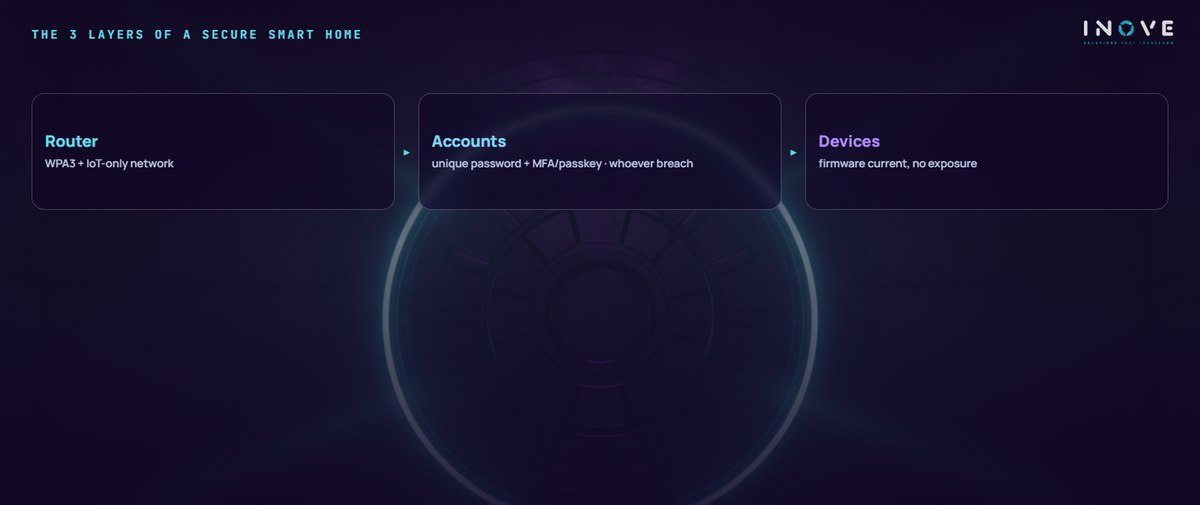
- Change the router’s default credentials and use WPA3 when available. It is the entry door to everything.
- Create a separate network just for IoT devices — if one device falls, the intruder cannot reach your laptop or your files.
- Strong, unique passwords for each service, preferably with a password manager. On the account that controls the automation, enable MFA — and prefer passkeys when supported.
- Keep firmware and apps updated — router included. A device the manufacturer has abandoned deserves retirement.
- Do not expose cameras directly to the internet and take extra care with administrator-level accounts.
- Screen lock always on for phones, tablets and computers — and teach these habits to everyone in the house, including whoever holds the passwords.
In short, home automation is here to stay, and the comfort it delivers is legitimate. What you cannot do is treat the connected home with less care than a company treats its corporate network — the cybersecurity principles are the same, from network segmentation to the identity management we apply in infrastructure projects. Take care of the three layers — router, accounts and devices — and you keep the comfort while leaving the risk outside.