



SAP Data Archiving Before Your Cloud Migration
Migrating SAP to the cloud with all your history on board is like moving house and hauling along the boxes you have not opened in ten years. You pay the freight, the new place fills up, and none of it makes life better for the people living there. That is why data archiving needs to come before the migration — not after.
In 2026, with S/4HANA consolidated as the standard and a large share of migrations running under RISE contracts or on public cloud, this sequencing matters more than ever. After all, in the cloud every gigabyte carries a monthly price tag, and in an in-memory database every gigabyte also consumes expensive memory. In this article, we show why archiving before migrating is the cheapest decision in the entire project.
Why data volume defines the cost of the migration
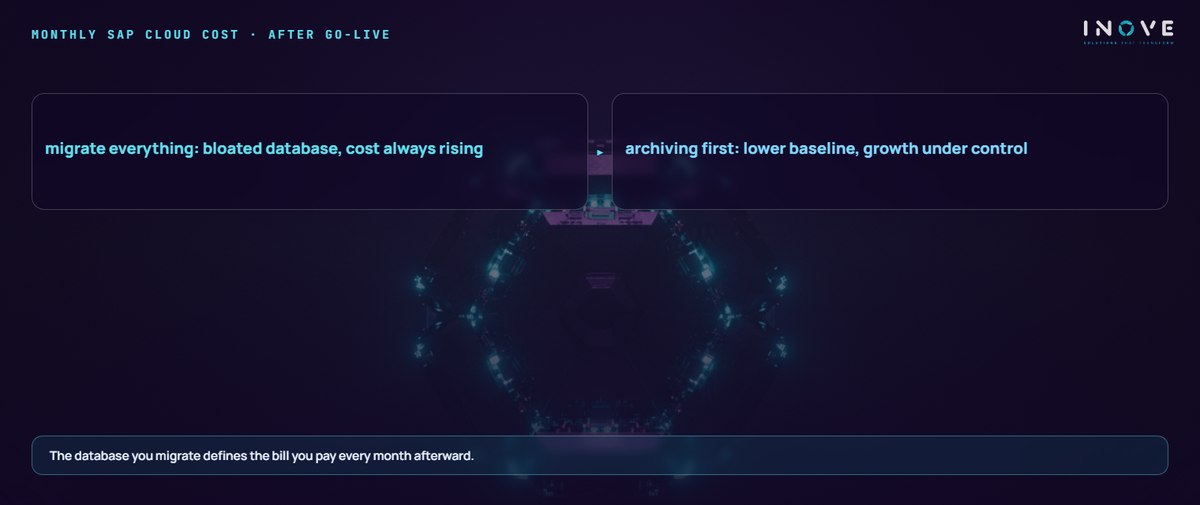
In practice, the size of the SAP database influences almost everything in the project: the downtime window, the sizing of the target infrastructure, the transfer cost, and the monthly storage bill. In RISE with SAP contracts, HANA memory sizing is one of the main components of the price. In other words, migrating a bloated database means paying for an oversized environment for years.
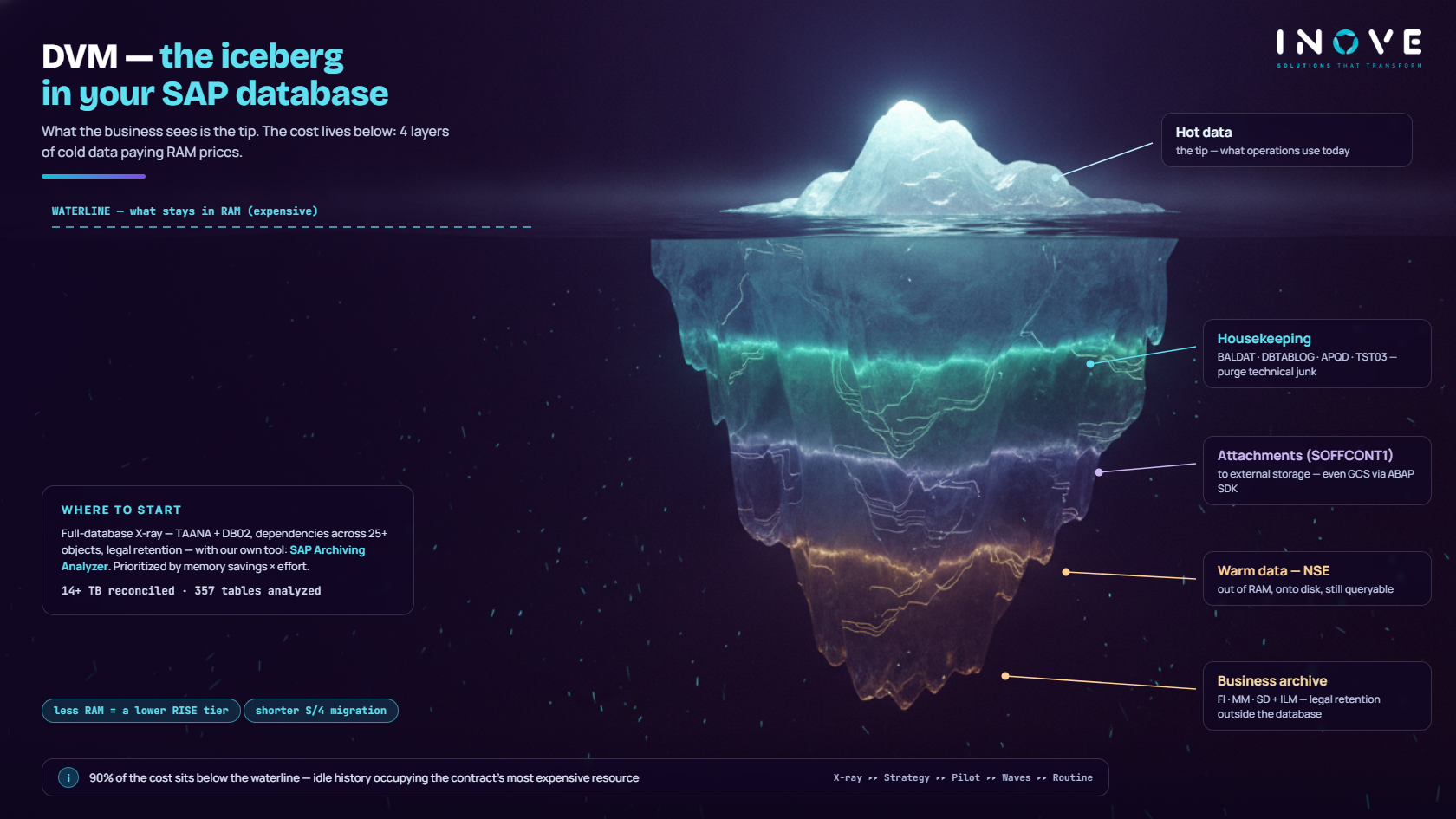
On top of that, SAP systems with decades of operation accumulate old fiscal documents, interface logs, change tables, and orders closed long ago. Typically, a significant share of the database is never touched by day-to-day operations. That is exactly the data that archiving takes out of the hot database and moves to low-cost storage, while keeping it accessible for queries and audits.
Less data, more performance
The gain is not only financial. A leaner database speeds up backups, shortens maintenance windows, and reduces the time needed for environment copies (the classic QAS refreshes). In addition, reports and transactions that scan large tables respond better once the cold history is out of the way.
Likewise, the migration itself becomes safer. Less data means shorter conversion windows, lower risk during the load, and faster validations. In S/4HANA conversion projects, upfront archiving is one of the classic levers for fitting into the downtime window approved by the business.
Security, LGPD, and tax retention
There is also the compliance dimension. With LGPD — the Brazilian data-protection law — now mature and actively enforced, holding personal data without need is no longer harmless; it has become a liability. Well-designed archiving applies retention policies by document type: what tax legislation requires you to keep stays preserved and accessible; what has completed its lifecycle is disposed of in a controlled, documented way.
Therefore, archiving before migrating also shrinks the risk surface. Less sensitive data in the production environment means less exposure in the event of an incident and a simpler response to audits.
How to fit archiving into the migration plan
In short, the sequence that works is simple:
- Volume analysis — identify the largest tables, the applicable archiving objects, and the real reduction potential.
- Retention policy — define, together with the tax and legal teams, what must stay online, what goes to the archive, and for how long.
- Execution in waves — archive by object and period, validating access to the archived data in every cycle.
- Migration of the already lean environment — size the target infrastructure based on the clean database, not the bloated one.
Moreover, archiving does not end at go-live: it becomes a routine of data volume management (DVM), so the new environment does not swell up again. It is the kind of discipline we handle jointly in our SAP practices and in our cloud projects — whoever runs the migration knows exactly where the volume hurts.
To go deeper into the topic, download the e-book “SAP Archiving — the invisible cost” at the Inove Academy — it details the most common archiving objects and how to build the retention policy.
At the end of the day, the right question is not “how much does it cost to archive before migrating,” but “how much does it cost not to.” The answer shows up on the first cloud invoice — and repeats every month. Whoever reaches the migration with a light database arrives with a faster project, lower risk, and a contract that is the right size.