



What are the trends in app development?
Phones concentrate most of people’s digital time — and Brazil is among the countries that live the most inside apps. But the game of app development has changed: the download is no longer the bottleneck, and retention has become the metric that matters. Acquisition costs have risen, and an app must prove its value in the very first session, compared against the best apps its user opens every day.
In this scenario, a handful of trends separate the projects that thrive from the ones that become a forgotten icon on the last screen. In this article, we present the seven that weigh most on product decisions in 2026 — from on-device AI to agent-oriented apps.
1. Embedded AI and on-device processing
Artificial intelligence has stopped being a separate feature and become part of the product. Summarization, natural-language search, translation, and transcription already run on smaller models on the device itself, without sending everything to the cloud. The gain is double: faster responses and less data leaving the device. As a result, performance and privacy are no longer opposing choices.
2. Privacy by default
Privacy has moved out of the legal notice and into the design. In other words: collect the bare minimum, explain in plain language what is collected and why, and ask for permission at the right moment — it converts better than the permission requested at first launch. The stores also require data labels, and the LGPD — Brazil’s data-protection law — now operates with real enforcement and sanctions.
In practice: process on the device whenever possible, set retention periods, delete what you do not use, and anonymize what remains. Privacy by default also reduces legal risk and storage cost.
3. AI-assisted development
AI code generation and review are now part of teams’ routines — they speed up testing, refactoring, and documentation. The gain only materializes, however, with human review and a quality pipeline. So treat AI as a pair programmer, not as the final author. And measure: delivery time and production defect rates tell you whether the gain is real.
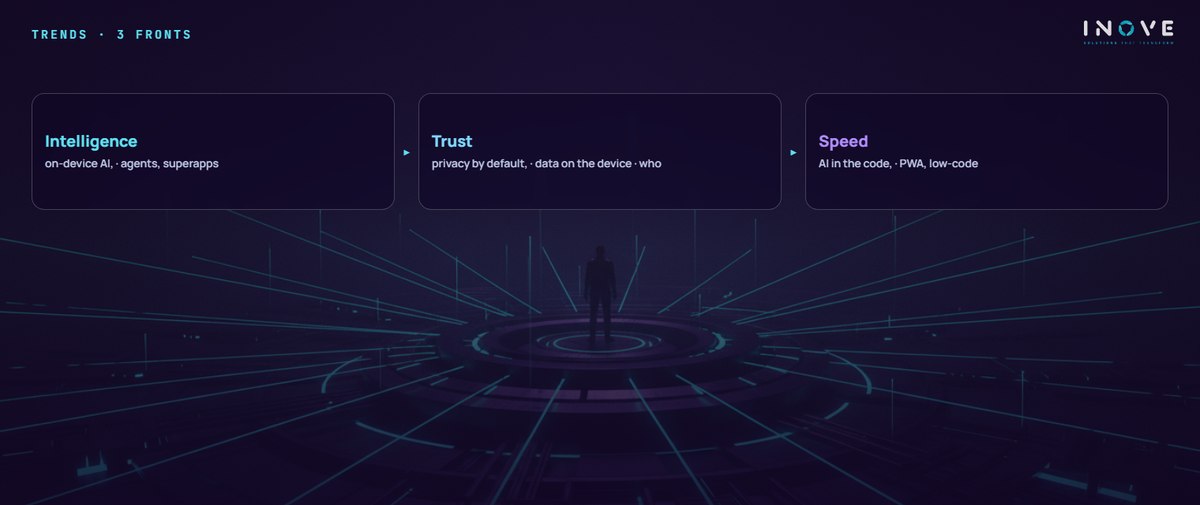
4. Mature PWAs as a real alternative to the store
A progressive web app installs from the browser, works offline, and receives notifications — and skips the store review queue and commission. For catalogs, self-service, and internal tools, a PWA is usually enough. Heavy native features, however, still call for a published app. So evaluate the channel before choosing the technology.
5. Low-code with governance
Low-code platforms have graduated from experiment to production systems. Business teams assemble screens, approvals, and integrations; the technical team focuses on what is specific to the product. Low-code shortens timelines — as long as you define, from the start, who maintains each flow created. Without an owner, today’s shortcut is tomorrow’s legacy.
6. Superapps and ecosystems
Users want to solve everything in one place, with fewer taps. Superapps bring together messaging, payments, shopping, and financial services in a single environment — in Brazil, digital wallets and banks are already on this path, with Pix, the country’s instant-payment system, as the glue holding it all together. The lesson applies even if you will never become a superapp: think in platforms and mini-apps, not just screens. Companies apply the same logic to internal environments for employees.
7. Agent-oriented apps
The newest frontier: apps where an AI agent performs tasks for the user — rebooking the flight, negotiating the bill, filling in the form — instead of merely displaying screens for the user to operate. This changes product design: beyond the interface for people, the app starts exposing actions agents can execute with security, permission, and logging. Those who structure this early will be ahead when personal assistants become the main point of contact.
App development trends, then, point to products that are smarter, more respectful of data, and built faster — many of them resting on a good cloud architecture. The challenge is not adopting all of them at once, but choosing the ones that serve your product. It is the conversation we have every day in our software and application development practice: a good trend is the one that improves the metric that matters — the retention of the people who use it.