



Artificial Intelligence in Hospitals: 7 Real Applications
When people talk about artificial intelligence in hospitals, the image that comes to mind is usually the robot surgeon. But in 2026, the AI that most changes the patient’s life is far less cinematic: it transcribes the consultation, organizes the emergency queue, cross-references the test with the medical record, and warns the team before the condition worsens.
This article lists seven real applications of AI in healthcare — from the triage desk to the operating room — and what an institution needs as a foundation to adopt them: integrated systems, reliable infrastructure, and rigorous handling of sensitive data.
The 7 applications that have left the pilot stage
1) Support for consultations and the medical record
Ambient-listening platforms follow the consultation, transcribe the conversation, and fill in the medical record in the institution’s standard. As a result, the professional looks at the patient, not at the keyboard — and the documentation comes out more complete and standardized.
2) Triage and patient-flow management
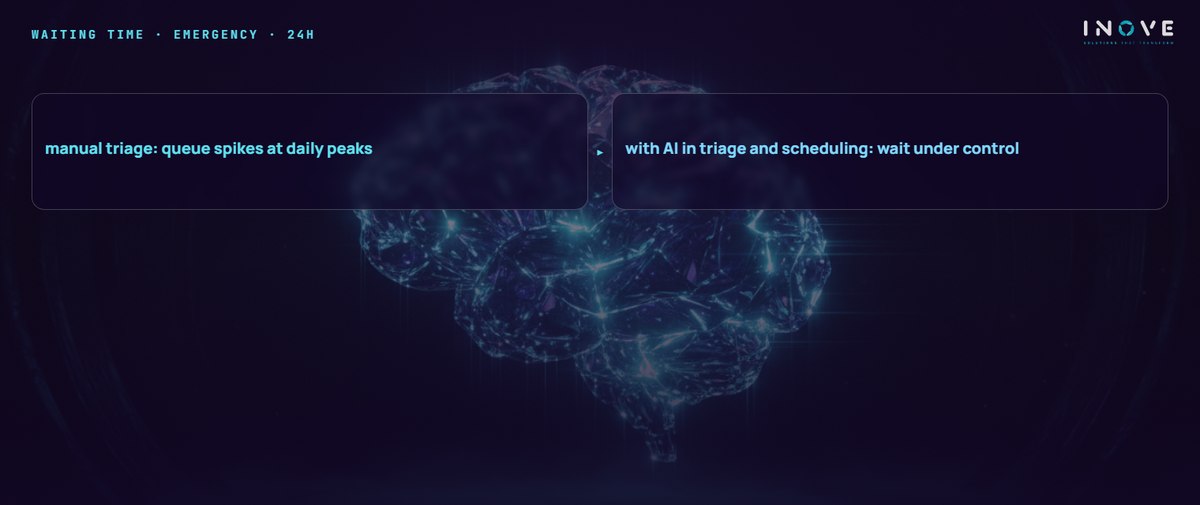
Protocols like Manchester rank urgency in theory; AI helps in practice. Models that combine vital signs, history, and hospital occupancy prioritize severe cases, predict demand peaks, and support staff scheduling. Waiting-room time drops where it costs the most: in the emergency department.
3) The patient’s history always at hand
With integrated systems and biometric identification, the team can access allergies, current medications, and previous procedures even when the patient arrives unconscious. Automatic alerts also prevent drug interactions and treatments contraindicated by the history.
4) Diagnostic support
Multimodal models combine imaging, record text, and test results in the same analysis. In radiology and pathology, they flag suspicious findings for the specialist’s priority review — including in cancer screening. The mature pattern is clear: the AI suggests, the physician decides, and the error rate falls with the two together.
5) Remote monitoring and wearables
Smartwatches and clinical sensors transmit patient data outside the hospital. Care therefore extends into the home: post-operative and chronic patients are followed at a distance, and the team is alerted when the pattern departs from the expected — before readmission.
6) Dosing and clinical pharmacy
Calculating a dose considering weight, kidney function, interactions, and diagnosis is a task where error is costly. Prescription-support systems check each order against the patient’s profile and flag the exception for the clinical pharmacist.
7) Robot-assisted surgery
Here the robot does exist — but commanded by the surgeon. The platform adds movement precision, magnified vision, and real-time data to human experience. The result is less invasive procedures with faster recovery.
What needs to exist before the AI
None of these applications works on top of isolated systems. The electronic medical record, the laboratory, the pharmacy, and bed management need to talk to each other — otherwise the AI sees only a piece of the patient. Besides, a hospital is a 24×7 operation: the infrastructure supporting these systems cannot go down on the Saturday shift. It is the kind of foundation we handle in our infrastructure practice.
- Integration — a single view of the patient, fed by every system.
- Availability — redundancy and a contingency plan; in healthcare, downtime is clinical risk.
- Data quality — duplicate records and incomplete charts become bad diagnoses at scale.
Security and the LGPD: the other side of the same coin
The more AI feeds on patient data, the more valuable — and more targeted — that data becomes. That is why encryption, access segregation, monitoring, and a tested incident-response plan belong to the same project, not a future one. This discipline, which we apply in our cybersecurity practice, is what makes it possible to innovate without exposing the patient twice.
Where to start
- Pick a measurable pain point — emergency waiting time and clinical documentation usually pay back fastest.
- Fix the foundation — system integration and record quality before the algorithm.
- Pilot with the clinical team on board — AI imposed from above becomes an ignored screen.
- Measure outcomes, not technology — minutes of waiting, readmission rate, documentation time.
In short, artificial intelligence in hospitals has already proved its value where it matters: more team time for the patient, less waiting, and safer diagnosis. What separates the pilot from the transformation is the usual: integrated data, reliable infrastructure, and governance taken seriously.