



Brazilian Tax Reform and SAP: Your 2026-2033 Survival Roadmap

The Brazilian tax reform is the biggest change to Brazil’s tax system in 60 years. It comes from Constitutional Amendment 132/2023, regulated by Complementary Law 214/2025. For companies running SAP, however, it is not a simple rate adjustment. Instead, it is a multi-year program that touches tax determination, master data, fiscal documents, accounting, banking integrations, and application support. Moreover, the clock on the Brazilian tax reform in SAP has already started: 2026 is the test year.
In this article, therefore, we go beyond “what changes”. Instead, we show exactly where SAP is impacted and the real transition timeline. In addition, we give a practical roadmap to reach 2033 without surprises.
The new model: dual VAT, IS, and split payment
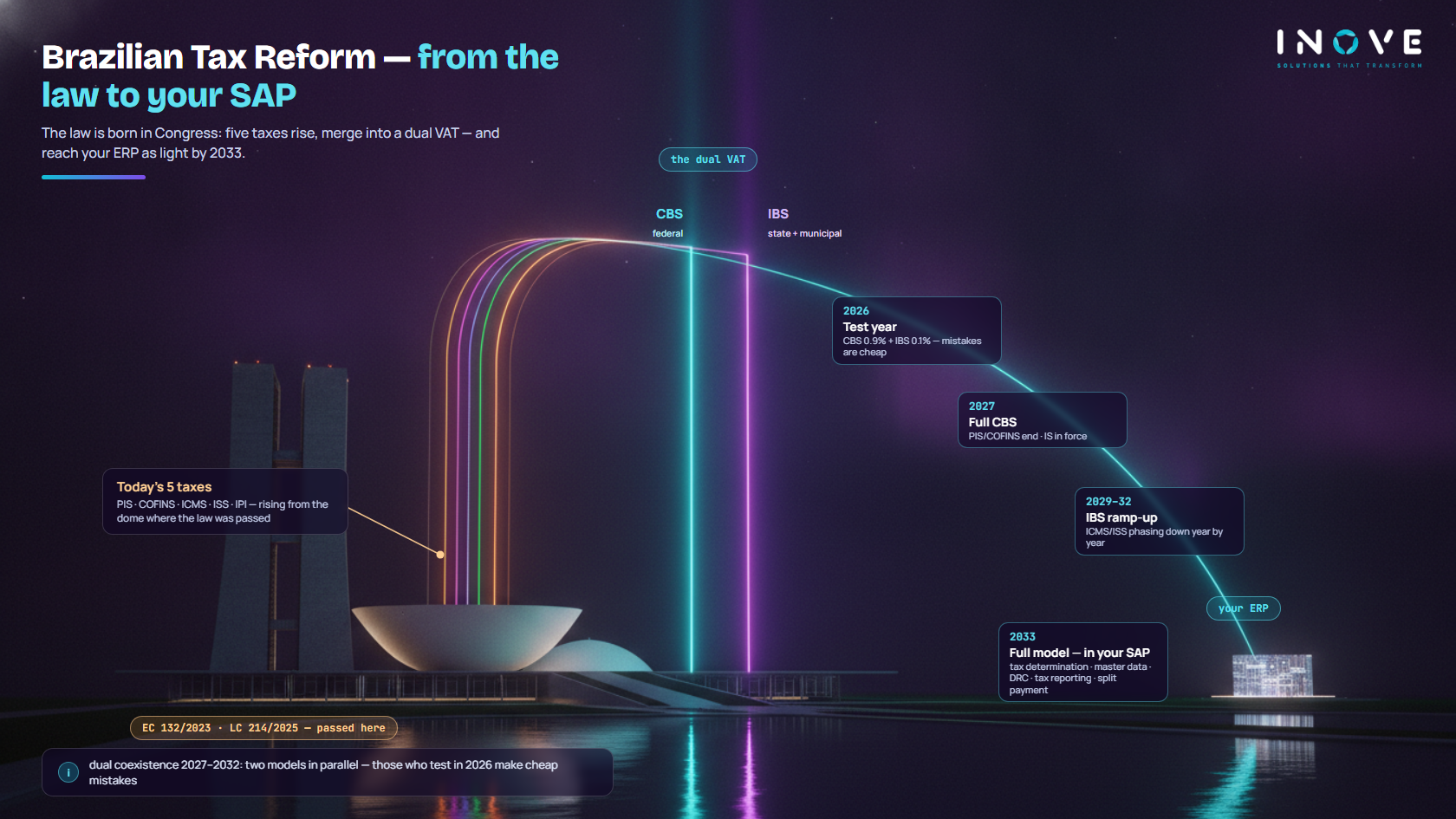
First, five taxes leave the stage: PIS, COFINS, ICMS, ISS and, in practice, IPI. The latter is kept only in specific situations, such as the Manaus Free Trade Zone. Then, in their place, a dual VAT arrives:
- CBS (Contribution on Goods and Services) — federal; in other words, it merges PIS and COFINS.
- IBS (Tax on Goods and Services) — state and municipal. It merges ICMS and ISS, in turn, under shared management by a Steering Committee.
- Selective Tax (IS) — finally, the “sin tax”, levied on goods harmful to health and the environment.
Two principles change the logic of the system. First, full non-cumulative taxation: broad credits on virtually all purchases, which changes both tax calculation and bookkeeping. Second, taxation moves to the destination, not the origin. As a result, revenue is redistributed, and tax determination must be recalculated for every transaction.
In addition, there is the split payment: the tax can be segregated and collected at the moment of financial settlement. In practice, this connects the tax world to the cash world: payment methods, banks, and reconciliation. Before, these two worlds never talked to each other.
The transition timeline (and why 2026 matters)
The old and new models coexist from 2026 to 2033. Here are the main milestones:
- 2026 — the test year. CBS at 0.9% and IBS at 0.1%, creditable against PIS/COFINS. In other words, this is the time to validate the system in production with controlled risk.
- 2027 — full CBS. PIS and COFINS are abolished; in addition, IPI drops to zero (with exceptions) and the IS takes effect.
- 2029 to 2032 — the IBS ramp-up. During this phase, IBS rises gradually while ICMS and ISS fall, in proportions defined by law.
- 2033 — the full model. Finally, IBS and CBS become fully effective and the old taxes are abolished.
Therefore, the strategic takeaway is clear: the system must run both models in parallel for years. In other words, this is not a one-date switch from one regime to another. Instead, it means operating both at the same time without breaking the business. That, precisely, is where the real complexity of the IT project lives.
Critical point — the biggest trap is not calculating the new tax. It is the dual coexistence: for years, SAP calculates, posts, and reports under both models at the same time. Consequently, testing this with time to spare is what separates a smooth go-live from a tax contingency.
Brazilian tax reform in SAP: where the system is impacted
In SAP, the scope is broad — and it applies to both ECC and S/4HANA. For companies still on ECC, for example, the reform adds to the pressure of end of support. On S/4HANA, on the other hand, you benefit from the modern engine. Even so, the work items are the same. Here is where the reform touches the system:
- Tax determination. The calculation schema (TAXBRA/TAXBRJ procedure), condition types, rate tables, and the origin/destination logic. In other words, new taxes mean new conditions, new tax codes, and revised credit rules.
- Master data. Tax classification of materials and services, plus customer and vendor tax groups. In addition, NCM codes (Brazilian goods classification) and the mapping to IBS/CBS/IS. After all, inconsistent master data blocks both calculation and testing.
- Fiscal documents and SAP DRC. First of all, the NF-e (Brazilian electronic invoice) and the statutory bookkeeping change in layout and obligations. Consequently, SAP Document and Reporting Compliance (DRC), running on SAP BTP, needs the new layouts and the new tax returns. It is the successor of NFE/GRC and SAP’s official product for statutory obligations.
- Accounting and tax reporting. Likewise, the new ledgers and full non-cumulative taxation require a review of the accounting flow. Credit computation, in turn, forces a review of the fiscal reports.
- Split payment and integrations. In addition, segregating the tax at payment time connects SAP to payment methods, banks, and reconciliation — new and sensitive integrations.
- Tax engine. Finally, you must choose between SAP’s native tax determination and a fiscal partner. The options include Sovos/Mastersaf, Thomson Reuters ONESOURCE, Avalara and Synchro. Therefore, this is an architecture decision with long-term impact.
The risks nobody wants to discover late
In practice, three traps keep repeating in projects that start at the last minute:
- A queue for specialists. Demand for SAP tax consulting concentrates in the same months. Therefore, whoever arrives late pays more and waits longer.
- Rushed testing. Dual coexistence multiplies the scenarios. Without time, testing becomes wishful thinking — and the error surfaces in the real tax return.
- Tax and operational risk. After all, a wrong calculation creates contingencies, penalties and, at the extreme, halted invoicing.
Therefore, starting early turns a scare into a controlled project. After all, the test year (2026) exists exactly for this: to fail cheaply, in a monitored environment.
Where Inove acts in the Brazilian tax reform for SAP
A Brazilian tax reform project in SAP has two halves. The first is functional-fiscal: tax configuration, SAP notes, and the calculation engine. The second is the IT foundation that sustains the program throughout the transition. This is precisely where Inove makes the difference.
Accordingly, we work with the experience of people who know the SAP landscape from the inside. In addition, we cover the fronts that decide the project’s success:
- SAP infrastructure and environments — DEV, QAS, and PRD sized for the intense testing cycle and for the dual coexistence. In addition, HANA performance is guaranteed at tax-closing peaks.
- Cybersecurity and access governance — in addition, segregation of duties (SoD), audit trails, and data protection around fiscal changes. After all, those changes are critical and fraud-sensitive.
- Cloud and FinOps — likewise, control of the cloud costs that multiple environments and reform testing trigger. As a result, the invoice never takes you by surprise.
- Support and operations — the “life insurance” model — we care for the environment end-to-end (hardware, OS, database, and SAP) throughout the transition. Likewise, we follow vendor best practices and optimize Opex.
Under confidentiality, we serve giants in energy, insurance, chemicals, and retail — we share references in conversation. In the tax reform, therefore, we deliver what makes the fiscal project happen without stalling underneath. That means a solid, secure IT foundation with costs under control. As a result, the functional-fiscal team can focus on taxes, not on firefighting infrastructure.
Our long-standing vision: we want our clients to be happy and free of IT headaches. That holds true, above all, while crossing the biggest tax reform in decades with SAP up to date.
A practical roadmap to start now
- SAP impact assessment — map the affected tax determination, master data, DRC, accounting, and integrations.
- Architecture decision — next, native tax engine or a partner; plus the ECC vs S/4HANA strategy.
- Dual coexistence plan — then, how to run the old and new models in parallel, with a testing strategy per milestone.
- Foundation readiness — infrastructure, environments, security, and FinOps for the cycle from 2026 onward.
- Execution in waves — finally, following the legal calendar, with validation at every milestone.
Read next
The reform, after all, is only one front of the SAP landscape. Here are others that usually walk alongside it:
- SAP S/4HANA migration: why the foundation decides the project
- SAP archiving: lower HANA costs and faster testing
- AI and SAP: Joule and GenAI with security and cost under control
- AMS for SAP: application support throughout the transition
Does your company run SAP and still has not mapped the impact of the Brazilian tax reform? Then the test year is your window. In addition, discover Inove’s IT services and talk to us. After all, we take care of the foundation so your fiscal project never stalls underneath.
To run this preparation with fixed timeline and price, there is the Virada Fiscal offer — exceptions tested and cutover rehearsed.