



ChatGPT vs Gemini: Differences and How to Choose at Work
The contest between ChatGPT and Gemini has stopped being a release race and become an architecture decision. On one side, OpenAI’s assistant, backed by Microsoft. On the other, Google’s, which since 2024 has unified everything under the Gemini brand — anyone still searching for “Bard” is a generation behind.
In practice, comparing the two by “which answers better” is a waste of time: the platforms evolve every quarter and swap ranking positions frequently. What does not change as fast — and what should guide the company’s choice — is the ecosystem, the integration with your systems, and data governance. That is what this article is about.
What the two have in common
First, the essentials: both are mature generative AI assistants. Both understand natural language, generate text and code, read documents, spreadsheets, and images, search the web, and offer both fast-answer and deeper-reasoning modes. In addition, both already operate as agents — executing multi-step tasks, not just answering questions.
Both also make mistakes. Hallucination is not one brand’s defect: it is a characteristic of the technology. So human review and traceable sources apply on either side.
Where they truly differ
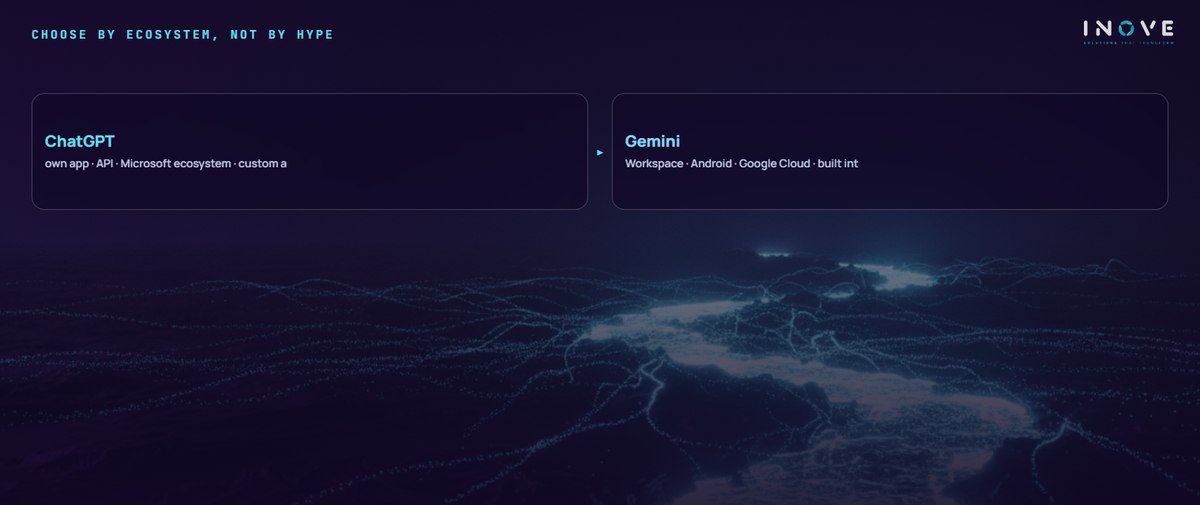
- Ecosystem. Gemini lives inside Google Workspace, Chrome, and Android: anyone using corporate Gmail, Docs, and Drive finds it embedded in the flow. ChatGPT arrives through its own app, through the API, and through the Microsoft ecosystem — including the productivity tools and the Azure cloud.
- Enterprise integration. Both offer APIs, custom assistants, and connections to internal knowledge bases. The practical difference lies in where your company already has contracts, identity, and data: integrating the assistant into the ecosystem you already govern costs less and leaks less.
- Model portfolio. Each platform maintains a family of models — light and cheap for simple tasks, robust and expensive for complex reasoning. Speed and cost depend on the model chosen, not on the brand.
- ERP and business. The major business systems followed the same path: SAP, for example, embedded generative AI into its processes with Joule. In many scenarios, then, the question is not “ChatGPT or Gemini?” but “what already comes inside the platform I use?” — a topic we follow closely in our SAP practice.
Selection criteria for the company
- Where are your data and your identity? Companies living on Microsoft 365 lean one way; those living on Workspace, the other. Native integration reduces cost and risk.
- What is the data contract? Only go to production with an enterprise plan that guarantees, in writing, that your data does not train the model and stays under access control.
- Test with real cases. Set up a pilot with your own tasks — your legal team’s contract, your finance team’s spreadsheet — and compare results, cost, and speed. The public benchmark does not use your data.
- Consider not choosing. Many companies run both platforms, each in its niche, behind a common management layer. A multi-provider architecture avoids dependence on a single vendor.
Governance applies to both
Whatever the choice, the rules are the same: a corporate account, a clear definition of what can and cannot go into the prompt (LGPD, the Brazilian data-protection law, first of all), human review of everything with consequences, and an audit trail on the integrations. This policy and control design is part of the work we do in our cybersecurity practice — because generative AI, today, is also an attack surface.
In short, ChatGPT and Gemini are two mature paths to the same destination. Compare them on your cases, in your ecosystem, and under your data contract — and remember that competitive advantage lies not in the model anyone can license, but in the corporate context only your company has.