



Infrastructure Modernization: Reach Goals Securely
Every company has ambitious goals for the year — and an infrastructure that decides whether they are feasible. When the environment is old, every new project starts by negotiating with the legacy: servers with no capacity, systems that do not integrate, updates nobody dares to apply. That is why infrastructure modernization has stopped being a technical topic and become a business condition.
Moreover, 2026 raised the bar. Generative AI entered the corporate routine and demands accessible data and elastic capacity. Hybrid work became the standard and requires secure access from anywhere. LGPD, the Brazilian data-protection law, now sees real enforcement. None of this runs well on infrastructure from ten years ago. In this article, we show how to modernize with method — without stopping the operation.
What modernization unlocks
In practice, the gains show up on four fronts. First, agility: with cloud and automation, standing up a new environment takes hours, not weeks — and business goals stop waiting for IT. Second, cost: capital locked in aging hardware goes out; on-demand consumption that adjusts to real usage comes in.
Third, security: modern platforms bring encryption, identity management, and continuous monitoring as the default, not as a separate project. Finally, capacity to innovate: analytics, AI, and integrations are born ready in the cloud — those on legacy systems have to build them from scratch.
The levers that work
- Cloud as the foundation — public, private, or hybrid, depending on the workload. The point is not “going to the cloud”; it is putting each system where it performs best and costs least.
- Containers and orchestration — packaged applications run the same in any environment, which simplifies deployment and eliminates the classic “it works on my machine”.
- Infrastructure as code — environments described in code are provisioned in a repeatable, auditable way. Less human error, more speed, and a history of who changed what.
- Managed services — databases, messaging, and services operated by the provider or a partner take the routine that does not differentiate the business off your team’s plate.
- Observability and FinOps — measure performance and cost from day one. A modern environment without governance turns into a surprise invoice.
Where to start without stopping the operation
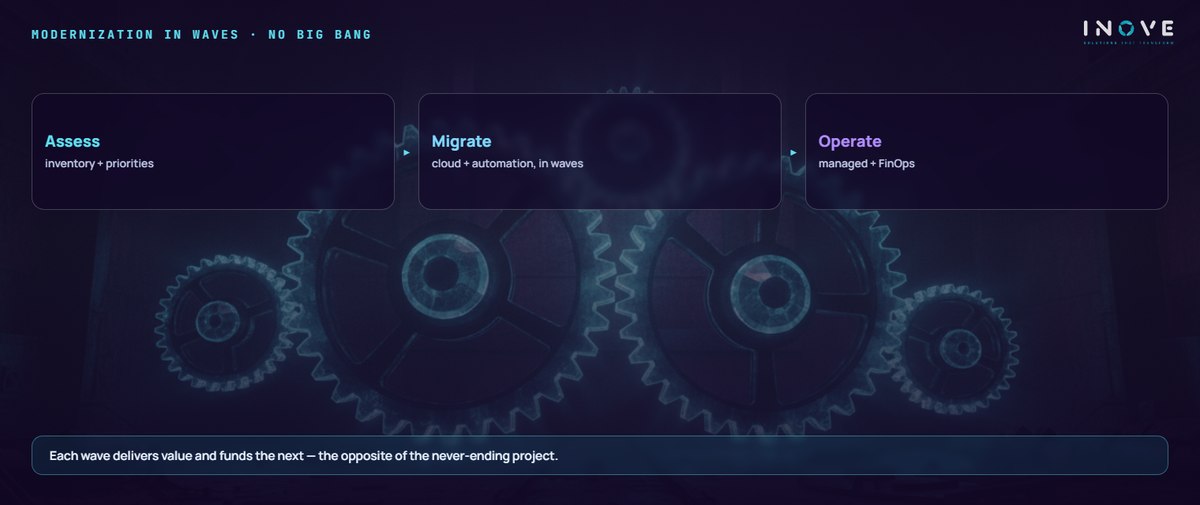
Likewise, successful modernization starts with an honest picture of the estate: what exists, what each system costs, what the business depends on. Then you prioritize by impact and risk — usually quick wins first (backup, DR, test workloads), critical systems later, with planned windows.
In addition, the golden rule is to migrate in waves. Each wave has a closed scope, a success criterion, and a defined rollback. That way, the lessons from the first wave reduce the risk of the second, and the operation is never held hostage to one heroic weekend.
More than technology: competitiveness
As a result, modern infrastructure changes IT’s role in the company. The team stops administering hardware and starts enabling the business: delivering the new project’s environment in a day, absorbing the campaign’s peak without drama, putting AI to work on organized data. That is the difference between IT that costs and IT that accelerates.
There is also a valuable side effect: modern infrastructure shortens the distance between the idea and the test. A pilot that used to require buying a server is now born in a disposable environment, costs a few days of consumption, and dies without a trace if it does not work out. Failing cheaply is a competitive advantage — and it is a direct child of modernization.
It is the kind of journey we run by combining infrastructure and cloud — with people who have seen what works (and what breaks) in environments of every size. To go deeper into the planning, download the “Cloud migration checklist” at the Inove Academy.
In short, the question is not whether your infrastructure will be modernized — the market, the costs, and security will force it anyway. The question is whether the modernization happens at your pace, with method and in waves, or at the pace of the next crisis.