



IT cost management: optimize without slowing down

The IT bill has grown at almost every company — cloud, licenses, security, data, and now AI assistants. That is why technology cost management has stopped being an annual budgeting exercise and become a continuous discipline. The right question has changed: it is no longer “how much to cut” but “where does each dollar yield the most.”
In this article, we show how to plan the IT budget, where the typical waste lives, and how to turn technology into a strategic investment — with the perspective of a team that operates cloud, SAP, and infrastructure every day.
Why IT cost management has changed in nature
In the old model, IT cost was predictable: you bought the server, paid the license, done. In the cloud, cost is variable and daily — every environment left running, every query, every byte in transit becomes an invoice. That is great for scaling and terrible for those who do not measure.
On top of that, subscriptions have taken over everything: collaboration, security, ERP, AI tools. The result is a scattering of contracts that no one sees as a whole. Without a consolidated view, the company pays twice for the same function and keeps licenses for people who have already left.
The most common challenges
- Fragmented IT — each department buys its own tool and the total cost becomes invisible (so-called shadow IT).
- Cloud without governance — test environments running 24/7, oversized resources, old data sitting in expensive storage.
- Contracts on autopilot — annual renewals with no renegotiation and no usage review.
- No bridge to the business — IT talks servers; the board decides on margin. Without translation, the budget loses the argument.
5 practices to optimize without slowing the business down
1. Adopt FinOps for real
FinOps is the continuous financial management of the cloud: visibility of consumption by department, cost targets, and monthly reviews. In practice, the quick wins are almost always the same — shut down idle resources, right-size the oversized, and use commitment discounts (reserved instances and sustained-use plans) for stable workloads. In environments without governance, initial savings usually land in the double digits. See how we work with cloud and FinOps.
2. Consolidate and renegotiate contracts
Take an inventory of everything the company subscribes to. Then cut the overlap: two tools for the same function is the rule, not the exception. Larger, consolidated contracts also bring negotiating power.
3. Treat licenses as an asset
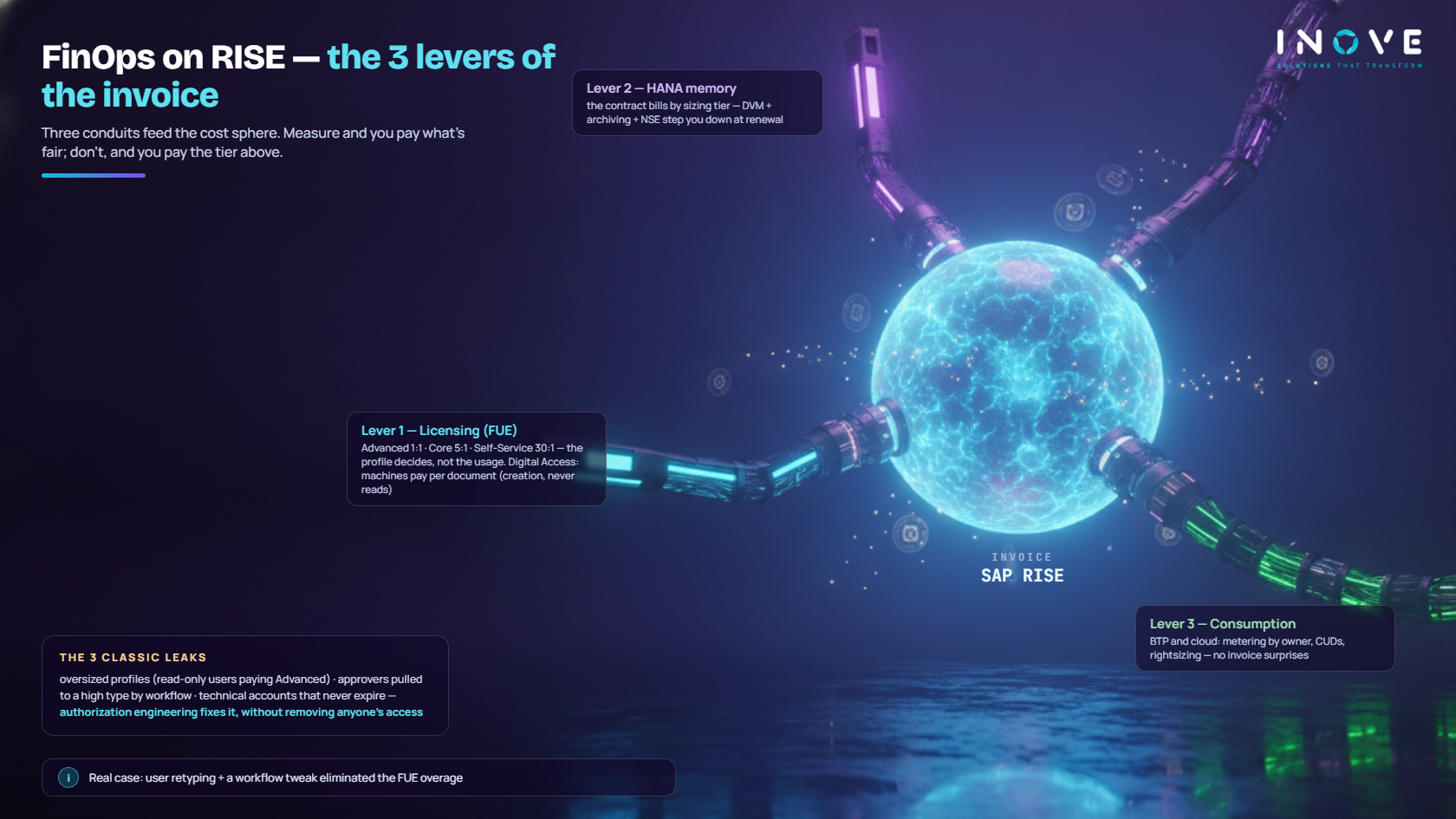
An unused license is money standing still. Likewise, review user profiles: not every user needs the most expensive tier. In SAP environments, accurate user measurement and archiving of old data prevent expensive surprises at renewal time.
4. Modernize what is expensive to keep
An aging on-premises data center, legacy systems with handcrafted maintenance, and out-of-warranty hardware drain the budget silently. A hybrid architecture — part cloud, part on-premises — is usually the path to the best total cost, as long as it is planned.
5. Measure the return, not just the spend
Finally, connect every budget line to an outcome: availability, delivery speed, risk avoided, revenue enabled. It is this translation that turns IT from a cost center into an investment — and that defends the budget at the board table.
How to structure the process
- Visibility — consolidate invoices, contracts, and consumption into a single dashboard.
- Classification — separate the cost of operating (run) from the cost of growing (change).
- Targets by department — then give each product owner their own cost target.
- Monthly cycle — review, optimize, and reallocate. Cost management is a routine, not a project.
To go deeper on the cloud front, download the cloud migration checklist at the Inove Academy — it helps you plan the move with costs under control from day one.
In short: the best IT cost management does not show up in a single year’s cut, but in the curve of the years that follow — predictable cost, waste near zero, and budget left over for what makes the company grow.