



Machine Learning in Manufacturing: From Prediction to Planning
For years, machine learning in manufacturing was conference material: an Industry 4.0 promise, a pilot project, a proof of concept. In 2026, the picture is different. Demand forecasting, predictive maintenance, and computer-vision quality inspection have become routine in plants of every size — including in Brazil.
That is why the right question has changed. It is no longer “does it work?” but “why is my operation still planning on gut feeling?”. In this article, we show where machine learning delivers concrete results in manufacturing and what needs to be in place — data, integration, and the ERP — before any model runs.
What it is, in practice, without the hype
Machine learning is the branch of artificial intelligence in which the system learns patterns from data, rather than following fixed rules programmed one by one. On the shop floor, the data already exists: production records, sensor readings, ERP orders, sales and delivery history.
In practice, the model turns that history into projections. In other words, it answers questions such as “how much will I sell in November?”, “which machine is likely to fail first?”, and “is this batch drifting out of spec?”. On top of that, generative AI has made the results accessible: managers ask in natural language and get the analysis, without depending on a data scientist for every query.
Where the return shows up first
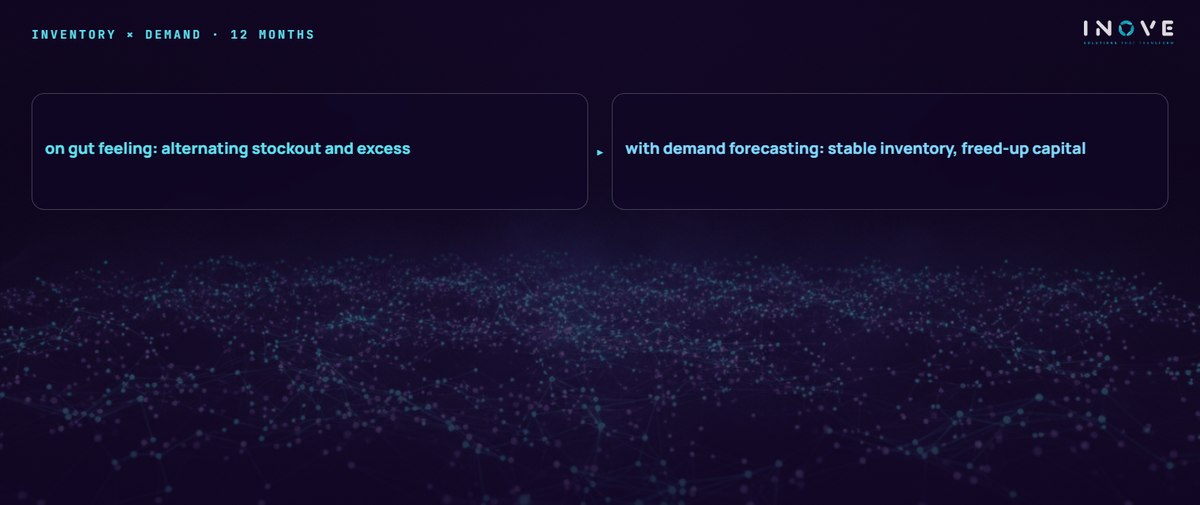
- Demand forecasting. Sales history, combined with seasonality and the promotional calendar, feeds production and inventory planning. This avoids both stockouts at Christmas and Black Friday and capital sitting idle on the shelf.
- Predictive maintenance. Sensors on the machines anticipate failures before an unplanned stop. As a result, the interruption becomes a scheduled window — and many plants already simulate the scenario in a digital twin before stopping the line.
- Quality control. Cameras and computer vision inspect 100% of production, not a sample. So the deviation is caught at the start of the batch, not in a customer complaint.
- Logistics and routing. In a continental-sized country, the model learns from past deliveries and designs better last-mile routes, optimizing fleet and lead time.
- Customer service and after-sales. AI assistants resolve most recurring questions and escalate to a person when the case falls outside the pattern.
The prerequisite nobody gets to skip: organized data and an integrated ERP
This is where the exciting pilot and the cash-generating project part ways. The model is only as good as the data that feeds it. So before the algorithm come three foundations:
- Reliable data — clean master data, consistent production records, and a single source of truth, usually the ERP.
- Systems that talk to each other — shop floor, sensors, ERP, and planning integrated. A sensor that never reaches the system is lost data.
- A process that owns the result — the forecast has to feed S&OP and production scheduling. A model nobody consumes is just a pretty dashboard.
In SAP environments, much of this comes built in: S/4HANA embeds forecasting and predictive analytics inside the planning processes themselves. At Inove, which implements and supports these environments, we see in practice that the gains appear when the ERP is well implemented and configured — not when yet another standalone tool is purchased.
Where to start
- Pick an expensive, measurable pain point — stockouts, machine downtime, or scrap are good candidates.
- Assess the available data — is there enough history? Is it reliable? Is it accessible?
- Run a pilot with a business target — cut stockouts by X%, not “test AI”.
- Industrialize — integrate with the ERP, define who maintains the model, and monitor the result every month.
It is also worth watching where the sector is heading: whoever produces well today competes with whoever produces well and forecasts well. The technologies behind this shift — sensors, integration, and analytics — are detailed on our technology for manufacturing page.
In short, machine learning in manufacturing has stopped being a bet and become a management tool. The competitive edge no longer lies in having access to the technology — it lies in having the data, the integration, and the process discipline to make it work every single day.