



How to Modernize the Mainframe: An Updated Guide
The mainframe is IT’s most enduring paradox: the technology so many declared dead keeps processing the core of banks, insurers, and governments. It is stable, secure, and fast — and, at the same time, expensive to maintain, hard to integrate, and dependent on a generation of specialists who are retiring.
That is why modernizing the mainframe does not necessarily mean shutting it down. It means deciding, workload by workload, what stays, what changes platform, and what gets rewritten — with the business running the whole time. In 2026, with a mature cloud and AI assistants even helping document legacy code, this work has become more feasible than ever. This guide shows the way.
Start with the picture: what runs in there
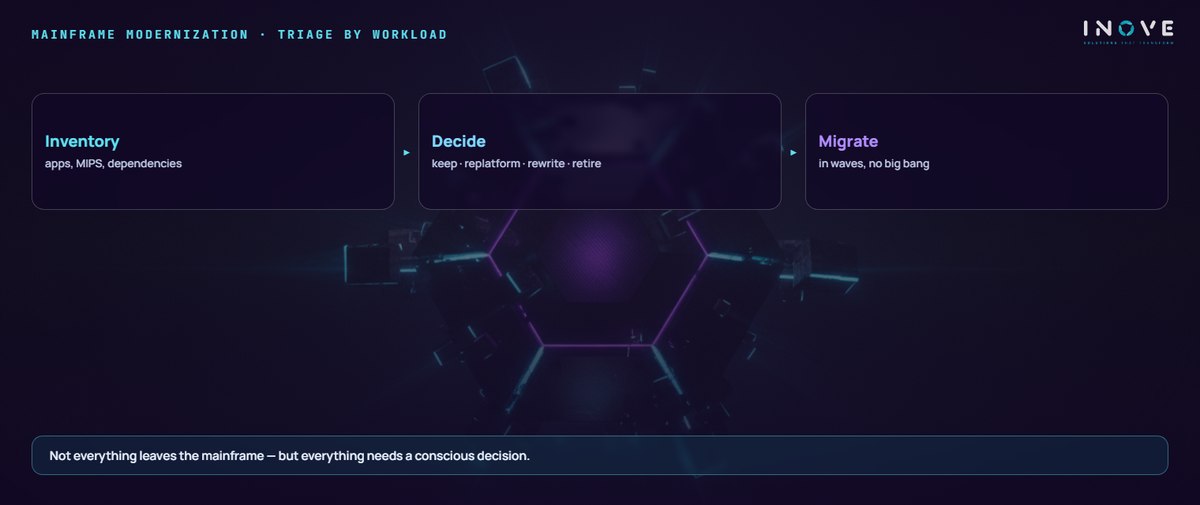
In practice, the biggest risk in modernization is ignorance of your own environment. Decades of operation accumulate ownerless programs, duplicated routines, and dependencies nobody documented. So the first step is the inventory: applications, integrations, volumes, batch windows, and — crucially — the cost of each workload in MIPS.
Furthermore, this is where generative AI has become a concrete ally: code assistants already help read and document old COBOL programs, reducing dependence on the memory of whoever wrote them. The picture is ready in weeks, not years.
The four destinations for each application
- Keep and expose — critical, efficient workloads can stay where they are, gaining APIs to talk to the modern world. The mainframe becomes a well-behaved backend.
- Replatform — move the application to the cloud or a distributed environment with minimal code changes. It is the typical path for cutting MIPS quickly.
- Refactor or rewrite — strategic applications that need to evolve get a new life on modern architecture, now with AI assistants accelerating code conversion.
- Retire — a surprising share of the estate is simply no longer used. Switching off is the cheapest modernization there is.
Hybrid cloud: legacy and new living together
Likewise, the model that works in real life is hybrid. The migrated workloads run in the cloud; the ones that stay on the mainframe talk to them through APIs and events. Well-designed integration is what makes migrating in waves possible — each wave with a closed scope, equivalence testing, and a rollback plan.
Furthermore, the cloud unlocks what the mainframe holds back: scaling on demand, layering analytics and AI on the data, and paying for usage instead of sizing for the peak. It is a journey we handle jointly across our infrastructure and cloud practices.
Security and compliance during the crossing
As a result of the migration, data that used to live in isolation starts circulating between platforms. Therefore, encryption in transit and at rest, identity management, and audit trails need to be born with the project — not after it. With LGPD, the Brazilian data-protection law, under real enforcement, the crossing is also a chance to put the house in order: map personal data, apply retention, and reduce what no longer needs to exist.
The plan in summary
- Inventory and cost per workload — know what exists and what it costs.
- Triage — a defined destination for each application, prioritized by value and risk.
- Hybrid foundation — connectivity, integration, and security ready before the first wave.
- Migration waves — start with what hurts little and teaches a lot; critical workloads last.
- Operation and optimization — monitor, tune costs, and keep shrinking the legacy footprint.
To go deeper into the legacy decision — including when the destination involves the SAP world —, download the guide “S/4HANA: brownfield vs. greenfield” at the Inove Academy.
In short, the mainframe is not a problem to eliminate: it is an asset to decipher. Whoever does the triage with method turns decades of legacy into a modern architecture, without betting the operation on a single switchover. Whoever postpones outsources the decision to the next retirement.