Retail Management: What You Need to Optimize Yours

Retail management is broader than many believe. After all, it involves managing the team, choosing suppliers, inventory, finance, marketing, and other areas. Therefore, retail management is a crucial topic for the survival and growth of any business in the segment.

Moreover, given the importance of the subject, administrators should seek out all the information they can about this discipline. To expand your knowledge, we prepared this material explaining its concept, its benefits, how to do it properly, and more!

What is retail management?

In practice, retail management is a set of monitoring, planning, usage, and analysis strategies and tactics. These help control the company’s financial, intellectual, and human resources, as well as its assets. Its main goal is to make the business increasingly efficient, optimized, and prosperous. In addition, it helps the business adapt to market changes.

The importance of retail management

Businesses that value transparent retail management gain a 360-degree view of their operations. In addition, they see the processes that make up the organization’s daily routine.

Therefore, check out some of the benefits of retail management below.

Seeking improvements

Likewise, by using the right methodologies, you identify the company’s strengths and weaknesses. As a result, you can design strategies to make the most of its virtues and correct its flaws. For example, this can be done with the SWOT matrix, where:

  • S (Strength): the company’s best internal points;
  • W (Weakness): the organization’s internal fragilities;
  • O (Opportunities): external events that benefit the retailer;
  • T (Threats): situations that can harm the company.

Identifying threats

As a result, good management includes studying different aspects related to the business. For example, these include legislation, competitors, suppliers, and consumers. Consequently, it becomes possible to identify potential threats in any of these areas.

For example, if a new competitor appears, managers can take measures to remain competitive in the market. Another example is anticipating changes in customer consumption and adapting products to please them better.

Visualizing results

In short, leaders gain a more complete, transparent, and objective view of the business. Therefore, they can design strategies and adopt best practices so that goals and targets are met.

Tips for excellent retail management

Retailers have certain peculiarities compared to other types of businesses. This means there are specific management tactics that should be applied. Learn about them below.

Use data as your foundation

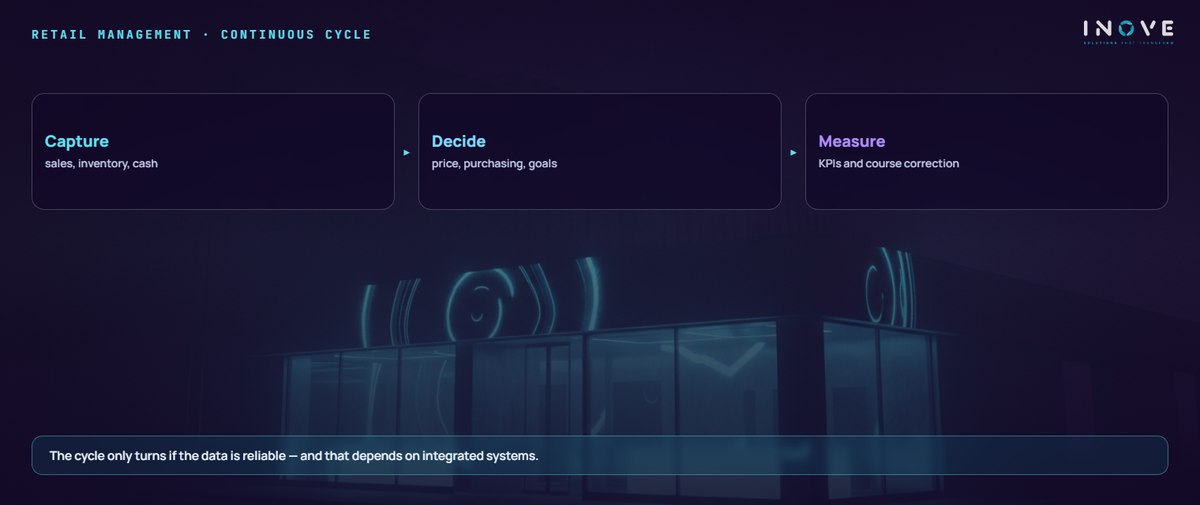
After all, making decisions based on mere assumptions is a big mistake. As a result, it can compromise business growth. However, this problem is solved when the organization starts making data-driven decisions. In practice, specialized technology should be used to collect business information and generate management reports.

Keep an eye on the market

In addition, good market research helps the organization position itself well. That way, it finds the best possible place within its market. This research should be detailed and include the following aspects of your audience:

  • Main products purchased;
  • Social class or average income;
  • Main payment methods;
  • Behavior, personality, and habits;
  • Age range; among others.

In practice, this data is necessary to build an effective marketing plan. However, it is also relevant to research your competitors, which involves:

  • The niche they operate in, if any;
  • Their differentiators;
  • How they serve customers;
  • Their product prices;
  • The marketing strategies they are using; among other information.

Set goals

Good goals must have certain characteristics so that staff clearly understand what must be achieved. Therefore, it is important that these goals be SMART, that is:

  • S (Specific): the goal must be clear, since confusing goals can lead people to pursue different ends;
  • M (Measurable): it should be easy to track progress toward them;
  • A (Attainable): they cannot be too difficult; otherwise, they may demotivate the staff;
  • R (Relevant): they must bring real results to the company;
  • T (Time-based): a deadline must be set to reach them.

For example, a good goal would be “increase sales by 15% within the next 12 months”.

Planning

Likewise, the first step for any project to succeed is creating a good plan. Some essential topics it should include are:

  • Overall objectives to be achieved;
  • Sales projection;
  • Marketing strategy;
  • Optimistic, realistic, and pessimistic scenarios;
  • All operational and product costs;
  • Key performance indicators (KPIs) that will measure business results.

As a result, keep in mind that creating the plan is not enough. You must ensure that all employees and leaders follow what was established. For example, this can be done through meetings. These meetings explain the importance of following the plan and answer questions about it.

Retail-focused marketing

Meanwhile, marketing involves promoting the products, the retail brand, the service provided, prices, and many other strategies. Neglecting this planning can prevent the company from selling. After all, the brand and its products will not be properly presented to customers.

In short, people are becoming increasingly active on the internet. Therefore, it is essential to consider digital marketing. In practice, this means using websites, social media, and messaging apps to promote your products.

A flexible attitude with customers

Having a flexible attitude means granting benefits to your best customers. In addition, it means being more open in negotiations with them. For example, imagine someone who always buys a lot and frequently from your store. In that case, you can offer them gifts or discounts. As a result, they will become a brand promoter and recommend your store to other people.

Team development

After all, employees are the ones who carry out the company’s activities in practice. Therefore, it is essential that they be properly trained and qualified for their operations. In addition, leaders need to know each individual’s strengths and weaknesses. That way, they can direct staff to the appropriate training.

Furthermore, another relevant aspect is the organizational culture. In practice, it is a set of guidelines, policies, and principles the team must follow. Ideally, this culture should:

Inventory management

Without a shadow of a doubt, inventory management is highly impactful. In practice, it is one of the most important areas for a retailer’s success. It is essential to avoid excess items, which reduce working capital and generate waste. Likewise, it is essential to avoid stockouts. These happen when a customer cannot find an item they are looking for in the store. Therefore, this management should address:

  • Future demand;
  • Order control;
  • Purchasing supervision;
  • Inventory projection and turnover;
  • Use of inventory KPIs;
  • Use of technology to manage inventory;
  • Warehouse control, monitoring, and supervision; among others.

Financial management

Financial management is an aspect that can compromise all retail operations. After all, product movements depend on financial resources. Therefore, you must consider:

  • Sales forecasting;
  • Cash flow;
  • Cash flow projection;
  • Accounts receivable and payable;
  • Pricing;
  • Suppliers;
  • Expenses and costs;
  • Revenue;
  • Profit; etc.

Loss prevention

Any loss will generate damage to the business, including those that seem insignificant at first glance. For example, they can occur through misplacement, robbery, theft, breakage, fraud, delays, or damage to equipment. Among the strategies to avoid these damages are standardizing procedures and investing in security. In addition, teams must follow strict processes.

Invest in technology

Likewise, keeping precise, manual control over every aspect of retail is unfeasible. After all, it requires mobilizing a large number of people, carries high costs, and remains prone to failure. However, you can achieve more efficiency by delegating controls to a specialized, customized, and integrated management system. This technology will automate and assist with several operational procedures, such as:

  • Invoice issuance;
  • Inventory control;
  • Manufacturer recommendations;
  • Damage containment and control;
  • Security management;
  • Integration between areas;
  • Report generation to support decision-making; among many other features.

Learn more about retail management with Inove Solutions

Inove Solutions is a company created in 2018 by innovative minds. Its goal is raising the standards of service delivery in Brazil. In addition, it meets the demand to provide clients with complete solutions in infrastructure, systems, and development.

Meanwhile, its solutions are customized and apply the most modern technologies. As a result, the software meets your business’s specific needs and always keeps up with technology trends.

In short, the service provided by Inove Solutions is quite broad. For example, it involves retail diagnostics, information security management, solution development, and special operations. In addition, there are others that you can check out in more detail here.

Clearly, retail management is exceptionally broad, which makes managing every aspect on your own unfeasible. However, with Inove’s support, you can automate several tasks. This way, you focus on activities that add more value, such as planning, negotiations, and decision-making.

So, talk to one of our specialists now to find out how we help improve your retail management!