



RISE with SAP: What Still Belongs to You (Including FUE)

RISE with SAP is the offering that takes S/4HANA to the cloud as a subscription: in a single contract, SAP delivers the software, the infrastructure (on a hyperscaler such as AWS, Azure, or GCP), and operation services. It sounds like it solves everything — and that is exactly where the risk lives: “as a service” does not mean “without responsibility”.
In this article, therefore, we explain RISE with SAP in plain language, show what remains yours, and cover a topic almost nobody addresses: FUE licensing — where, in practice, we have watched money leak away.
What RISE with SAP covers — and what stays with you
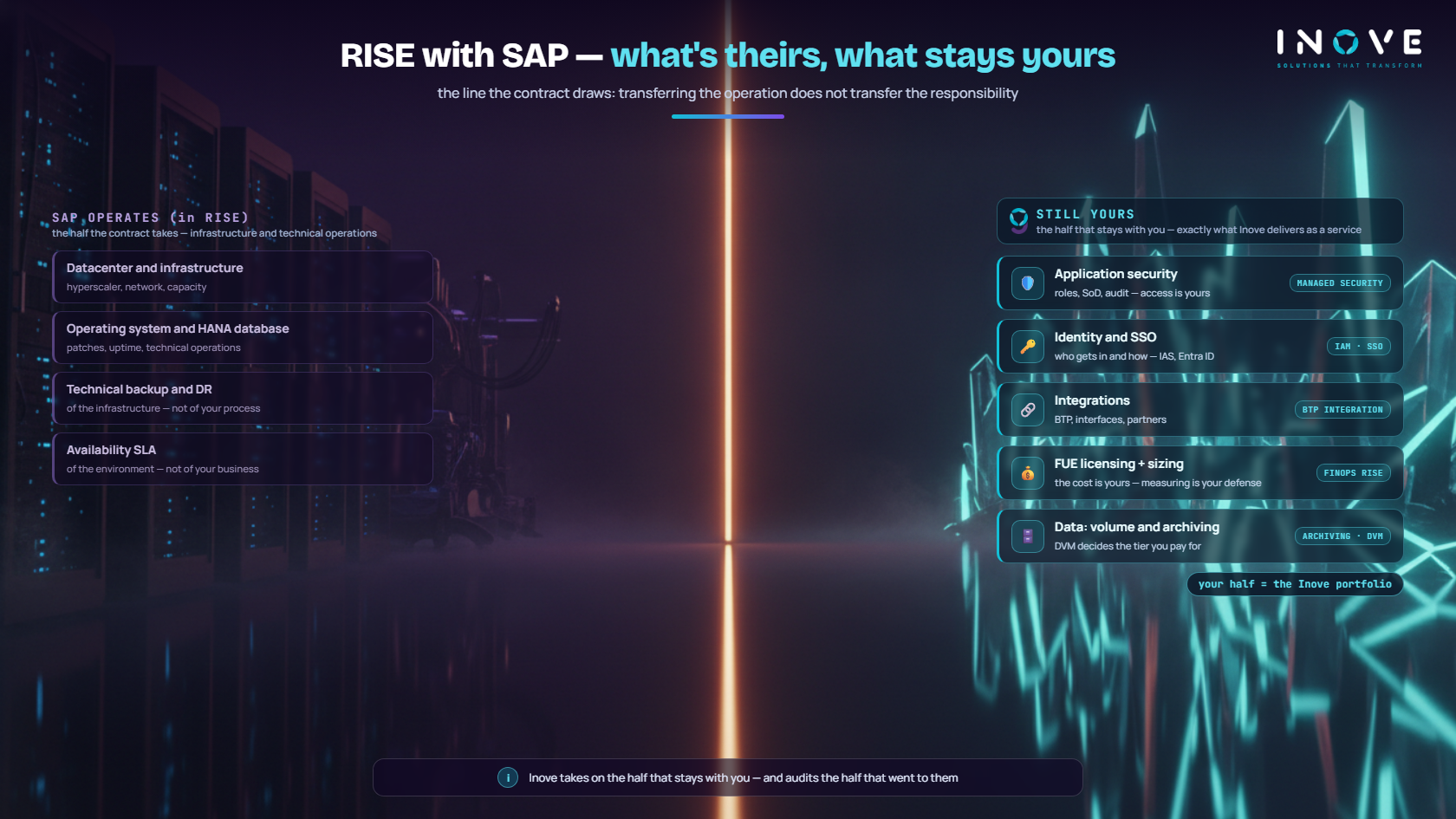
The model is called shared responsibility. SAP takes care of the infrastructure, the database, the patches, and the contracted availability. On your side, however, remain:
- Application security. Access, roles, segregation of duties (SoD — whoever buys does not approve), and data protection.
- Identity. Single sign-on (SSO) and user governance between SAP and the rest of the company.
- Integrations. Banks, payment methods, legacy, and third-party systems.
- Consumption and cost. The contract has tiers — and, therefore, someone must watch what pushes you into the tier above.
FUE: the licensing nobody explains
In RISE with SAP, users are licensed in FUE (Full Use Equivalent) — a “currency” that converts each user type into a weight: an advanced user is worth 1 FUE, a functional user a fraction, and a self-service user much less. The contract, in turn, defines how many FUEs you bought.
In practice, we have watched money leak through two drains: mistyped users (people classified as advanced who do self-service work) and invisible consumption — for example, workflow approvals counting as advanced use for someone who only clicks “approve”. In one RISE environment we optimized, retyping users and adjusting the workflow design eliminated the FUE overage — without, moreover, removing access from anyone who needed it.
How Inove helps
We take care of the half that is still yours: cybersecurity and SoD, identity and SSO, integrations, contract FinOps (FUE + sizing), and application support around S/4HANA in the cloud. As a result, you enjoy the best of RISE with SAP — without discovering holes later.
Our long-standing vision: we want our clients to be happy and free of IT headaches — including inside RISE.
Where to start
- Responsibility map — in black and white: what belongs to SAP, what belongs to you.
- FUE X-ray — the real user typing versus the contract.
- Security and identity — SoD and SSO designed for the RISE environment.
- Continuous FinOps — licensing and sizing watched all year, not only at renewal.
Read next
- SAP archiving and DVM: hold back HANA sizing
- S/4HANA migration: the three paths
- AI in SAP: Joule and assistants with security
Already on RISE with SAP, or evaluating it? Talk to Inove Solutions — we X-ray your contract and your foundation.