



SAP Implementation: Why the Foundation Decides Your Go-Live
An SAP implementation that runs late or goes live unstable rarely fails in the functional workstream. The consultant delivers the process, the ABAP runs — and yet the go-live becomes an ordeal. Why? Because almost every problem lives in the foundation: environments, access, data, and integrations.
In this article, therefore, we show where projects really stumble — with lessons from people who lived through large implementations from the inside — and the foundation checklist that prevents the stumble.
Where SAP implementation projects really stumble
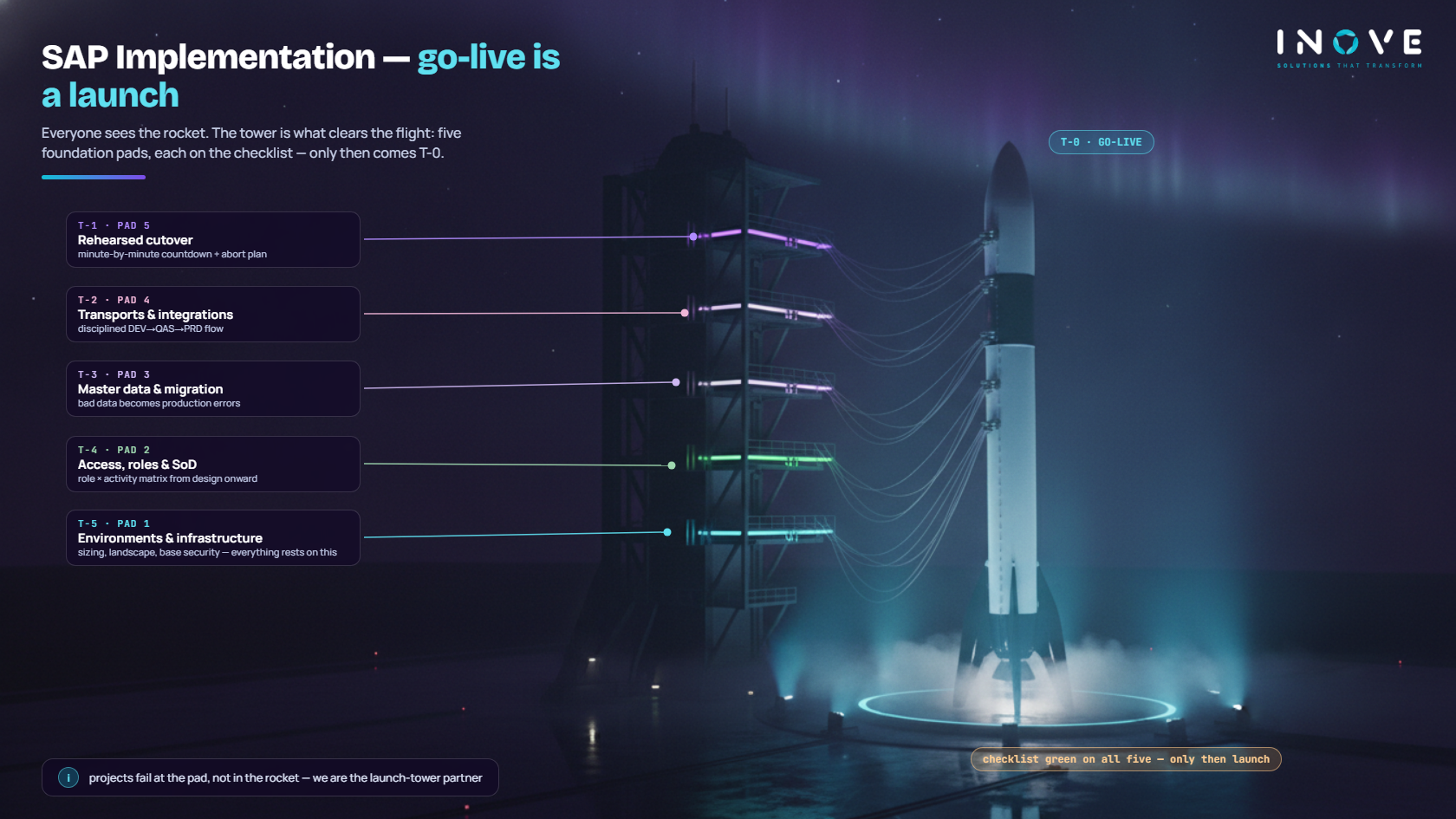
- Environments delivered late. Poorly sized DEV, QAS, and PRD (development, testing, and production) stall the entire schedule — after all, nobody tests without an environment.
- Access left for the end. Roles and SoD (segregation of duties: whoever buys does not approve) handled in the final stretch become a bottleneck, rework, and audit risk.
- Dirty master data. Inconsistent materials, customers, and vendors knock down the integrated tests — and, consequently, user confidence.
- Transports without discipline. A “transport” is the package that carries each change from one environment to the next. Without strict control, production and test drift apart — and the go-live becomes a lottery.
- Underestimated integrations. Banks, tax, legacy systems: every forgotten endpoint shows up at the worst possible time.
- Cutover without rehearsal. The switchover needs a script, roles, timings, and a plan B — written and rehearsed before the decisive weekend.
How Inove helps
We are the partner for the foundation: sizing and operation of the environments, access governance and SoD, technical baseline quality, transport discipline, integrations, and the cutover plan — plus the AMS support that takes over the environment the day after go-live, when the project leaves and the operation stays.
Our long-standing vision: we want our clients to be happy and free of IT headaches — from the first day of the project.
Where to start
- Foundation assessment — environments, access, data, and integrations before the functional kick-off.
- An early role matrix — role × activity × access designed with the business.
- Transport discipline — owner, sequence, evidence.
- A rehearsed cutover — script and plan B tested.
- Support ready — AMS taking over on day one after go-live.
Read next
- S/4HANA migration: the three paths
- Brazilian tax reform and SAP: the program that has already started
- AMS for SAP: the day after go-live
Starting an SAP implementation, or already mid-project? Talk to Inove Solutions — we take care of the foundation.