



Federal tax debt: reconciling what the company calculated with what the authority charges

Ask a director how much tax their company owes, to whom, at which level of government and by when. Almost nobody answers without calling the accountant — and the accountant answers with what sits in the accounting system, which is not necessarily what the government is charging.
That gap between what the company believes it owes and what the tax authorities record is the most common blind spot in mid-market financial management. Not through carelessness: the information is split across three levels of government, each with its own portal, login, calendar and logic, and none of them talks to the others, or to your accounts.
Three levels, three logics
At federal level, the debt lives in two different places under two different regimes: what is still with the federal tax authority, and what has already been entered as registered federal debt and passed to the PGFN (Brazil’s federal debt attorney office). The difference is not bureaucratic — it changes who negotiates, what can be negotiated and which programmes apply. Registered federal debt can also be protested through a notary, which hits credit standing and eligibility to bid for public contracts.
At state level, ICMS (the state VAT) and vehicle tax follow the calendar and the programmes of each individual state, with amnesties that open and close in short windows.
At municipal level, the service tax (ISS) and local fees are usually the smaller amount and the loosest control — and that is precisely where the surprise turns up most often, generally when somebody requests a tax clearance certificate.
Each of these sources is public and open to enquiry. The work is not finding it: it is gathering, normalising and comparing — and it is exactly that repetitive reading work that AI does well.
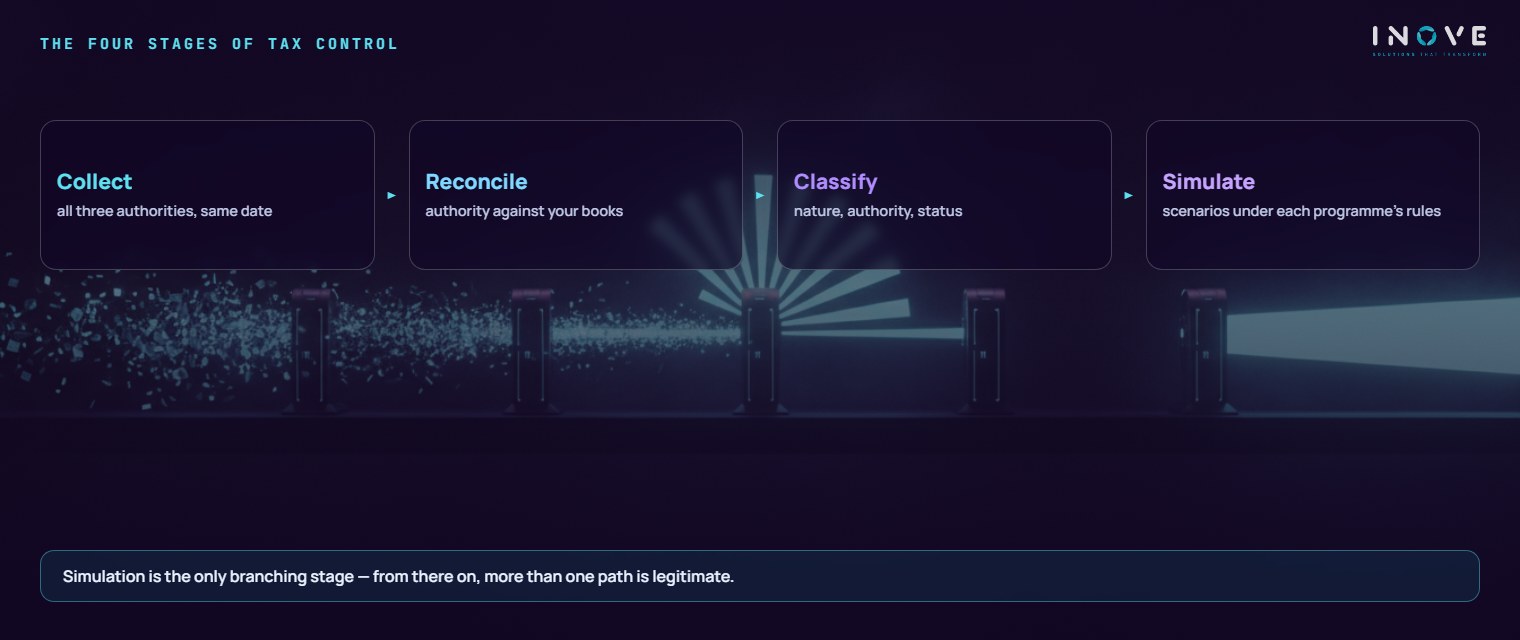
What can be automated
Collecting the position. Statements, outstanding-item reports and clearance certificates all exist on the official portals. Bringing them into a single inventory, with a reference date, is the first deliverable — and it is usually revealing on its own.
Tracking payment slips and deadlines. Every tax has its own due date, and every instalment plan in progress has its own instalment. One forgotten instalment terminates the agreement, and a terminated agreement returns the debt to its previous state, often with the loss of favourable terms.
Reconciling against the accounts. What the accounting system records as a provision, compared with what each authority is actually charging. This is where automation finds what nobody was looking for.
Classifying each debt. Nature (tax, social security, fee), level of government, status (under collection, registered, protested, in instalments) and whether or not it falls within a live programme. Without that classification, any conversation about strategy is guesswork.
Reconciliation is where the shock appears
At one company we analysed, the total recorded in the accounts and the total charged by the authorities differed by more than 30% — and the accounts held the higher figure. It was neither the accountant’s error nor the tax authority’s: different natures were being added together, debts already under instalment plans appeared twice, and amounts were booked with surcharges calculated on a different basis from the authority’s.
The practical consequence is large. A company that negotiates using the accounting figure is arguing over a debt that does not exist at that size; one that plans cash using the tax authority’s figure may be ignoring an obligation still to be registered. Before any strategy, you need to know what the number is.
Reconciling that by hand is a week of spreadsheets, because each authority exports in its own format and each report uses a different vocabulary. With AI reading the statements and proposing the match line by line, it becomes an afternoon of review — the same pattern we described in data conversion with AI: the machine proposes, the person checks.
Strategy: read the programme before signing up
Here is the part that most surprises anyone who has never had to negotiate. Settlement programmes advertise discounts of up to 65% on fines, interest and charges — the number that appears in every law-firm advertisement and every article on the subject.
What is almost never publicised is that this discount depends on the CAPAG (the payment-capacity rating) assigned by the PGFN. The PGFN estimates the company’s capacity from the data it already holds and places it in bands from A to D. And the rule that decides everything is this: bands A and B carry no discount at all — they carry time and entry terms. The discount starts at C.
In other words: a company deemed able to pay receives an instalment plan, not forgiveness. And the dividing line between “time only” and “meaningful discount” sits exactly between B and C.
In the case we analysed, the AI read the rating assigned and the capacity estimate behind it, compared it with the total debt and reached a conclusion that changed the entire conversation: that company sat in a band with no right to a discount, because the estimated capacity exceeded the debt by more than twice over. All the planning that had been done in the expectation of a 65% cut rested on a false premise.
Finding this out before negotiating changes the strategy radically: instead of waiting for a reduction, the conversation turns to time, monthly cash flow, the order of priority between levels of government, and which protested debts have to clear first because they affect credit and contracts.
What the AI did, and what stayed human
It is worth separating this clearly, because the line is the same in any case of this kind.
The AI did: read dozens of pages of statements from three levels of government and turn them into a comparable table; identify duplication and divergence between the accounts and the tax authorities; separate tax debt from social security debt — a distinction that changes what can be negotiated; read the published programme rules and cross them with the actual position; and build scenarios for time and monthly outlay.
Stayed human: deciding whether to sign up, and to what; assessing the effect of admitting the debt; choosing the order between levels of government; and signing. The accountant and the lawyer were not replaced — they came to the conversation with the picture ready instead of spending the first week assembling it.
How to repeat this in your company
- Gather everything, as at the same date. Federal under both regimes, state and municipal. A position taken on different days does not tie out, and the difference turns into a pointless argument.
- Reconcile against the accounts. Item by item, with the divergence explained — not just the total.
- Classify. Nature, level, status and applicable programme. It is this list, not the total, that supports a decision.
- Read the rules in force. Each programme has its own requirement, window and effect; many open and close within weeks.
- Simulate before deciding. Scenarios with monthly outlay and the effect on clearance certificates, so the choice is made with a number.
- Keep the routine going. A tax position changes on its own: a new registration, a missed instalment, a programme that opens. Periodic checking is what stops you going back to square one.
What lasts
The immediate gain is knowing the number — the real one, reconciled, by level and by nature. That is already more than most mid-sized companies have today.
The gain that lasts is the monitoring routine: payment slips on a calendar, instalments with alerts, clearance certificates monitored and new programmes appearing on the screen of the person who decides, instead of arriving as notice that the deadline has passed.
And the evidence stays. Every conclusion with the official statement attached and the date of the enquiry — the same standard we apply in observability: a report that serves as proof, not as opinion.
The honest limit: none of this pays the bill. Automation organises, reveals and simulates. Choosing the path, negotiating and honouring the agreement remain human decision and human effort — and that is how it should be.
If your issue is less the debt and more the volume of monthly obligations, the reasoning is the same applied to filing: see simulating tax obligations with AI before you file. And for the inbound side, classifying incoming invoices in SAP.
Frequently asked questions
Why doesn’t what the company thinks it owes match what the tax authority charges?
Can tax calculation be automated?
What does AI not do in this area?
Reconciling what the company calculated against what the tax authority records is one of the fronts in SAP tax and DRC.