



6 technologies for small businesses to invest in 2026

In Brazil, the overwhelming majority of businesses are small — from solo entrepreneurs to small companies, millions of operations sustain a large share of the country’s jobs. For this group, technology is not a big-company luxury: it is what separates those who compete from those who merely survive. And the good news is that, in 2026, the right tools cost little and deploy fast.
That is why we selected six technology fronts for small businesses with the best return per dollar invested — with one fixed criterion: the scarcest resource in a small business is the team’s time, so each tool needs to pay for itself in weeks, not years.
Before the tools: fix the process
Technology in isolation solves nothing — automating a messy process only produces a faster mess. So before subscribing to any tool, sketch the flow on a sheet of paper: how the order comes in, who approves it, how the money arrives. With the process clear, each technology below fits into a specific spot.
The 6 technologies that deliver the most
1. Cloud management (lightweight ERP)
First, get the business out of scattered spreadsheets. A cloud management system — sales, inventory, finance, and invoicing in one place — is the foundation for everything else. Moreover, with Brazil’s Tax Reform in its test year (the new CBS/IBS taxes), running a system kept up to date by the vendor is no longer a convenience: it is protection against tax errors.
2. Real digital payments
PIX, Brazil’s instant-payment system, has become the country’s dominant payment method — and it has evolved: recurring charges, scheduling, and automatic reconciliation. Next, connect incoming payments to the management system so the cash position reconciles itself. A stalled checkout is a lost sale, at the counter or on the website.
3. Generative AI assistants
The cheapest newcomer on the list. AI assistants draft proposals, answer emails, summarize documents, and help create content — tasks that consume hours of the owner’s and the team’s time. In practice, there is a single golden rule: do not paste sensitive customer data into free tools; use corporate accounts, with clear usage rules.
4. Service and relationships (CRM + WhatsApp)
Likewise, WhatsApp is Brazil’s storefront counter. A simple CRM connected to business WhatsApp organizes contacts, records the history, and keeps sales from depending on someone’s memory. Automate the basics — confirmations, reminders, follow-ups — and save the human touch for the conversation that closes the deal.
5. Security and backup: the basics that save you
Scams, fraud, and ransomware do not pick company sizes — and neither does LGPD, the Brazilian data-protection law, now backed by real enforcement. The minimum kit fits any budget: two-factor authentication on everything, tested automatic backups, managed antivirus, and phishing-awareness training. It is the kind of foundation our cybersecurity practice builds and maintains.
6. Collaboration for hybrid work
Finally, the cloud productivity suite — professional email, shared documents, video calls — professionalizes the operation and frees the team to work from wherever makes sense. A custom email domain, by the way, is still the cheapest credibility badge there is.
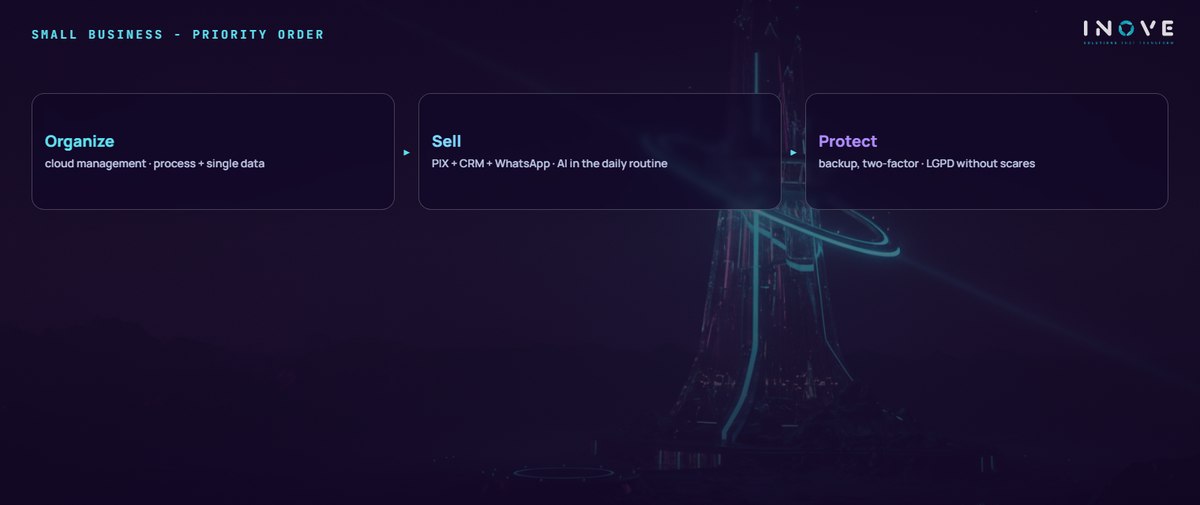
How to deploy without stalling the operation
- One front at a time — deploy, stabilize, harvest the gain, and only then move on. A small business has no slack for three simultaneous projects.
- Prefer subscription over purchase — next, monthly SaaS reduces risk: pick wrong, and you switch without major loss.
- Integrate from the start — a tool that does not talk to the management system creates rework, enemy number one.
- Have someone to call — finally, a small business does not need an IT department, but it does need someone responsible. An on-demand IT support partner covers that function for a fraction of the cost of hiring.
In short, the small business’s competitive advantage lies in agility — and the right technology multiplies exactly that. Start with the foundation, advance one front at a time, and measure the time each tool gives back to the team. It is that time, reinvested in the customer, that makes the business grow.