



SAP HANA and S/4HANA: Why the Migration Cannot Wait
SAP HANA stopped being news a long time ago: it is the in-memory database that S/4HANA runs on, the ERP that has become the market standard. So the question in 2026 is no longer “is the migration worth it?”. It is “how much longer can you afford to wait?” — and the answer gets shorter every quarter, because mainstream maintenance for ECC ends in 2027.
Moreover, anyone who treats the migration as a simple database upgrade misses the point. HANA changes how the system processes data — and the road to S/4HANA changes how the company operates. In this article, we explain what is really at stake and how to plan the crossing without surprises.
What the in-memory database changes in practice
In HANA, data lives in memory, organized in columns. That eliminates a large share of the aggregate tables and indexes that existed only to speed up the traditional database. As a result, reports that used to run overnight respond in real time, and analytics happens on the operational data itself — no waiting for a load into another system.
In practice, that means closing the month with the number on the screen, not yesterday’s number. It also means simplification: less data redundancy, fewer aggregation jobs, fewer layers to maintain. And it is on this foundation that SAP delivers today’s innovations — from Fiori apps to AI assistants embedded in business processes.
2027 is not a contract footnote
So let us be direct about the calendar: mainstream maintenance for SAP ECC (Business Suite 7) ends in 2027, with paid extended maintenance until 2030 for those who need it. Staying past the deadline means paying more to stand still — no innovation, growing security and compliance risk, and a specialist market increasingly focused on S/4HANA.
Besides, the real bottleneck is not the technology: it is the calendar. Experienced consultancies and teams have waiting lists, and conversion projects take months between preparation, code adjustments, and waves of testing. Whoever starts planning now can still choose the window, the approach, and the partner without pressure.
Brownfield, greenfield, and the homework
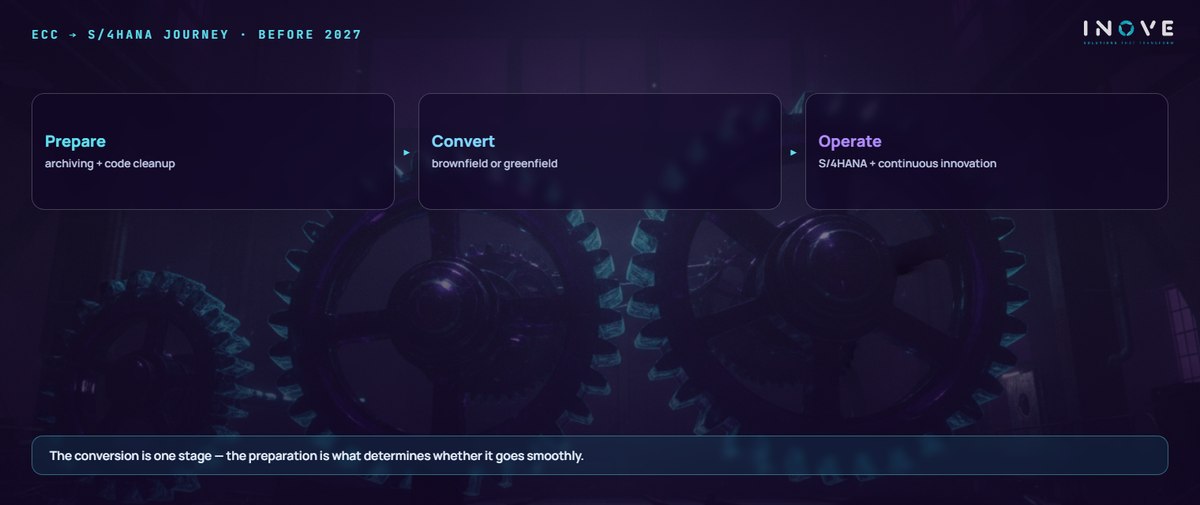
There are two classic paths. In a brownfield project, you convert the current system, preserving the history and the customizations that still make sense. In a greenfield project, you implement from scratch, redesigning processes around the S/4HANA standard. Between the two lies a range of selective approaches — and the right choice depends on the state of your environment, not on fashion.
Whichever path you take, however, the homework is the same:
- Reduce data volume — archiving before the conversion shortens downtime and lowers the cost of the target infrastructure.
- Clean up custom Z code — identify dead customizations and adapt the living ones to HANA.
- Decide on the infrastructure — RISE with SAP, public or private cloud; the hosting decision goes hand in hand with the conversion decision.
- Prepare the business — Fiori changes the user experience; without change management, the gains stay on the screen.
Where to start
In short, the first step is not signing the conversion contract — it is running the assessment: measuring the real size of the database, mapping customizations, evaluating process readiness, and simulating approach and hosting scenarios. With that picture, the brownfield vs. greenfield decision stops being opinion and becomes arithmetic. That is how we run these journeys in our SAP practices, from preparing the environment to operating in the cloud.
To go deeper into the approach decision, download the guide “S/4HANA: brownfield vs. greenfield” at the Inove Academy.
SAP HANA is the foundation of everything SAP delivers today — and 2027 is the line separating those who migrated with a strategy from those who migrated in a hurry. The difference between the two groups will not be in the technology, which is the same. It will be in the planning that started (or did not) in 2026.