



IT management: boost your organizational processes
A stuck process is almost never a people problem — it is a problem of poorly managed systems, integrations that do not exist, and approvals trapped on paper. IT management, done well, attacks exactly that: it takes organizational processes and makes them simpler, faster, and more reliable. Done poorly, IT itself becomes the bureaucracy.
In this article, we show how mature IT management drives company processes in 2026 — from operational continuity to automation with AI — and where to start structuring yours.
What IT management actually manages
In practice, IT management runs four things: the systems that power the business, the data it generates, the risks that surround it, and the resources (people, contracts, budget) that sustain it all. The differentiator is the systemic view: IT is the only area that sees the process end to end, from customer order to invoicing.
That is why the modern IT manager spends less time talking about servers and more time designing workflows with the business areas. The question that guides everything: where does the process stop, and what does technology do to keep it from stopping?
Four direct gains for your processes
Continuity: the process cannot stop
Every process today depends on systems and available data. An organized management function monitors the environment, spots anomalies before users feel them, and keeps contingency plans tested. As a result, availability goes up — and with it the business areas’ trust in technology. That is the role of mature IT support: resolve fast and address the root cause so the problem does not come back.
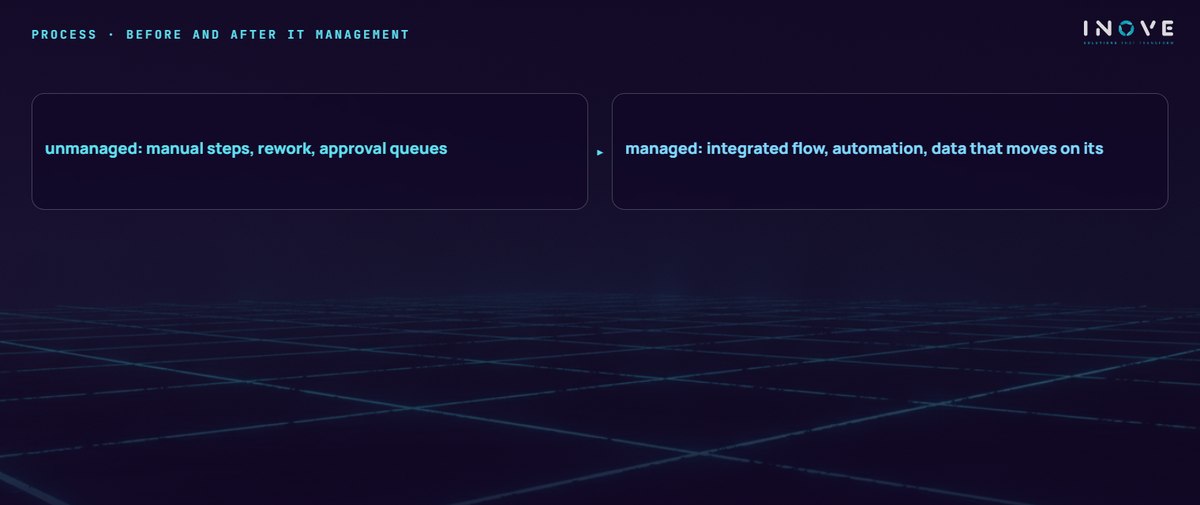
Automation: fewer manual steps
The frontier of cutting red tape has also moved. Digital approval workflows became the baseline; the news is generative AI taking over reading, triage, and drafting tasks — classifying documents, summarizing tickets, preparing drafts. In practice, the best results come from processes that are already organized: automating a mess only produces a faster mess.
Integration: the end of rework
Typing the same data into two systems is the portrait of a bureaucratic process. Good IT management prioritizes integrations — usually via APIs — so information flows on its own between ERP, CRM, and departmental tools. In SAP environments, well-built integration is what separates an ERP that helps from an ERP that gets in the way; it is one of the focuses of our SAP practices.
Decisions: data instead of opinion
Finally, managed processes generate data — and reliable data changes the quality of decisions. Near-real-time operational indicators replace the monthly report assembled by hand.
IT management and hybrid work
There is also a chapter that has become permanent: hybrid work. Processes that used to live at the office now stretch across homes, branches, and phones. IT management therefore needs to guarantee secure access from anywhere, fluid collaboration, and the same process discipline inside and outside the corporate network.
That is not just tooling: it is access policy, well-managed identity, and security designed for a perimeter that no longer exists. Companies that treated hybrid work as improvisation accumulated risk; those that treated it as a process gained flexibility without losing control.
The signs of immature IT management
- The team is always firefighting and improvement projects never start.
- Every department keeps its own side spreadsheet because “the system doesn’t help.”
- No one can say what IT costs or what it delivered this quarter.
- Approvals and registrations depend on email, paper, or one specific person.
Where to start structuring
- Map the critical processes — which flows, if they stop, stop the company?
- Measure the pain — then chart where there are manual steps, waiting, and rework.
- Prioritize by impact — attack first what unlocks revenue or reduces risk.
- Establish a management routine — indicators, meetings with business areas, and quarterly reviews.
- Bring in reinforcements where hands are short — finally, a specialized partner covers the fronts the in-house team cannot reach, with a defined SLA.
In short, IT management is the silent engine of organizational processes. When it works, no one notices — orders flow, approvals move, data arrives. And it is precisely that invisibility that frees the company to grow.