



Strategic IT: how technology drives the business
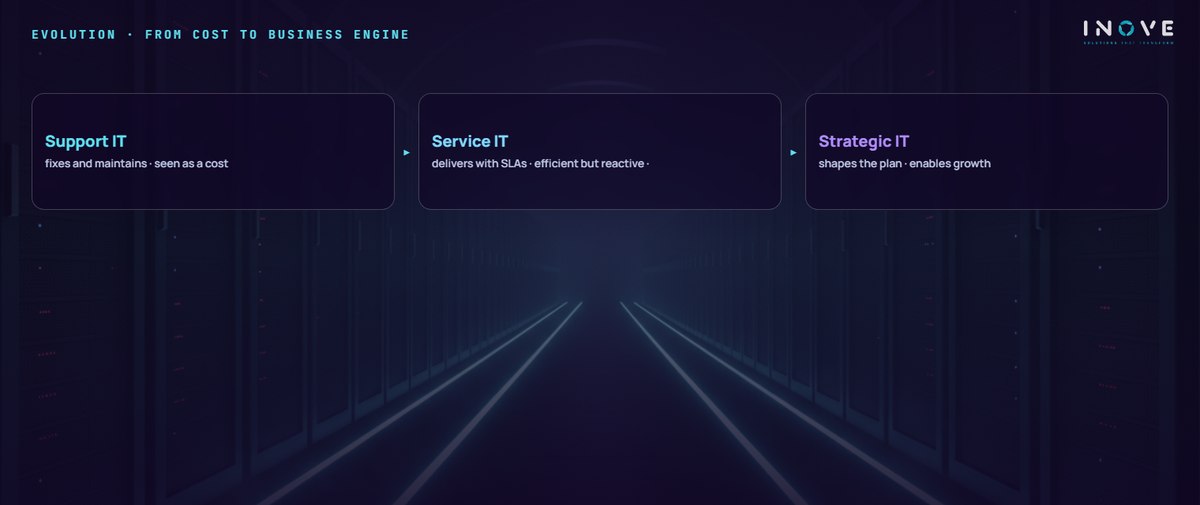
For decades, IT was treated as a cost: a support area that fixed computers and kept systems running. That view is dead. Today, strategic IT takes part in company planning, enables new business models, and in practice defines who competes and who watches. The question is no longer “how much does IT cost” but “how much does the business grow because of it.”
In this article, we show what characterizes strategic IT in 2026, why the transition from support to protagonist has become a matter of survival, and how to structure that shift in your organization.
From support to protagonist: what changed
Digital transformation stopped being a project and became a permanent state. Sales, logistics, customer service, finance: there is no longer a relevant process that does not run through a system. It is therefore impossible to separate the business plan from technology decisions — choosing an ERP, a data architecture, or a cloud model is choosing what the company will be able to do in the coming years.
On top of that, the current wave of generative AI has raised the stakes. AI assistants already write, analyze, and automate tasks across every department. Companies with organized data and mature integration capture that gain quickly; companies with support-mode IT watch from the sidelines. The difference between the two groups is not the tool — it is the foundation IT built beforehand.
The five traits of strategic IT
- A seat at the strategy table — IT leadership takes part in business planning instead of receiving a finished plan to “make feasible.”
- Business indicators — what gets measured is revenue enabled, time to launch, and risk avoided, not just server availability.
- An architecture that allows change — systems integrated via APIs and a well-governed cloud foundation, so that each change of business direction does not become a two-year project. That is the design we work on in our cloud practice.
- Data as an asset — reliable, governed information ready for analytics and AI, with LGPD, the Brazilian data-protection law, treated as a foundation.
- An operation that does not consume the team — finally, routine work delegated and automated, so internal energy goes to what differentiates the company.
What blocks the transition (and how to unblock it)
The most common obstacle is not budget — it is bandwidth. A team consumed by operations cannot think strategically. That is why the transition usually starts with the basics done well: stabilize the environment, address root causes, and delegate routine maintenance to a partner with an SLA. Only then is there room for the rest.
The language barrier weighs just as much. IT that talks servers loses the budget battle to those who talk margin. Translating technology into results — “this modernization cuts the closing period by two days” — is a strategic competency as important as the technical one.
In SAP environments, that translation is especially visible: a well-managed ERP is the heart of the operation and the source of the data that feeds strategy. Not by chance, it is where we concentrate our SAP practices.
The role of leadership outside IT
The transition does not depend on the CIO alone. The board needs to change the question it asks of technology: instead of “why does IT cost so much,” ask “what are we failing to gain by underinvesting.” It also needs to accept that business decisions have technical consequences — deadlines that are too tight create technical debt, and technical debt charges interest in incidents and slowness.
Mature companies formalize this: committees where business and technology decide together, an IT budget split between running and growing, and technology goals written into the company’s strategic plan.
Where to start
- Honest assessment — where does the team spend its day today? What is the environment’s real maturity?
- Stabilize and delegate — next, get the routine out of the way: automation and managed support.
- Connect to the business plan — bring IT into strategy discussions with shared goals.
- Build the data and integration foundation — it is what sustains every future initiative, from AI to a new sales channel.
- Measure in business language — finally, show the value in numbers the board recognizes.
In short, strategic IT is not a title — it is an earned position. Organizations that made this transition now have a growth engine in-house; those that did not have an ever more expensive cost center. Company performance, more and more, is the performance of its technology.