



Big Data in Pharmaceutical Companies: Data to Decision

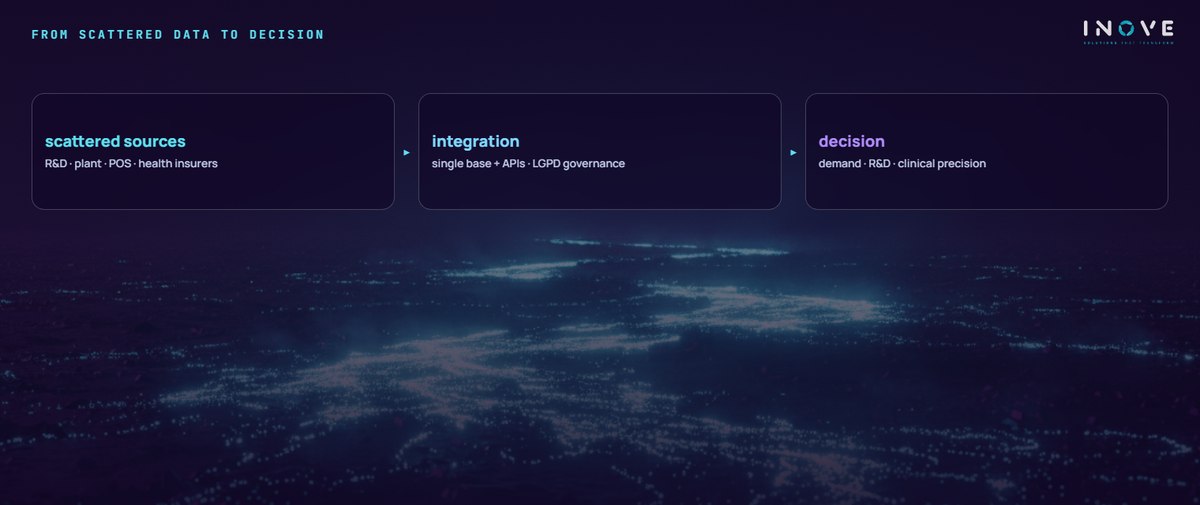
Few industries produce as much data as pharmaceuticals. Research and development, clinical trials, manufacturing, distribution, the point of sale, health insurers: every link in the chain generates information around the clock. Even so, big data in pharmaceutical companies still runs into an old problem — the data exists, but it lives in systems that do not talk to each other.
That is why, in 2026, the industry’s challenge is not collecting more data. It is integrating it, governing it, and turning it into decisions — from which molecule to research to how much to produce for the next flu season. In this article, we show where the value lies and why integration comes before any analysis.
Why pharma is a special case
First, the chain is long: the manufacturer rarely sees the end consumer. Between it and the patient sit distributors, pharmacies, and health insurers — each with their own systems and their own data. On top of that, almost everything in circulation is sensitive health data, the most protected category under the LGPD, the Brazilian data-protection law. In other words, the industry needs to integrate more than others do and, at the same time, more carefully than others do.
As a result, many companies hold enormous volumes of information they cannot use. Not for lack of tools, but for lack of architecture: duplicated master data, fragile integrations, and no single source of truth.
Where big data creates value in the industry
- R&D and clinical trials. Developing a new drug costs billions and takes years. Data analytics shortens the path: it selects participants by fine-grained criteria, simulates scenarios before the trial, and detects side effects early. In addition, generative AI already summarizes scientific literature and protocols in minutes.
- Demand forecasting and seasonality. Cross-referencing sales history, weather, and epidemiological data makes it possible to adjust production before the peak — and to avoid both the drug missing from the pharmacy and inventory expiring in the warehouse.
- Precision medicine. Combining sources reveals patterns linking patient profile, drug usage, and clinical outcomes. Treatment becomes more targeted and hospitalizations drop.
- Sales and trade. Understanding behavior at the point of sale guides campaigns, pricing, and replenishment — with data, not the sales rep’s intuition.
The real bottleneck: integration
Without integration, there is no next step. Artificial intelligence and machine learning depend on organized, accessible data — and that is exactly where most projects stall. In practice, the same problems repeat: legacy systems without APIs, parallel spreadsheets in every department, product master data that differs between plant and distributor.
The answer involves service-oriented architecture, well-designed integration layers, and, quite often, the ERP itself as the backbone. It is engineering work, not tool shopping — the kind we do every day in software development and systems integration.
Governance and security move together with analytics
Beyond the legal basis, the attack surface grows with every integration. A unified clinical-data foundation is valuable to the business — and to the attacker. That is why encryption, access segregation, and continuous monitoring belong to the same data project, not a separate one. Our cybersecurity practice usually steps in at exactly this point: when data starts flowing between systems and partners.
Where to start
- Map the sources — which data exists, where it lives, and who owns each set.
- Define the anchor use case — demand forecasting is usually the fastest return.
- Build the integration layer — with governance and LGPD compliance designed in from the start.
- Evolve into analytics and AI — reliable descriptive analytics first, then predictive.
In short, big data in pharmaceutical companies has gone from differentiator to prerequisite. Whoever integrates first — with governance — makes better decisions across the entire chain: from the lab to the pharmacy shelf.