



The Cost of System Instability on Black Friday
On Black Friday, every minute offline is a sale going to the competitor — who is one tap away. The date remains the second most important for Brazilian e-commerce, behind only Christmas, and packs into a few hours a level of traffic the site never sees the rest of the year. Studies of past editions have already tallied tens of millions of reais lost to slow and crashing sites during the period.
On top of that, the consumer of 2026 no longer tolerates instability. They pay with PIX, Brazil’s instant-payment system, expect confirmation in seconds, and abandon the cart at the first error screen. In this article, we show where the losses from instability come from and what to do — months in advance — so the peak becomes revenue, not an incident.
Where the losses come from
Industry monitoring usually classifies three situations as instability: error pages, waiting queues (the “holding” pages), and the timeout — when the site simply never finishes loading. In monitored editions, nearly half of the major stores went down at some point during the promotional period.
The math is direct: take your e-commerce revenue per minute at the peak and multiply it by the downtime. Then add the invisible cost — the customer who went back to buying from the competitor, and the paid media that drove traffic to an error page. In other words, a few minutes of downtime pays for months of preparation, with room to spare.
How to avoid instability on Black Friday
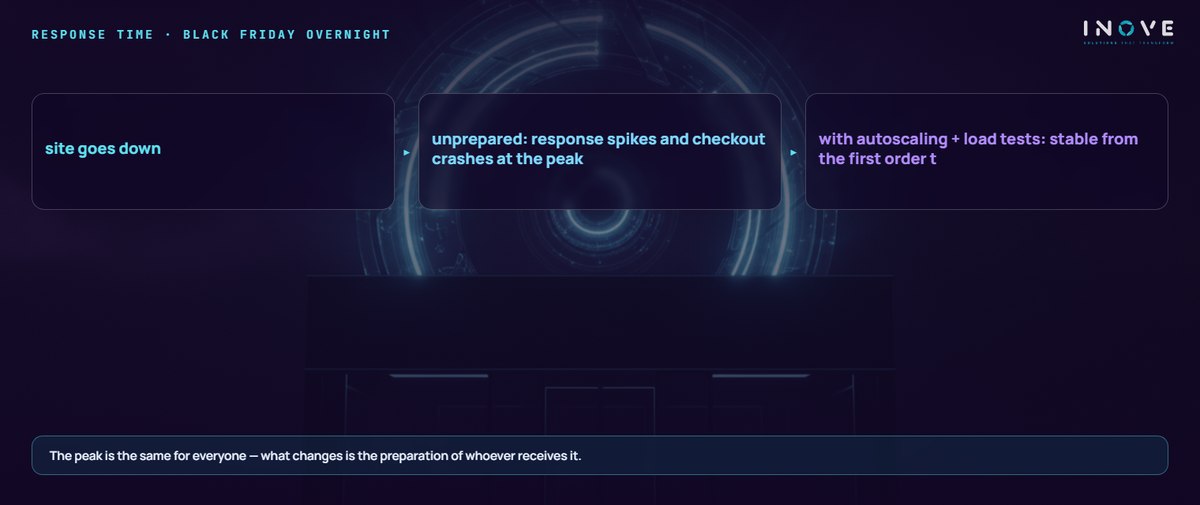
The main investment is in scalability. In practice, this means a cloud architecture with autoscaling and containers, able to multiply capacity during peak hours and give it back afterwards — paying only for what is used, with FinOps finding the balance between cost and headroom. It is the model we cover in our cloud practice.
Beyond that, three practices separate those who get through the peak from those who make the news:
- Continuous load testing — not one test on the eve, but simulations throughout the year, with realistic concurrent-user scenarios, including checkout and PIX payment confirmation.
- Observability — correlated logs, metrics, and traces reveal the bottleneck before the customer feels it. Without them, diagnosing mid-peak is guesswork.
- Rehearsed contingency plans — a dignified waiting queue, a static emergency page, and fallback routes for payment. Rehearsed, not just documented.
Likewise, distribute the load before it reaches the server: a CDN for static content, aggressive caching on storefront pages, and edge processing shorten the path to the customer. Our infrastructure practice treats this design as part of the same project — because, at the peak, every request that never reaches the backend is spare capacity for the checkout.
The technologies that hold the peak
- Demand forecasting — models that combine the history of previous editions and project the expected volume. That number becomes the load-test scenario.
- AI in operations — assistants that triage tickets and summarize incidents during the peak, freeing the team for whatever is blocking the sale.
- Integrated data — reliable analytics to decide promotions and inventory based on reality, not hunches.
Think time: test like a human, not like a robot
“Think time” is the time a real user takes between actions — looking at the product, deciding, filling in the card. Tests that ignore this rhythm create unrealistic scenarios: they either oversize the infrastructure (wasted cost) or undersize it (a crash at the peak). So calibrate the simulations with human behavior across login, search, cart, and payment.
In short, the losses from instability on Black Friday are avoidable — but not in November. Preparation starts months earlier, with scalable architecture, honest testing, and full visibility of the operation. Whoever arrives at the peak prepared turns the date into the best day of the year; whoever does not, finances the competitor.