



Edge computing: what it is and where it pays off

The conversation about edge computing has moved to a new level. It has stopped being a lab bet: today it runs in factories, stores, and distribution centers, processing data where it is born. So the question that matters is no longer “what is it” but “where is it worth it in my operation.”
In this article, we explain the concept without jargon, show the use cases that have matured, and help you decide what to process at the edge and what to keep in the cloud — because the right answer is almost always a combination of the two.
The concept, without jargon
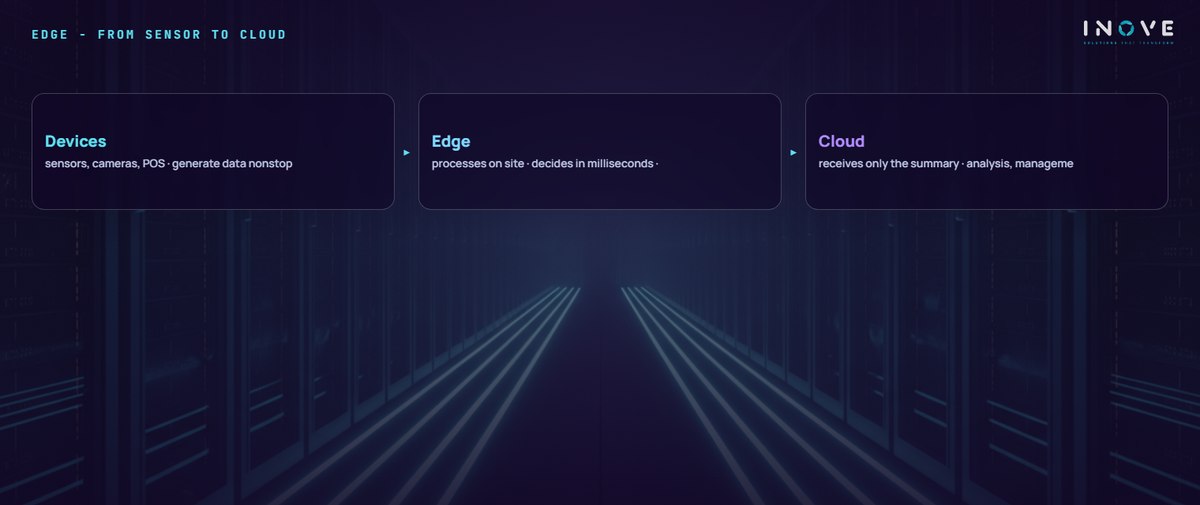
In the centralized model, every piece of data travels to a data center or cloud, gets processed, and comes back. In edge computing, part of that processing happens on site — in a gateway, a factory server, the store’s POS terminal. In other words: sensors, cameras, and machines generate and consume information right there, and the network carries only what needs to go further.
It is also worth clearing up a common confusion: 5G does not replace the edge. It delivers high bandwidth and low latency on the network segment, but it does not eliminate the distance to the remote server — nor the dependence on the link. In practice, 5G and edge combine: one shortens the path, the other eliminates the trip.
Why the edge grew: AI close to the data
The decisive push came from artificial intelligence. Computer-vision and anomaly-detection models now run on compact local equipment — inspecting product on the line, counting foot traffic in the store, watching machine vibration. The image no longer needs to go up to the cloud with every frame.
As a result, traffic costs and response times drop — and control over personal data improves, a sensitive point now that LGPD, the Brazilian data-protection law, is mature: camera footage can be processed and discarded on site, with only the anonymized event going up.
Where edge computing is worth it
- Manufacturing — image-based quality control, predictive maintenance, and automation that cannot wait for the cloud to respond. It is the most mature use case, and one of the focuses of our work with technology for manufacturing.
- Retail — a POS that keeps selling with the link down, camera-based queue and shelf management, dynamic in-store pricing.
- Logistics and agribusiness — fleet and field telemetry in areas with poor connectivity: the edge collects, decides, and syncs when the network comes back.
- Healthcare and critical services — finally, everything involving real-time response and sensitive data that should not travel unnecessarily.
The common thread is the same: latency, autonomy, and volume. If the decision must be immediate, if the operation cannot stop with the internet down, or if the volume of raw data would make traffic too expensive — there is a case for the edge.
Edge and cloud: complement, not competition
Meanwhile, the cloud remains irreplaceable in its role: consolidating history, training AI models, running enterprise systems, and providing centralized management of the whole. The winning architecture is hybrid: the edge decides fast on site; the cloud sees the whole and learns. It is the design we work on in our cloud practice — with the edge as an extension, not an exception.
Where to start
- Identify the concrete pain — outages when the link drops? Slow response? Traffic costs? Edge for fashion’s sake does not pay off.
- Start with a pilot — next, one site, one use case, results measured in weeks.
- Standardize remote management — dozens of edge points without centralized management become an operational nightmare.
- Scale with governance — finally, replicate the validated pattern, with security and monitoring from the start.
In short, edge computing has matured and found its place: close to the data, complementing the cloud. For most companies, the question is not whether to adopt it — it is identifying the two or three points in the operation where processing on site changes the outcome, and starting there.