



How to Increase the Security of Your Customers’ Data
Customer data is an asset and a liability at the same time. Well protected, it supports sales, service and decisions. Leaked, it turns into fines, lawsuits, extortion and headlines — and the damage does not end on the day of the incident, because stolen information feeds scams for years. That is why data security has stopped being an IT-only topic and moved firmly onto the board’s agenda.
In this article, we organize the path into ten practical fronts: from initial mapping to incident response. This is not theory — it is the playbook we apply, at Inove, in companies that handle sensitive data every day, under a mature LGPD (the Brazilian data-protection law) with genuine enforcement by the ANPD, the national authority.
Why customer data became a priority target
The cost of a breach remains in the millions and the curve has not reversed. Furthermore, leaked data has a long life in the wrong hands: it feeds far more convincing phishing — now written by generative AI, in the right tone, flawlessly worded — plus financial fraud and social-engineering scams against the data subjects themselves.
Meanwhile, the most common vectors keep repeating: ransomware with double extortion (encrypting and copying the data, with a threat of publication), identity theft via infostealers that capture passwords and session cookies, and the supply chain — one compromised vendor hits the entire customer base at once.
Know and classify before you protect
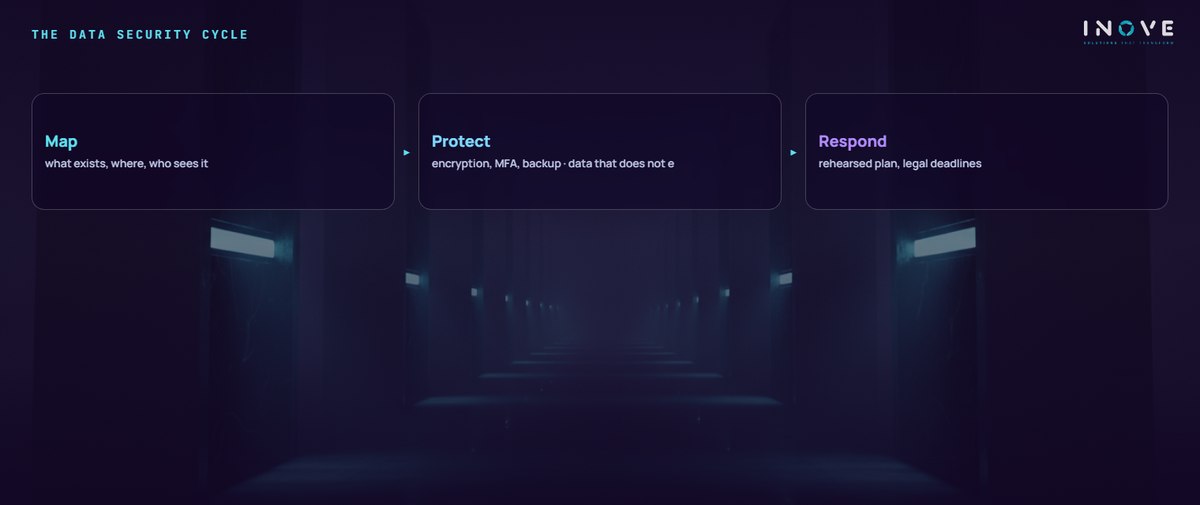
1) Map what you collect. Everything else depends on this step. Classify by sensitivity: public data (announcements), internal (budgets, processes), confidential (personal, financial, health data) and restricted (passwords, API keys, intellectual property). This map also supports the processing records the LGPD requires.
2) Collect only what is necessary and limit access. Data that does not exist cannot leak. Of what does exist, each team accesses only what it needs — IAM tools manage permissions, and privileged access deserves frequent review.
3) Audit constantly. Processes change, people come and go, vendors rotate. Periodic review keeps the map alive and the access honest.
The technical controls you cannot skip
4) Encryption as the rule — at rest and in transit, with keys stored outside the same environment. Done well, it makes leaked data lose its value even when there is a breach.
5) The right technologies in the right places — email filtering against phishing, EDR on endpoints and, above all, phishing-resistant MFA with passkeys or FIDO2 keys. SMS codes do not withstand today’s attack kits.
6) Immutable, tested backup — isolated from the network and restored periodically. Remember, though: with double extortion, backup fixes the downtime, not the leak.
7) Everything up to date — prioritize patches on what is internet-exposed and stay on supported versions. Unpatched systems remain among the most-used entry doors.
People, transparency and the trial by fire
8) Train the team for the current threat — including voice and video deepfakes in approval requests, and the duty to report suspicious messages. The best filter fails if the person does not know what to do in the very next second.
9) A transparent data policy — customers, employees and partners need to know what is collected, why, and how to exercise the rights the LGPD grants them. Transparency before the incident buys credibility during it.
10) Test everything, including the plan — regular security testing of your own and third-party systems, plus incident-response simulations with the notification deadlines for the authority and the data subjects. A script that was never rehearsed does not work under pressure.
In short, protecting customer data is a continuous process, not a project with an end date. Attack patterns change, systems evolve and the regulatory bar keeps rising. Companies that work through the ten fronts above — with an internal team backed by specialists, as we do in our cybersecurity practice and in IT support — turn the obligation into an advantage: customers trust more those who prove they care.