



Inventory Management: The Main Mistakes and How to Avoid Them
Inventory management is retail’s financial heart. Idle product is working capital locked up; an empty shelf is a lost sale — and, in the omnichannel world of 2026, it is a sale lost in every channel at once. When the website promises an item the store does not have, the damage comes twice: the margin disappears and so does the customer’s trust.
In this article we detail the most common mistakes that sabotage inventory. We also show how technology — from an integrated ERP to AI-powered demand forecasting — solves each one in practice.
The 3 mistakes that hurt inventory management the most
1. Too many manual processes
Spreadsheets, paper, and eyeball checks still hold up plenty of inventories out there. The result is familiar: slowness, rework, and human error piling up with every movement. Besides, the manual process does not scale — what works with one store breaks with three, and collapses on Black Friday.
2. Outdated stock counts
If the system balance does not match the shelf, every decision built on it is born wrong. You buy what you already have and run out of what sells. That is why every change in a product’s status — receiving, sale, exchange, return, damage — needs to enter the system the moment it happens, not at month-end close.
3. Decentralized information
Inventory in one system, purchasing in another, e-commerce in a third. Without a single foundation, the classic symptoms appear: products registered in duplicate, perishables expiring, supplier lead times blown, and nobody holding the right number. As a result, decisions go back to guesswork.
The role of technology in overcoming these mistakes
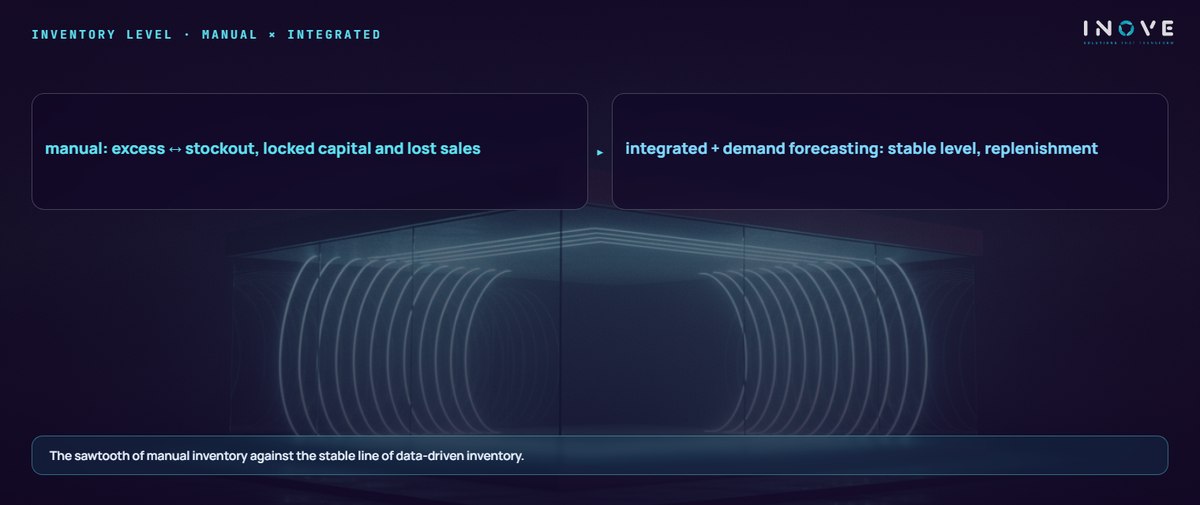
The answer to all three problems is the same: put the operation on an integrated management system. The ERP centralizes master data, movements, purchasing, and finance on a single foundation — and every barcode scan updates the balance in real time, for the store and for the e-commerce channel.
On top of that foundation come the layers that change the game:
- Demand forecasting — models that combine history, seasonality, and the promotional calendar to suggest each item’s reorder point. AI has made this accessible to operations of every size.
- Continuous stock counting — cycle counts supported by scanners and labels, instead of the annual count that stops the store.
- Automatic alerts — approaching expiry, abnormal turnover, divergence between channels. The system warns before it becomes a loss.
Integrated inventory is also the prerequisite for omnichannel. Buy-online-pick-up-in-store, delivery from the nearest store, and exchanges in any channel only work if every point sees the same balance, in the same second. On peak dates like Black Friday, that synchronization is tested to the limit — and a system that lags on updates sells the same item twice or fails to sell what it has.
3 direct benefits of computerized inventory management
- Less risk — accurate records reduce losses, waste, and balance-sheet surprises. Predictability even improves supplier negotiations.
- More efficient processes — purchasing, sales, and customer service start working with the same number. On-time delivery and less “let me check if we have it”.
- More competitiveness — with working capital freed from excess stock, there is room for pricing, assortment, and investment. On tight margins, that decides the game.
Where to start
First, get the house in order: a single product master, standardized inbound and outbound processes, and a reliable stock count. Then integrate — ERP, POS, and e-commerce on the same foundation. Only then does it make sense to switch on forecasting intelligence, because no model gets it right on top of wrong data.
Consider specialized support as well. Inove implements and maintains management systems for retail — including SAP environments — taking care of integration, infrastructure, and continuous operation.
In short, inventory mistakes are expensive precisely because they are silent. Eliminate the manual process, unify the information, and let the data drive replenishment. Inventory stops being a risk and becomes the operation’s edge.