



Why IT architecture matters in the pharmaceutical industry
The pharmaceutical industry is one of the most regulated environments on the planet — and one of the most technology-dependent. From research to the point of sale, every batch must be traceable, every trial data point must be intact, and every system must prove it does what it claims. In this scenario, IT architecture stops being an internal technology matter and becomes a condition for innovating without stepping out of compliance.
In this article, we explain what IT architecture means in the pharmaceutical context, which challenges it has to solve, and where the industry is heading — with AI in daily operations, consolidated cloud, and end-to-end traceability.
What IT architecture means in the pharmaceutical sector
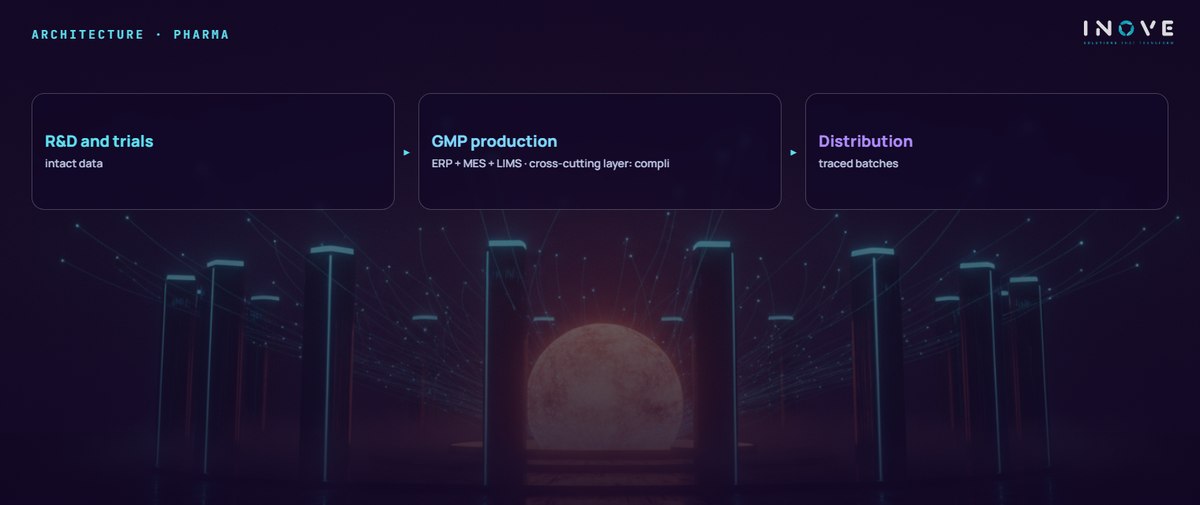
It is the structure of systems, applications, networks, and data that supports the entire operation: research and development, clinical trials, manufacturing, supply chain, distribution, and pharmacovigilance. A well-designed architecture streamlines processes, cuts cost, and — above all — safeguards the quality and safety of what reaches the patient.
In practice, the heart of that architecture is usually the ERP integrated with the shop floor (MES), the laboratory (LIMS), and the logistics chain. Most Brazilian pharmaceutical companies run this core on SAP — territory we know well through our SAP practice.
The challenges the architecture has to solve
- Regulatory compliance — Anvisa (Brazil’s health-regulatory agency), the FDA, and the EMA demand traceability, data integrity, and good manufacturing practices (GMP). Validated systems and audit trails are not optional.
- Data volume — clinical trials, lab tests, and production sensors generate data at an exponential pace. The architecture must store, protect, and analyze all of it efficiently.
- System integration — R&D, production, quality, and logistics use different tools. Without integration, data fragments and compliance turns into manual rework.
- Security and LGPD — under the LGPD, Brazil’s data-protection law, health data is sensitive data. A breach here costs fines, reputation, and, ultimately, patient trust.
What a good architecture gives back to the business
Agility with compliance. When systems are integrated and data is born traceable, launching a product or meeting a regulatory demand stops being a heroic project. The audit finds the answer in the system, not in paper folders.
Operational efficiency. Integration eliminates re-keying, reduces human error, and shortens the cycle between production and batch release. The cost of keeping isolated systems — licenses, support, and improvised interfaces — also drops visibly.
Data-driven decisions. With an organized foundation, advanced analytics and AI come in naturally: demand forecasting, raw-material inventory optimization, and real-time monitoring of quality deviations.
Where the industry is heading
Three movements define the agenda from 2026 onward. First, generative AI applied to real routines: triaging quality deviations, supporting regulatory documentation, and analyzing pharmacovigilance data — always with documented human review. Second, the consolidation of the cloud as the default platform, including for validated workloads, which demands cost discipline and compliance discipline at the same time. Third, end-to-end traceability of the chain, with drug serialization fighting counterfeiting and providing visibility from the lab to the pharmacy.
None of it stands, however, without the basics: segregated development and production environments, rigorous access management, and a tested continuity plan. A good architecture is the one that handles an audit and a middle-of-the-night incident with the same composure.
Where to start
- Map the current architecture — systems, integrations, critical data, and single points of failure.
- Prioritize by risk — then, whatever threatens compliance or continuity comes first.
- Build an integrated roadmap — core modernization, cloud, and security moving in the same plan, not in isolated projects.
- Keep continuous governance — finally, architecture is not a snapshot, it is a motion picture: every new system joins by following the standard.
In the pharmaceutical industry, IT architecture is the foundation that decides whether innovation accelerates or stalls. It is the kind of groundwork we regularly build for regulated manufacturers: it starts organized on paper, proves itself in the audit, and shows up in the results.