



IT assessment: focus your team on high-value work

Every IT team says it wants to work on strategy. Few manage to. The day gets swallowed by tickets, fixes, and emergencies — and what truly generates value is left for “when there’s time.” The way to flip that game starts with an IT assessment: an honest snapshot of the environment that shows where the team spends its energy and where it should.
In this article, we show how an assessment run by people who operate environments every day works, what it evaluates, and how to use the results to focus the team on high-value actions.
Why the assessment is the starting point
In practice, the agenda of IT leaders has been the same for years: modernize the architecture, digitize the experience, scale data and AI, rethink how services are delivered. What blocks that agenda is rarely tooling — it is management: lack of visibility, accumulated technical debt, and a team consumed by operations.
Many companies also still carry the rushed decisions of the forced digitization of recent years: cloud contracted without governance, improvised integrations, patched-up security. That technical debt does not show up in the budget — it shows up in the team’s time. That is why an external, structured look finds what the internal routine has already normalized.
What a good assessment evaluates
- Infrastructure and cloud — capacity, obsolescence, cost per environment, and optimization opportunities (the FinOps lens).
- Security and resilience — exposure to attack, maturity of controls, tested backups, and a real recovery plan. With ransomware a daily reality and LGPD (the Brazilian data-protection law) actively enforced, this front is usually the most urgent item in the report — it is where our cybersecurity practice comes in.
- Systems and integrations — health of the ERP and critical applications, fragile integrations, versions out of support.
- Data — quality, governance, and readiness for analytics and generative AI.
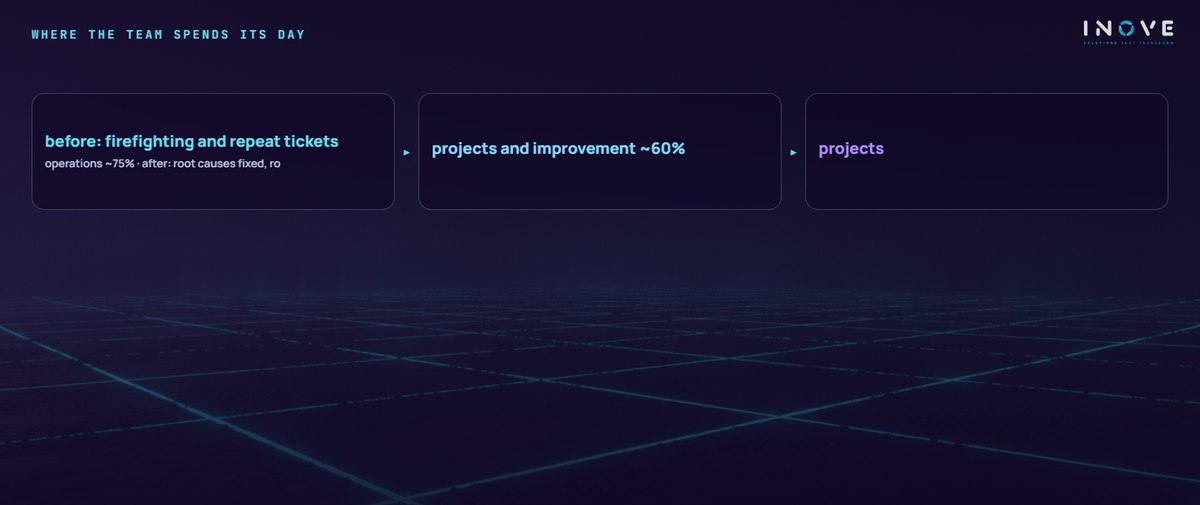
- Operations and tickets — finally, the most revealing: where does the team’s time go? Which incidents keep repeating because the root cause was never addressed?
How the assessment works in practice
A well-run assessment combines three sources. First, data from the environment itself: monitoring, ticket history, cloud invoices, asset inventory. Then, interviews with the team and with business areas — because the technical bottleneck and the user’s pain do not always coincide. Finally, comparison against market best practices, which provides the maturity yardstick.
The typical timeline is a few weeks, not months. And the deliverable is not a hundred-page report: it is a prioritized list of findings, each with impact, effort, and a clear recommendation. An assessment that does not fit into a board meeting does not guide decisions.
From snapshot to plan: how to prioritize
The assessment is only worth what comes after it. The results need to become a plan prioritized by two simple criteria: business impact and execution effort. In general, the plan takes shape in three waves:
- Stop the bleeding — critical risks first: backups that do not restore, systems out of support, known security gaps.
- Free up time — next, address the root causes of repeat tickets and automate the routine. Every incident that stops coming back returns hours to the team every week.
- Build value — finally, with the team breathing again: reliable data, AI applied to processes, modernization of whatever is holding back growth.
Likewise, the assessment reveals what the in-house team should not be doing. Routine maintenance, monitoring, and first-level service are strong candidates for a partner with an SLA — that is the role of managed IT support, which gives the internal team back to its projects.
Signs that the time is now
- The same incidents come back every month and no one has time to investigate why.
- The IT budget grows, but the business areas’ perception of value does not keep pace.
- Strategic projects — data, AI, modernization — have been stalled for more than two quarters.
- No one can answer with confidence: “if we are attacked today, how long until we are back?”
In short, no team focuses on high value through willpower alone — it focuses because the environment allows it. The IT assessment is the first step: it turns the feeling of overload into a concrete map of causes and priorities. From there, every hour freed from operations becomes an hour invested in what makes the company grow.