



IT outsourcing: 5 reasons to count on it

Keeping a complete IT operation in-house has become expensive — and, for most companies, unnecessary. IT outsourcing is growing for exactly that reason: technology plays an increasingly strategic role, but not every company needs (or manages) to build and retain an internal team for every discipline, from infrastructure to security.
In practice, outsourcing is a partnership: a specialized company takes over infrastructure management, user support, licensing, and the evolution of the environment — with an SLA in the contract. In this article, we present the 5 reasons that make IT outsourcing worthwhile, and what to look for when choosing the partner.
1. More focus on the core business
Every hour a manager spends putting out IT fires is an hour that does not go to customers, product, or expansion. With the operation in a partner’s hands, leadership goes back to looking at where the company truly competes. IT also stops being the crisis item in meetings and becomes a strategy item — which is where it belongs.
2. Predictable cost, not just lower cost
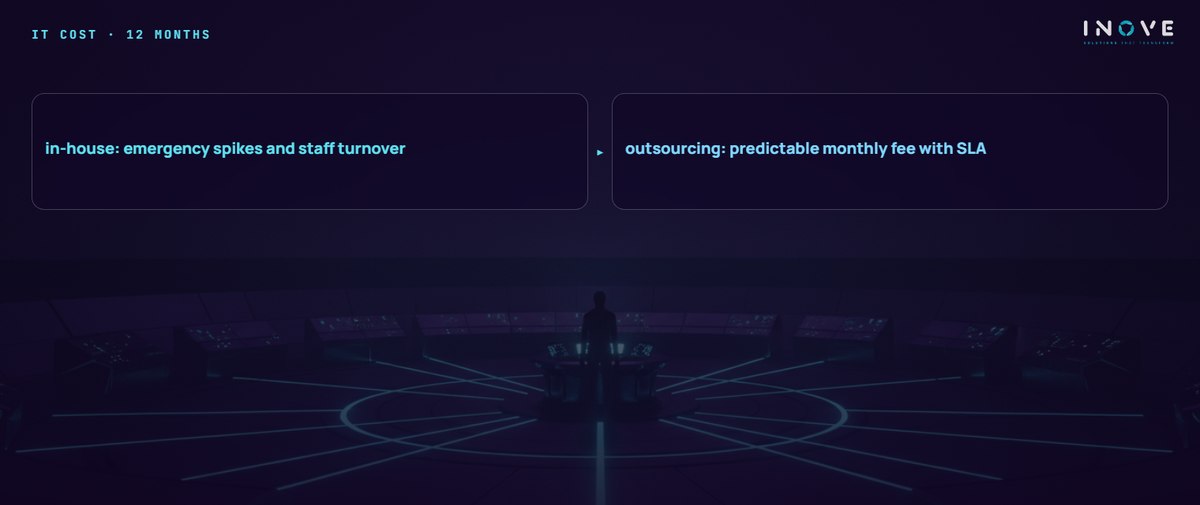
Building your own structure demands heavy investment in equipment, tools, and people — and purchasing mistakes are expensive: millions invested in solutions that do not meet the real need. Outsourcing trades that risk for a predictable monthly fee, with the partner accountable for keeping the environment up to date.
Likewise, the cost that weighs the most rarely shows up in the spreadsheet: the cost of downtime. A professional operation, with monitoring and prevention, reduces outages — and an outage avoided is the most valuable savings there is.
3. Flexibility to grow (and for the peaks)
Technology demand is not linear: there is the Black Friday peak, the new project, the acquisition that doubles the number of users. An in-house structure sized for the peak sits idle all year; sized for the average, it breaks at the peak. Outsourcing — especially combined with the cloud — scales up and down as needed, and the company pays for what it uses.
4. Access to talent you don’t need to hire
The IT market lives with a chronic shortage of qualified professionals — and the fight for specialists (security, data, cloud, AI) is even tougher. Hiring, training, and retaining that team is expensive and slow. With outsourcing, the company gains access to a ready-made multidisciplinary team that serves several clients and therefore accumulates experience no isolated internal team can replicate. No recruiting process, no risk of the knowledge walking out the door with a resignation letter.
5. Reinforced information security
Threats have grown more sophisticated — scams and attacks now use AI too — and ransomware keeps taking companies offline. Facing that requires up-to-date tooling, continuous monitoring, and trained people: exactly what a lean internal team cannot keep current. A partner with a structured cybersecurity practice brings layered protection, rehearsed incident response, and compliance with the LGPD — Brazil’s data-protection law, which already operates with real enforcement.
How to choose the right partner
- SLA with numbers — response time, resolution time, and availability, with auditable reporting.
- Clear scope — also, what is in, what is out, and how extras are billed.
- Documented transition — knowledge of the environment must be recorded, not kept in the vendor’s head.
- Experience in your sector — finally, a partner who already serves similar businesses makes fewer mistakes in yours.
IT outsourcing, then, is not giving up on technology — it is making it professional. Our IT support practice was born from that conviction: the client takes care of the business, and we make sure technology is never the reason for a sleepless night.