



Managing Logistics Costs: How Technology Can Help
Logistics has become a storefront. Consumers compare shipping before price, expect real-time tracking, and treat a delay as a broken promise. At the same time, fuel, warehousing, and labor squeeze the margin. That is why managing logistics costs has stopped being a back-office chore: it decides whether the operation is profitable or not.
In this article, we map the main costs in logistics. We also show why managing them well changes the business result and how technology — from integrated systems to telemetry data — turns that control into competitive advantage.
Know the main logistics costs
Logistics costs are all the expenses tied to the flow of materials — from purchase to delivery. The first step is mapping them. In practice, four groups concentrate the bill:
- Warehousing — physical space, handling, insurance, and the deterioration of idle items. Excess inventory is cost sleeping on the shelf.
- Transportation — usually the biggest slice. Freight, fuel, fleet maintenance, or carrier contracts — all sensitive to external factors, such as the price of diesel.
- Losses and damage — damaged product, misplacement, poorly processed returns. It is the most silent cost and one of the most avoidable.
- People and processes — warehouse labor, checks, rework. Manual processes multiply this item without showing up on any invoice.
Why managing these costs well changes the result
First, through decisions: whoever knows the cost per route, per order, and per customer knows where it pays to renegotiate, outsource, or change the transport mode. Without that number, every freight negotiation happens in the dark.
Second, through profitability: in e-commerce, shipping is decisive for conversion — and subsidizing it without control erodes the margin order by order. Likewise, excess inventory locks up working capital that would be better spent on a better-negotiated purchase.
How technology helps manage logistics costs
The starting point is integration. An ERP connected to the warehouse (WMS) and transportation (TMS) systems makes every order carry its real cost — picking, packing, freight — with no parallel spreadsheet. Cost per order stops being an estimate and becomes an auditable number.
On that foundation, the intelligence layers come into play:
- Routing and telemetry — algorithm-optimized routes and real fleet consumption cut the biggest slice of the cost.
- Demand forecasting — AI models size inventory and delivery capacity ahead of peaks like Black Friday, avoiding both emergency freight and an idle warehouse.
- Traceability — sensors and automatic scanning reduce losses and damage, and give the customer the visibility they already expect.
- Cost dashboards — indicators per route, carrier, and SKU, updated daily. The deviation shows up within the week, not at quarter close.
There is also the tax factor. With Brazil’s tax reform in its 2026 test year, consumption taxation starts migrating to the new CBS and IBS taxes — and that affects freight costs, price formation, and distribution networks designed around the old tax logic. Reviewing the logistics strategy with systems ready for the new model avoids discovering, in 2027, that the cheapest route has moved.
Where to start
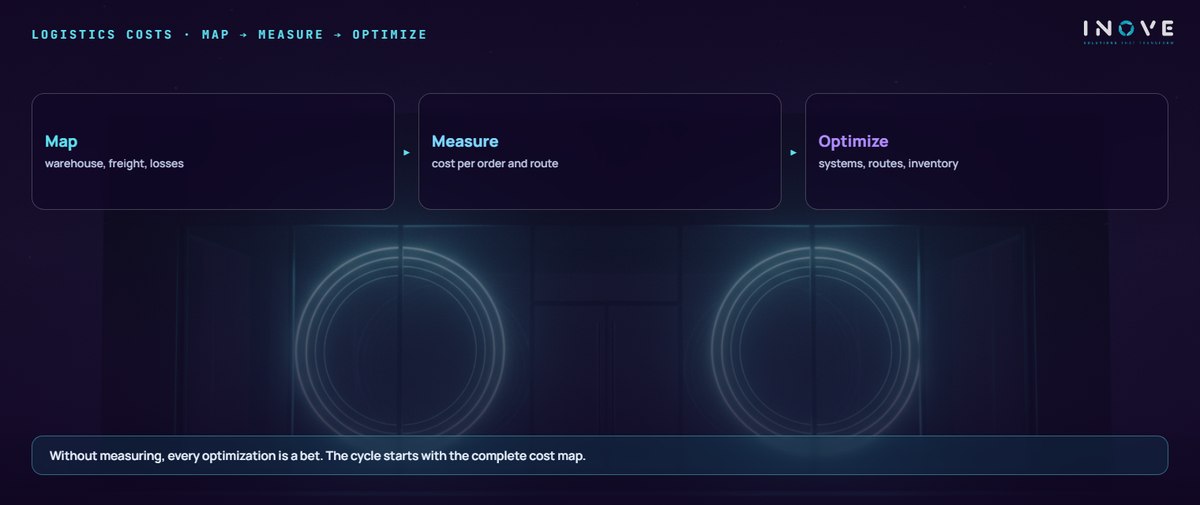
Start by measuring: gather all logistics costs from recent months and calculate the average cost per order. Then integrate the systems so that number updates itself. Only then prioritize the optimizations — usually transportation first, inventory next.
Infrastructure matters too: logistics systems need to be available around the clock, including at the peak. Inove supports this journey end to end — from integrating management systems, including SAP environments, to a cloud sized with FinOps so you do not pay for idle capacity.
In short, managing logistics costs means trading the opaque month-end invoice for a clear number on every order. With reliable data and integrated systems, logistics stops being a cost center and becomes a selling point.