



IT areas: a map of the key functions in 2026
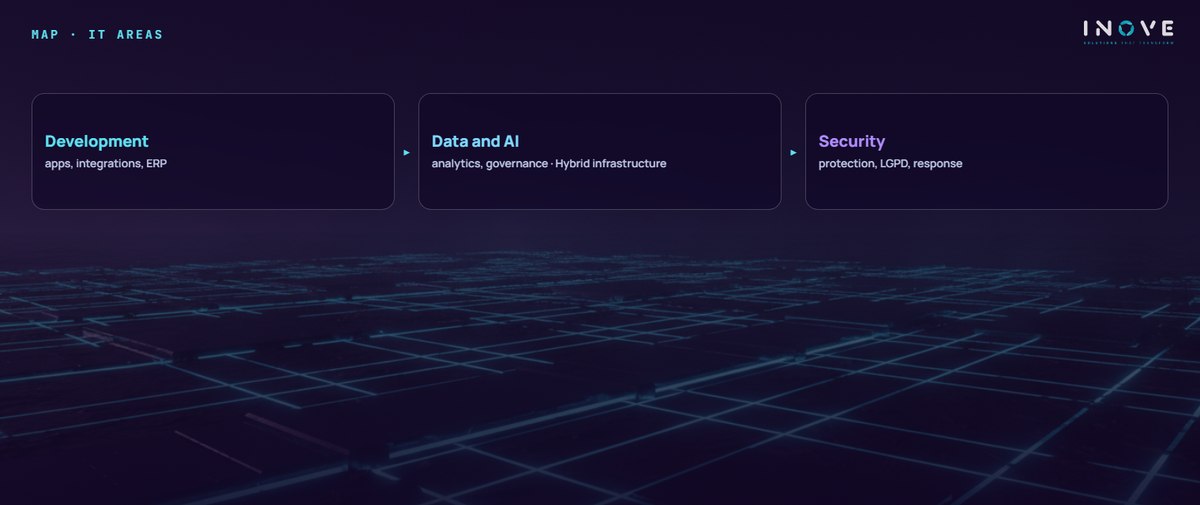
Talking about “IT” as a single thing has become impossible. IT areas have specialized: infrastructure, development, data, security, support, governance — each with its own responsibilities, tools, and profiles. Understanding this map helps managers build the right team, hire the right partner, and demand the right results from each front.
That is why this article presents the main IT areas as they are organized today, in 2026 — including the boundaries that have shifted with cloud, AI, and hybrid work. It is the map we use at Inove to structure technology operations end to end.
Infrastructure: the foundation of everything
The infrastructure area takes care of what sustains the operation: networks, servers, storage, and the bridge to the cloud. Today it is, in most companies, hybrid — some systems run in the public cloud, some on-premises, and the team manages both worlds as one.
Within it live classic specialties that remain essential: networking (connectivity and communication, now including secure remote access for hybrid work), servers and virtualization (increasingly defined by code, not by cable), and backup and recovery — which has gone from bureaucratic routine to a central defense against ransomware. A backup that is not tested is not a backup.
Development and systems: where the business becomes software
The systems development area builds and integrates the applications the business uses — from in-house apps to ERP extensions. Two shifts have marked recent years: API integrations became the fabric that connects everything, and AI assistants entered the developer routine, speeding up code writing and review without replacing engineering.
Close to it sits the management of enterprise systems (ERP, CRM, and the like). In SAP environments, this front has a life of its own: implementation, support, and evolution call for dedicated specialists — the universe of our SAP practices.
Data and AI: the area that guides decisions
The data front has grown from “reports” into a full discipline: data engineering, analytics, and now generative AI applied to the business. In practice, it is responsible for collecting, organizing, and governing information — and for putting AI assistants to work on reliable data, with clear privacy rules.
This is also where LGPD, the Brazilian data-protection law, meets day-to-day operations: knowing which personal data exists, where it lives, and who accesses it is no longer optional.
Security: from supporting role to protagonist
Cybersecurity has become a first-tier area. It defines access policies, monitors threats, responds to incidents, and drives compliance. It also works across the board: validating architectures, reviewing integrations, and training users — because the most attacked link is still the human one, via phishing and social engineering.
Support and governance: who maintains and who steers
IT support is the front line with users: it responds, resolves, and — when mature — addresses the root cause so the problem does not come back. Meanwhile, governance steers the whole: budget, contracts, vendors, risks, and the bridge between IT and company strategy.
Worth highlighting: support is also the best thermometer of IT health. The volume and type of tickets reveal where the structural problems are — and good governance uses exactly that data to prioritize investment.
How to use this map at your company
- List the functions, not the job titles — first, check that each area has a clear owner, in-house or partner.
- Find the orphaned areas — security and governance are the most common discoveries (and the most expensive when they fail).
- Define the interfaces — then agree on how the areas talk to each other: who approves a new integration? Who validates an access request?
- Review annually — finally, the map changes: data and AI, for instance, barely existed as an area a few years ago.
In short, smaller companies do not need a department for every area — they need every function covered. It is common to keep a lean in-house team and delegate entire fronts to specialized partners, with clear SLAs and accountability.
So use this map as a checklist: is any of these areas uncovered in your operation? That is exactly where the next incident — or the next missed opportunity — will show up.