



SAP Support: Stability and Efficiency for Your Landscape
SAP carries the heart of the operation: billing, purchasing, inventory, payroll, tax. When it stumbles, the whole company feels it — shipping stops, approvals never arrive, the closing slips. That is why SAP support is not a line item in a contract: it is the difference between a predictable operation and a routine of scares.
Moreover, the SAP landscape of 2026 is more dynamic than ever. S/4HANA, Fiori apps, cloud integrations, the requirements of Brazil’s tax reform in its test year, and AI assistants entering business processes. Every new piece that comes in is one more thing to keep stable. In this article, we show what mature SAP support delivers — and how to recognize it.
Why SAP demands specialized support
In practice, SAP is an ecosystem, not a system. There is the HANA database, the application layer, Fiori and the Gateway, background jobs, interfaces with banks and government, and the tax layer with its Brazilian particularities. A simple symptom — “the invoice will not print” — can have its cause in any layer, from output control to the spool.
That is why generalist support is not enough. Whoever maintains SAP needs to move between the functional and the technical, know the customer’s environment by name, and know where to look. The right diagnosis beats brute force: the same ticket that consumes days of trial and error is resolved in hours when someone has seen that pattern before.
What mature support delivers
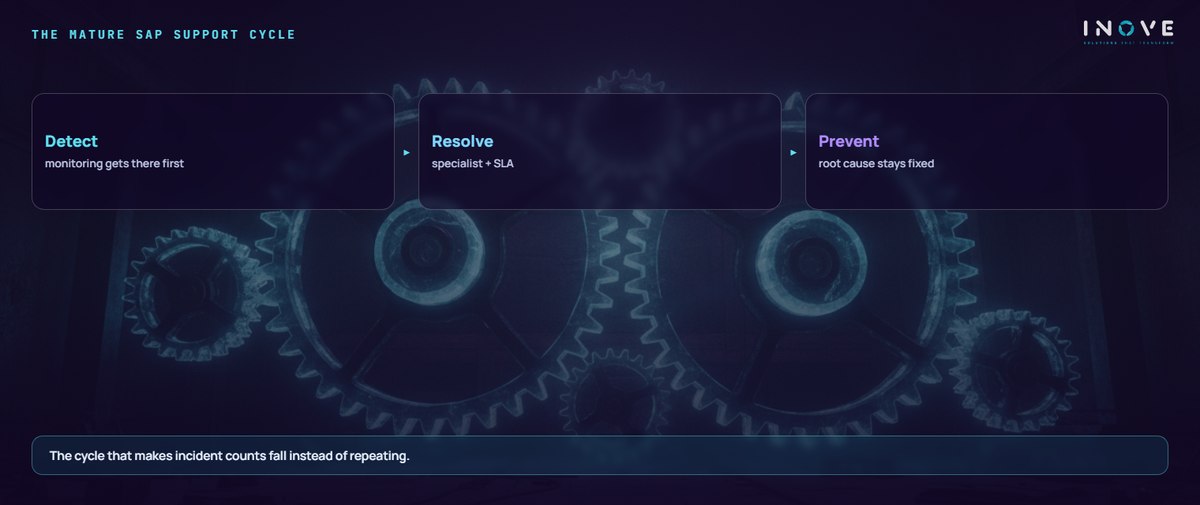
- Resolution with SLAs — response and resolution times agreed in the contract, with clear severity levels. The operation knows what to expect.
- Root cause, not band-aids — the incident that keeps recurring becomes an investigated problem. That is what makes ticket volume drop quarter after quarter.
- Prevention — monitoring of jobs, queues, interfaces, and database growth. Support finds the problem before the user does.
- Continuous evolution — security patches and notes, planned updates, and small improvements that unblock the daily routine.
- Compliance — access controls, audit trails, and attention to LGPD, the Brazilian data-protection law, which now sees real enforcement.
Reactive support vs. strategic managed services
Likewise, it is worth separating two models. Reactive support waits for the ticket; strategic managed services manage the environment. In the first, your internal team keeps carrying the risk and the knowledge lives in the heads of one or two people. In the second, there is governance: metrics, improvement meetings, a backlog prioritized with the business, and documentation that stays with the company.
As a result, strategic managed services change where your team spends its day. Instead of firefighting, it takes part in the projects — the S/4HANA conversion, the adaptation to Brazil’s tax reform, the adoption of AI in business processes. It is the difference between IT that chases and IT that leads.
How to get the most out of your SAP support
- Demand SLAs with teeth — defined severities, deadlines, and penalties; without them, priority becomes a negotiation on every ticket.
- Insist on root cause analysis — every recurring incident deserves an open problem record and a plan to keep it from coming back.
- Ask for monthly metrics — volume, recurrence, SLA compliance, and trends. What is not measured does not improve.
- Secure the documentation — knowledge of the environment belongs to your company, not to the vendor.
- Align with the business — support should know when the closing is, when the harvest is, when Black Friday is. Context changes priority.
In addition, watch for a simple signal in any vendor’s proposal: whoever talks only about hours is selling effort; whoever talks about metrics, root cause, and prevention is selling outcomes. The lowest hourly rate tends to get expensive when the same incident comes back every month.
That is the yardstick behind our support operation and our SAP practices: large-scale environments, service delivered by people who know each system by name, and an obsession with root cause.
To go deeper before signing or renewing, download the guide “AMS: what to demand in an SLA” at the Inove Academy.
In short, SAP stability is not luck — it is method. Whoever treats support as a commodity buys hours; whoever treats it as strategy buys predictability. And in an operation that depends on SAP to invoice, predictability is the cheapest asset there is.