



What are the types of IT support and what is each for?
When people mention IT support, the image that comes to mind is almost always the same: the person who fixes the frozen computer. But the types of IT support go far beyond that — and knowing the differences is what separates a well-designed contract from a bill that only grows. Each modality solves a different problem, and the right combination depends on where each company stands.
Support also remains among the most outsourced services in the corporate world, precisely because it is essential without being the core of the business. In this article, we list the main modalities, what each one covers, and how to choose — now that AI, cloud, and hybrid work have reset the bar for what good service means.
Help desk: the best known — and the L1, L2, and L3 tiers
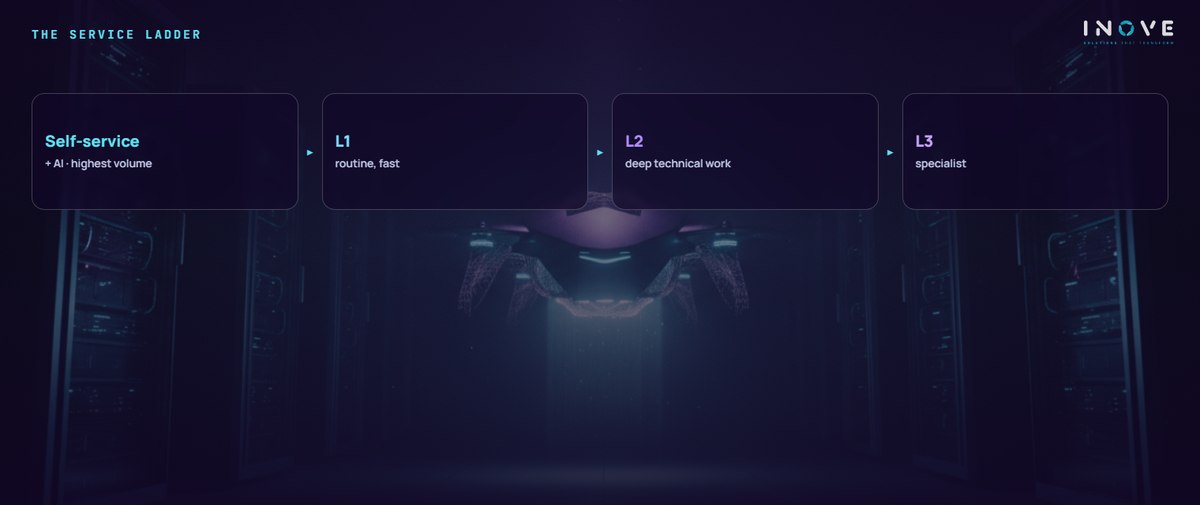
This is direct user service: software that fails, equipment that will not turn on, access that does not work. The market organizes this work in tiers. L1 resolves the routine, low-complexity requests — today with strong help from AI assistants and self-service. L2 takes the technically deeper cases: software, network, or hardware failures. L3 handles what requires a specialist — security, complex networks, critical systems.
In practice, the contract can combine remote service (which resolves most cases) with on-site support (indispensable when the problem is physical). What matters is treating the help desk as customer service, not as a technical favor.
Infrastructure management and managed services
Here the contracted company takes over ongoing management of the environment: servers, network, email, data, devices, and updates. It is the step beyond “fix it when it breaks” — the partner becomes responsible for the health of the environment as a whole, with an SLA in the contract.
This is also where proactive monitoring (NOC) services come in: continuous tracking that detects the anomaly before it becomes an outage. A disk filling up, a certificate expiring, a service degrading — good monitoring turns tomorrow’s incident into today’s adjustment. Our infrastructure practice was born from exactly this logic.
Cloud, backup, and communications
Cloud services — SaaS and cloud infrastructure adoption has become the standard: no local server needed, hybrid work supported, and scale that follows the business. Support here involves sizing, migrating, protecting, and optimizing the environment’s cost.
Backup and recovery — in a world where ransomware is a permanent risk, backup is life insurance. A serious service includes encryption, isolated copies, and — a point many companies forget — periodic restore testing. A backup that has never been restored is a promise, not protection.
Corporate communications (VoIP) — internet telephony integrated with collaboration tools, with more security and control than improvised solutions for handling sensitive information.
Development and application support
When off-the-shelf software falls short, custom development comes in — and with it, application support: fixes, enhancements, and ongoing maintenance of what was built. In larger corporate environments, this modality extends to sustaining entire management systems, known as AMS.
How to choose the right combination
- Classify by criticality — what stops the operation if it fails deserves proactive monitoring; the rest can live with help desk.
- Look at total cost — then, add the cost of downtime, not just the contract price.
- Demand a measurable SLA — response time, resolution time, and availability, with reporting.
- Prefer a partner who integrates — finally, each modality with a different vendor creates gaps; the problem always lands “on the border”.
So the question is not “which type of support should I hire?” but “which combination sustains my business?”. That is the design we do in our IT support practice: different modalities, a single owner — and the entire operation covered, with no overlap and no gaps.