



Plan your IT for Black Friday: zero instability
Planning IT for Black Friday means planning for the busiest day of the year. The date has established itself as the second biggest in Brazilian e-commerce, behind only Christmas — and the consumer of 2026 no longer accepts instability. They expect to browse without freezes, pay with PIX, Brazil’s instant-payment system, in seconds, and get confirmation on the spot. Any friction becomes an abandoned cart.
Historically, consumer complaints on the date split across three fronts: technology (slowness and crashes), customer service, and payment. All three run through IT. In this article we organize the essential precautions — from infrastructure to security — so the site withstands the peak and converts every visit.
Infrastructure: scale before the traffic arrives
On Black Friday the site receives traffic far above the yearly average. Containers and cloud autoscaling are the standard for keeping up with that demand: capacity grows during peak hours and shrinks afterwards. FinOps sizes that elasticity without blowing the budget — headroom for the peak, without paying for idle capacity in December. It is the approach we apply in our cloud projects.
Scaling on paper is not enough, though: validate that the architecture actually scales under pressure, including the database, search, and third-party integrations.
Test before the customer does
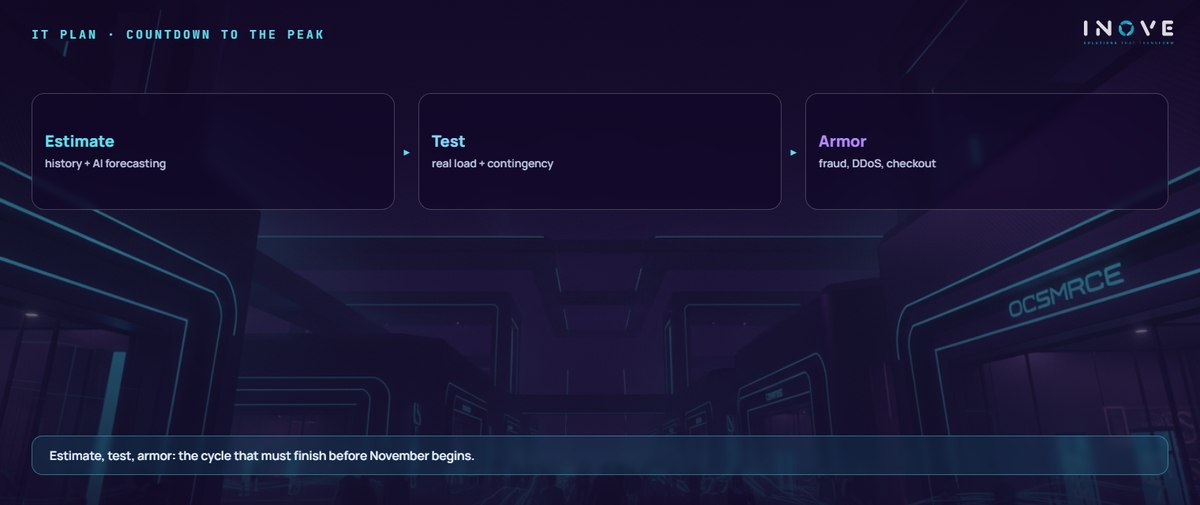
Continuous load testing shows how the site reacts to heavy traffic — and cloud tools eliminate buying hardware just for the peak. In the simulations, include payment methods and logistics, which tend to be the forgotten links. In addition, observability correlates logs, metrics, and traces and points to the bottleneck before the customer finds it. Then rehearse the contingency plans: a dignified queue, an emergency page, an alternative payment route.
And test against real numbers. With the history of previous editions, build pessimistic, realistic, and optimistic projections of concurrent users. AI forecasting models refine these scenarios — and the test starts measuring the system’s true limit.
Security: fraud has its own Black Friday
Fraud attempts grow along with sales volume, edition after edition. Denial-of-service attacks and data theft intensify on the date. That is why zero trust has become the baseline: verified identity, least privilege, and network segmentation. Add machine-learning anti-fraud scoring the risk of every order in real time and DDoS protection at the edge. Our cybersecurity practice treats this preparation as part of the peak plan, not a separate project.
Also guide the consumer: fake emails with coupons and order confirmations do not depend on your site to exist. Communicate which channels your brand actually uses.
From payment to after-sales
- Checkout under pressure — PIX, cards, digital wallets, and bank slips coexist in Brazilian payments. The checkout needs to sustain thousands of transactions without delay, from authorization to confirmation — and reconciliation has to keep up.
- Responsiveness — the purchase happens on the smartphone. Speed, stability, and security have to be the same on every screen.
- After-sales at the ready — tracking, exchanges, and customer service sized for the volume. The Black Friday experience decides whether the customer comes back at Christmas.
On the day: war room and post-mortem
For peak day, set up the war room: an on-call team with defined roles, monitoring dashboards in plain sight, and a direct line to the payment gateway, the cloud provider, and logistics. Contingency decisions need an owner and criteria agreed in advance — in the heat of the peak you do not debate, you execute.
After the date, run an honest post-mortem: what degraded, at what volume, which contingency was triggered. That learning is the cheapest input for next year’s planning.
In short, planning IT for Black Friday is a months-long project, not an eve-of-battle task force. Estimate with data, test honestly, and armor the payment path. Do that, and the peak stops being a threat and becomes the best day of the year.