



Compliance and Information Security: How They Connect in IT
Every company that handles data today lives under two demands at once. On one side, laws and contracts require compliance: LGPD (the Brazilian data-protection law), customer clauses, industry standards. On the other, criminals demand defense: ransomware, phishing and data leaks do not wait for an audit. Compliance and information security are the two answers — and, in practice, one does not work without the other.
That is why, in this article, we explain what each concept means in IT, how they relate to each other and where to start structuring both in an integrated way. The perspective comes from practitioners: Inove designs and operates these controls in SAP, cloud and infrastructure environments every day.
What compliance means in IT
Compliance means conforming to the rules. In IT, it means ensuring that the way the company collects, stores, uses and discards information follows the rules of the game. Moreover, those rules have multiplied: LGPD, Brazil’s data-protection law, is now mature, with real enforcement and sanctions applied by the ANPD, the national authority; B2B contracts carry increasingly strict security annexes; and regulated industries add standards of their own.
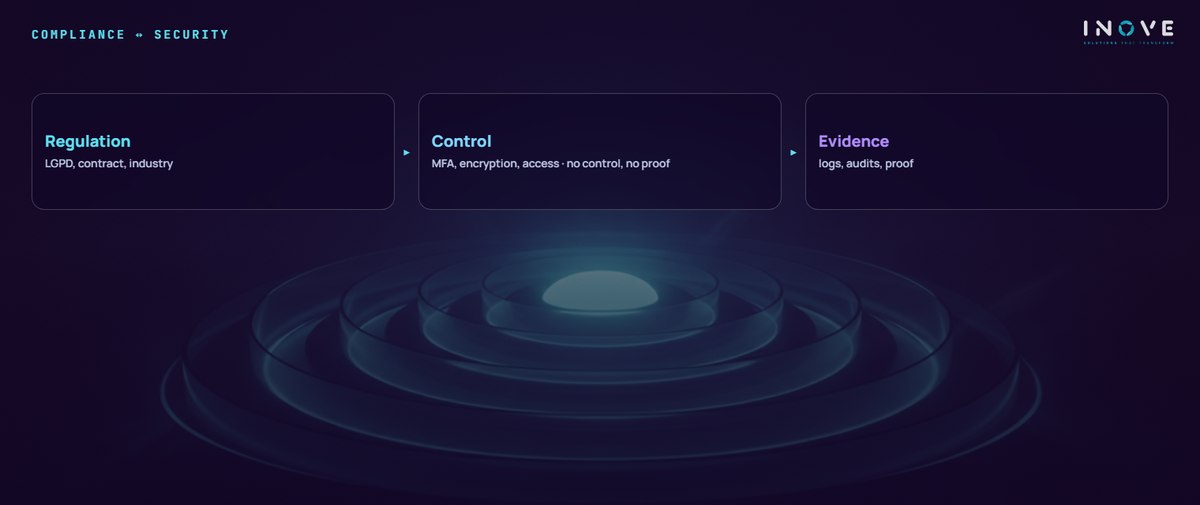
In practice, being compliant requires three things: knowing the obligations, translating them into policies and processes, and being able to prove that all of it works. IT governance is the engine of that proof — without process control, there is no evidence.
What information security means
Information security is the discipline that protects data against leaks, fraud, downtime and attacks. The classic triad still holds: confidentiality, integrity and availability. What changed is the landscape — cloud, hybrid work and AI assistants have widened the exposed surface, and identity has become the new perimeter.
That is why security is not just tooling. It involves technology (MFA, encryption, monitoring), processes (access management, incident response) and people — after all, a large share of incidents still starts with a single click. For a deeper technical view, see our cybersecurity practice.
How the two concepts connect
The relationship runs both ways. Compliance gives security a map of priorities: which data is sensitive, which notification deadlines exist, what the customer’s contract requires. Security, in turn, gives compliance substance: a data-protection policy is worthless if any intern can access the entire customer database.
Moreover, the two share the same fate when something fails. A single leak produces, all at once, the technical incident, the regulatory sanction, the contract breach and the reputational damage. Likewise, the response must be joint: containing the attack is security’s job; notifying the authority and the data subjects on time is compliance’s job.
Benefits of treating both as one
- More trustworthy data — access control and audit trails raise the quality of the information that supports decisions.
- Lower risk of leaks and fraud — the controls the regulation demands are, in general, the same ones that close the doors criminals use most.
- Stronger business relationships — more and more customers audit their vendors’ security before signing. Being ready shortens the sale.
- Mature crisis response — a company that has already mapped its data and processes responds to an incident in hours, not weeks.
Where to start
- Take inventory — which data exists, where it lives, who accesses it and which rules apply to each set.
- Prioritize by risk — protect what is sensitive and exposed first; perfection in everything at once does not exist.
- Deploy measurable controls — MFA, encryption, access management and monitoring, always with records that can serve as evidence.
- Audit and train continuously — regulations change, attacks change, teams change. A mature IT support and operations routine keeps the cycle alive.
In short, compliance and information security are the same commitment seen from two angles: taking good care of the data that customers, partners and employees have entrusted to the company. Those who run both as a single program spend less, prove more and sleep better — turning a regulatory obligation into a concrete competitive advantage.