



Green Cloud: How Cloud Migration Cuts Carbon Emissions

IT has become part of companies’ carbon accounting — and now it needs to prove reduction, not just promise it. Regulation, investors, and customers demand auditable data in ESG reports, and environmental compliance already shows up as a requirement in supply contracts. It is in this scenario that the green cloud left the talking points and became a metric.
Moreover, a new factor has raised the pressure: generative AI workloads have multiplied data centers’ energy demand. In other words, at the same time IT processes more than ever, it needs to emit less than before. In this article, we show how cloud migration helps close that equation — and what to demand so the gain is real.
What the green cloud is, with numbers
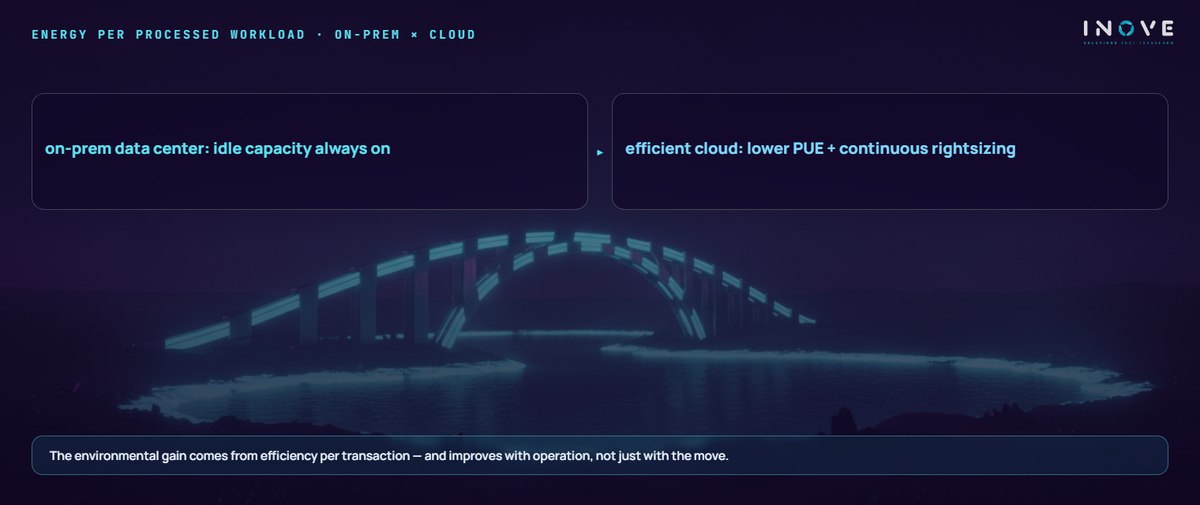
In practice, it is about reducing IT’s environmental impact with measurable data. The focus is on electricity consumption and data center efficiency, and the reference indicator is PUE — the ratio between the site’s total energy and the useful IT energy. Hyperscale data centers operate at far better PUE than local server rooms, because scale, optimized cooling, and automatic consolidation of idle capacity make a brutal difference.
Likewise, the source of the electricity weighs as much as the volume. The same workload emits less in a region with a renewable energy mix — and Brazil, on that front, starts ahead. That is why region selection has become an environmental decision, not just a latency one.
Why FinOps and sustainability are the same agenda
As a result, almost everything that cuts emissions cuts costs. Shutting down idle environments, rightsizing oversized instances, contracting to real demand via IaaS: each of these actions reduces kilowatts and dollars in the same stroke. That is why the FinOps discipline has become the operational arm of the green cloud — some already call this pairing GreenOps.
In addition, the foundation of it all is seeing the estate. An always-current inventory shows the server running with no use, the volume with no owner, the workload that could run in a cleaner region. Without that map, sustainability becomes a slide; with it, it becomes an executable backlog.
What to demand from providers and partners
So, when choosing a vendor, demand evidence, not promises:
- Emissions reporting by service and by region, with an open methodology and auditable data for your ESG report;
- Contracted renewable energy, not just carbon-offset quotas;
- Published PUE, water management, and environmental certification of the buildings;
- A carbon calculator integrated with the cost dashboard — the major providers already offer one, and it turns emissions into an operational metric;
- Reverse logistics for the hardware decommissioned in the migration.
The advantages beyond carbon
Meanwhile, the benefits pile up on other fronts. Direct savings on inputs: energy is a significant, volatile cost, and optimizing consumption protects the margin. Customer retention: those who measure and publish answer due diligence without improvising — more and more contracts require it. And talent attraction: professionals prefer companies aligned with their values, and sustainability weighs in that choice.
In short, the green cloud is the rare case where the environmental and financial agendas point in the same direction. That is how we treat the topic in our cloud and FinOps and infrastructure projects: cost efficiency and emissions reduction on the same track. To structure this discipline, it is worth downloading the FinOps infographic at the Inove Academy.
The transition has stopped being a trend and become a requirement — contractual, regulatory, and competitive. The question that remains is not whether your IT will report emissions, but: when they ask for the number, will you have it?