



How IoT can impact agribusiness
The Internet of Things has moved off the trend slides and into the daily routine of the field. A sensor on the tractor, an electronic ear tag on the cattle, a weather station in the crop, and drone imagery analyzed by AI: all of this is already running on Brazilian farms of every size. What changed in recent years was the bottleneck — rural connectivity, which used to hold everything back, was unlocked by 5G and low-orbit satellite networks.
Meanwhile, the pressure for productivity keeps growing. The world is heading toward nearly 10 billion people, and land and water do not multiply. Producing more with the same resources has stopped being a competitive edge: it has become a survival condition for the agribusiness. In this article, we show where IoT delivers results today and where to start.
What IoT in agribusiness means in practice
The Internet of Things is the network of connected sensors and equipment that collect data from the physical world and send it for analysis. In manufacturing, machines “talk” to each other about the production process. In the field, the logic is the same: soil, weather, machinery, and animals become real-time sources of information.
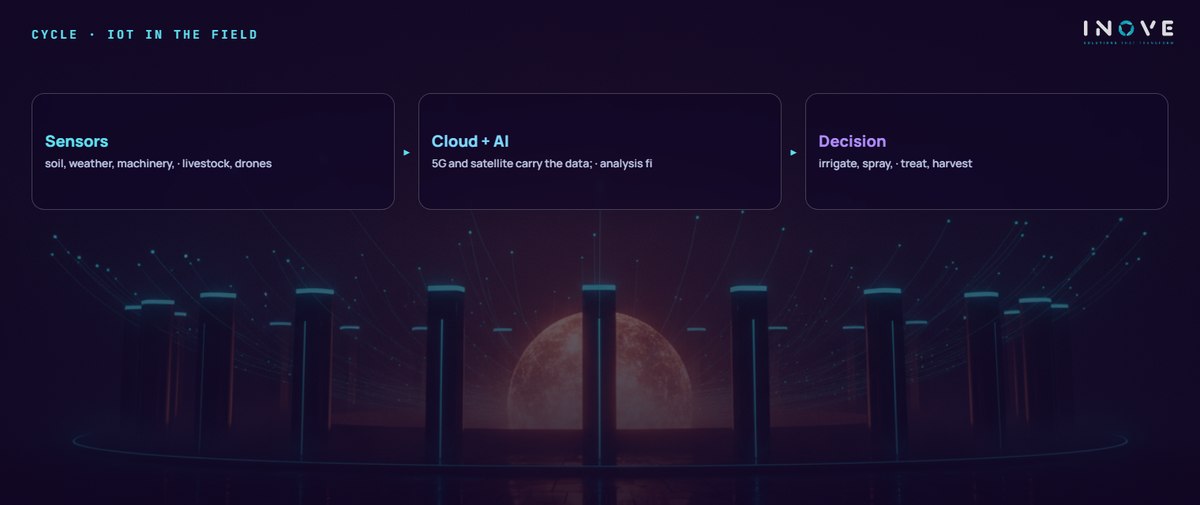
The value is not in the sensor itself — it is in the full cycle. The data goes up to the cloud, the analysis (increasingly done by AI) identifies the pattern, and the recommendation comes back to the decision-maker: where to irrigate, when to spray, which plot to replant.
Where IoT already delivers results
- Machine telemetry — location, fuel consumption, maintenance alerts. Managers track the fleet remotely and anticipate breakdowns instead of stopping the harvest.
- Precision weather — on-farm stations guide irrigation and input application. In extreme events, such as frost and hail, you can act ahead of time.
- Connected livestock — sensors on animals monitor health, weight gain, and reproductive cycles. In poultry, lighting and feeding already run automatically.
- Aerial imagery with AI — drones and satellites map the crop, and computer vision automatically classifies planting gaps, pests, and vegetation density.
- Autonomous machinery — self-driving tractors and sprayers are advancing faster in the field than cars in the city: the farm is a controlled environment.
The bottleneck has moved
For years, the precision-agriculture pitch hit the same wall: with no signal on the farm, no data gets out. That picture has changed. 5G has spread through rural areas and the low-orbit satellite constellations have brought broadband to properties no carrier ever reached.
With that, the challenge has moved inside the farm gate: integrating sensors from different manufacturers, organizing the data, and making sure it reaches the decision-maker. In other words, the problem is no longer the antenna — it is data architecture, exactly IT’s home turf. A well-designed foundation in the cloud is what separates the farm with pretty dashboards from the farm that decides better.
Where to start
- Pick one pain point — input losses, machine breakdowns, herd mortality. Start with the most expensive problem, not the prettiest technology.
- Prove the value in a pilot area — then measure the before and after with simple numbers.
- Standardize the data — define where the information lives and who accesses it, before multiplying sensors.
- Scale securely — finally, remember that a connected device is also an entry point: include IoT in the company’s security policy.
The Internet of Things is no longer a bet on the future of farming — it is a management tool for the present. Those of us who follow agribusiness closely see the same pattern as in other industries: the advantage does not go to whoever has the most sensors, but to whoever turns data into decisions faster.