



IT in Retail: Why Technology Defines Who Grows
Brazilian retail in 2026 runs in real time. PIX, the country’s instant-payment system, settles the sale on the spot, the physical store’s inventory doubles as the e-commerce storefront, and the customer compares prices on the phone right in front of the shelf. In this scenario, IT in retail has stopped being a support function: it is the operation itself. When the system stops, the store stops — and the consumer does not wait.
In this article, we show why technology became the engine of the sector. We also explain the role of IT in this new context and where to invest first. That way, you turn data and systems into sales, not headaches.
Why technology transformed retail
The consumer changed the game. They research online, buy in the app, pick up in the store, and handle the exchange over WhatsApp. They also pay with PIX and expect immediate confirmation. That journey only works if the systems talk to each other — and stay up all the time.
Likewise, the sector’s tight margins demand efficiency. Pricing, promotions, and inventory replenishment are now data-driven decisions, often supported by generative AI and forecasting models. In practice, the retailer still deciding on intuition competes at a disadvantage against the one deciding with information.
The role of IT in this new context
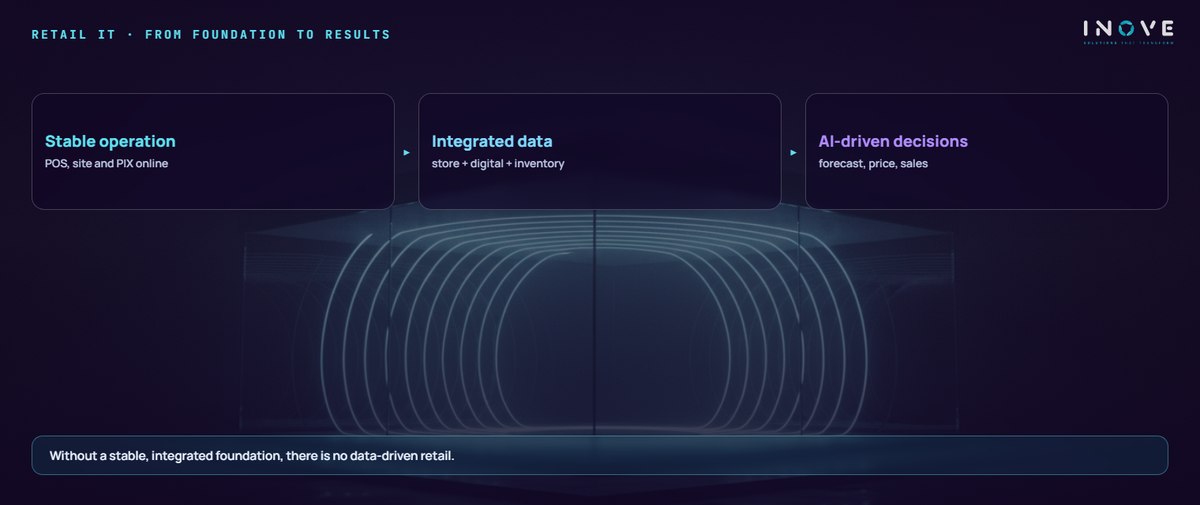
IT’s job in retail boils down to three deliverables. First, availability: point of sale, e-commerce, and payment methods online, including at peaks like Black Friday. Second, integration: physical store, digital channel, inventory, and finance operating on the same data foundation. Third, intelligence: turning sales history into demand forecasting, assortment, and personalization.
IT therefore needs a seat at the strategy table. It stops being the team that “fixes computers” and becomes the one that enables every new revenue front.
Where technology delivers results in retail
- Predictive analytics and AI — demand forecasting, dynamic pricing, and product recommendations. AI assistants also already support customer service and store operations.
- True omnichannel — unified inventory, buy-online-pick-up-in-store, and exchanges in any channel. This requires integration across ERP, e-commerce, and POS.
- Checkout and payments — PIX, cards, and digital wallets coexisting without friction. A failed payment is a sale that dies at the last step.
- The connected store (IoT) — sensors, electronic shelf labels, and smart Wi-Fi generate behavioral data and reduce shrinkage.
- Security and the LGPD — retail holds personal and payment data. With enforcement of Brazil’s data-protection law now mature, protecting that information is a business requirement, not bureaucracy.
The tax front deserves a mention too. With Brazil’s tax reform in its 2026 test year, retail systems need to issue and record the new CBS and IBS tax obligations in parallel with the current model. Whoever depends on an outdated ERP or fragile integrations feels that weight first at the store’s checkout. So the tax agenda is also an IT agenda — and it has a deadline.
Where to start
Start with a diagnostic: which systems sustain the sale, where the bottlenecks are, and what goes down most often. Then prioritize what touches the customer — checkout availability, inventory integration, response time. Only after that come the intelligence projects, which depend on that tidy foundation.
Also assess the operating model. Keeping everything with an internal team is expensive and pulls focus away from the business. A specialized IT support partner keeps the operation running continuously while your team handles strategy. Inove works on exactly that combination in retail: infrastructure, systems, and security end to end.
In short, IT in retail is today what separates those who grow from those who watch. The right technology, well operated, becomes inventory in the right place, a checkout that does not crash, and a customer who comes back. The first step is treating it as the strategic asset it already is.