



How the Cloud Makes IT Asset Mapping Easier
You cannot govern what you cannot see. Mapping assets — knowing what exists, where it is, who uses it, and what it costs — is the first step of any serious IT management. And in 2026, that map has changed in nature: beyond servers and laptops, it needs to include containers, serverless functions, APIs, SaaS subscriptions, and identities.
Moreover, the estate is distributed by definition. With hybrid work normalized, assets live in the office, in people’s homes, and across several providers at the same time. That is why cloud operations stopped being merely the destination of a migration: they became the tool that makes the mapping possible. In this article, we show how.
From manual inventory to continuous discovery
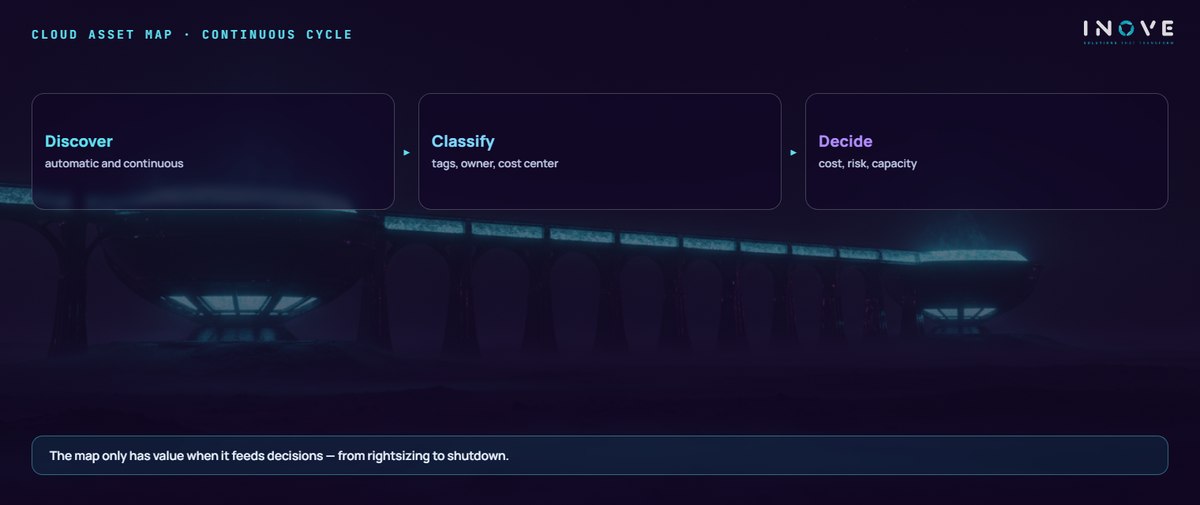
In practice, the annual inventory died because it could not keep up with the environment. Cloud resources are born and die in minutes; SaaS subscriptions come in on any corporate card; containers scale on their own. Discovery therefore needs to be automatic and continuous — and that is exactly what cloud platforms offer natively.
As a result, everything converges in one place: every virtual machine, disk, database, and function shows up in the console with a creation date, an owner, and its consumption. The modern CMDB is fed by this automatic discovery, not by manual collection — and it starts supporting incident, change, and capacity processes with reliable data.
Tags: the link between technical and financial
Likewise, the cloud solves an old problem: connecting the asset to the business. With a well-defined tagging policy — cost center, project, environment, owner —, every resource carries its identity. That is the foundation of chargeback and showback: each area sees its own consumption, and the cost conversation moves past guesswork.
This is where FinOps comes in as a continuous discipline. The asset map feeds the right questions: what is idle? What is oversized? Which unused license can be reallocated? Without the map, FinOps has no raw material; without FinOps, the map becomes a report nobody reads.
Assets and identities: the map is also security
In addition, mapping assets today includes mapping identities. Orphaned accounts, forgotten credentials, and access beyond what is needed are classic entry points for incidents. That is why the modern inventory treats device and identity together, within a zero trust model: every access is verified, and whatever has no owner surfaces early.
With LGPD, the Brazilian data-protection law, under real enforcement, this cross-referencing has become mandatory. Knowing where every piece of personal data lives — in which system, with what retention, accessible by whom — starts with the asset map. It is a front where the inventory and cybersecurity meet.
Capabilities that make a difference
- Automatic discovery of resources, including containers and ephemeral functions;
- Usage data cross-referenced by area, project, and period, feeding rightsizing and chargeback;
- Risk alerts integrated with identity management — orphaned access surfaces before the incident;
- Integration with ERP, ITSM, and FinOps — technical data talking to financial data;
- Correlated observability — logs, metrics, and traces showing the asset in real use, not just on a list. AI models already help here, flagging orphaned resources and oversized instances without a manual sweep.
How to start without stalling
Meanwhile, a tip from those who have run this work many times: do not try to map everything at once. Start with your main cloud, enable native discovery, publish the tagging policy, and connect cost to the map. Then bring in SaaS and devices. Also, involve leadership and the business areas from the start — chargeback only works when each area recognizes its own consumption. With every cycle, the map gains a layer and decisions gain context.
In short, mapping assets in the cloud turns IT from a keeper of spreadsheets into a source of decisions. Spending gets an owner, risk gets visibility, and the team stops wasting time hunting for what should have been registered. It is the foundation on which we build our cloud and FinOps projects — because every optimization starts with the same question: what exactly are we running? Whoever answers with data, not memory, is already ahead.