



Structured IT: 5 real benefits for your company
Investing in cutting-edge technology guarantees nothing by itself. What does deliver results is structured IT: defined processes, a managed environment, security treated as routine, and a clear plan for what technology must deliver to the business. Without that foundation, every new tool becomes one more cost — and one more risk.
That is why this article covers the five benefits a well-structured IT function brings to a company in 2026. These are gains we see every day in Inove’s projects, from infrastructure to SAP. And in practice, they all start in the same place: organization before tooling.
1 — Costs under control, not under surprise
In a structured IT operation, every resource has an owner, a purpose, and a measurement. That applies to software licenses, cloud contracts, and equipment. As a result, the classic waste disappears: licenses paid for but unused, servers running with no function, contracts renewed on autopilot.
On top of that, the discipline of FinOps — continuous financial management of the cloud — has become part of the basics. Companies that structure their IT know what each environment costs and can decide based on data, not impressions. Planned maintenance matters too: prevention typically costs a fraction of an emergency repair with operations at a standstill.
2 — Security and compliance as routine
LGPD, the Brazilian data-protection law, is no longer news: today there is real enforcement and sanctions being applied. Likewise, ransomware and fraud hit companies of every size. Structured IT treats cybersecurity as a continuous process — asset inventory, patches up to date, tested backups, access reviews — not as a project that happens after the incident.
In practice, this changes the conversation with customers and partners. More and more B2B contracts require evidence of security controls. Having your house in order becomes a commercial differentiator, not just protection.
3 — An environment ready to innovate (AI included)
The innovation of the moment is generative AI — assistants that write, summarize, analyze, and automate everyday tasks. However, AI only creates value on top of an organized foundation: accessible, high-quality data, working integrations, and a clear corporate usage policy. Companies with improvised IT get stuck exactly there.
Structured IT can also test what is new without putting operations at risk. A separate environment for experiments, data governance, and adoption criteria turn innovation into routine rather than a gamble.
4 — Operational continuity
To be clear: structuring does not mean rigidity. Good IT structures have lightweight processes, automated where it makes sense, and reviewed frequently. The goal is predictability, not bureaucracy.
Today, virtually every business process depends on a system. An IT outage is therefore a company outage — sales that cannot be invoiced, shipments that do not leave, payroll that does not close. Well-managed infrastructure works with monitoring, redundancy, and a tested recovery plan.
In practice, this means detecting the anomaly before the user feels it. Support stops firefighting and starts addressing root causes — a problem solved for good does not come back every week.
5 — Better decisions and better relationships
Finally, structured IT delivers reliable information for decision-making. Without inventory and without measurement, every budget discussion becomes opinion versus opinion. Indicators of operations, cost, and risk reach the board in business language. That improves relationships with every audience: customers experience stable service, suppliers find organized integrations, and employees work without friction — at the office or in the hybrid model that has become the norm.
Where to start
- Assessment — map current assets, contracts, risks, and bottlenecks.
- Priorities — then attack what hurts most: security, cost, or availability.
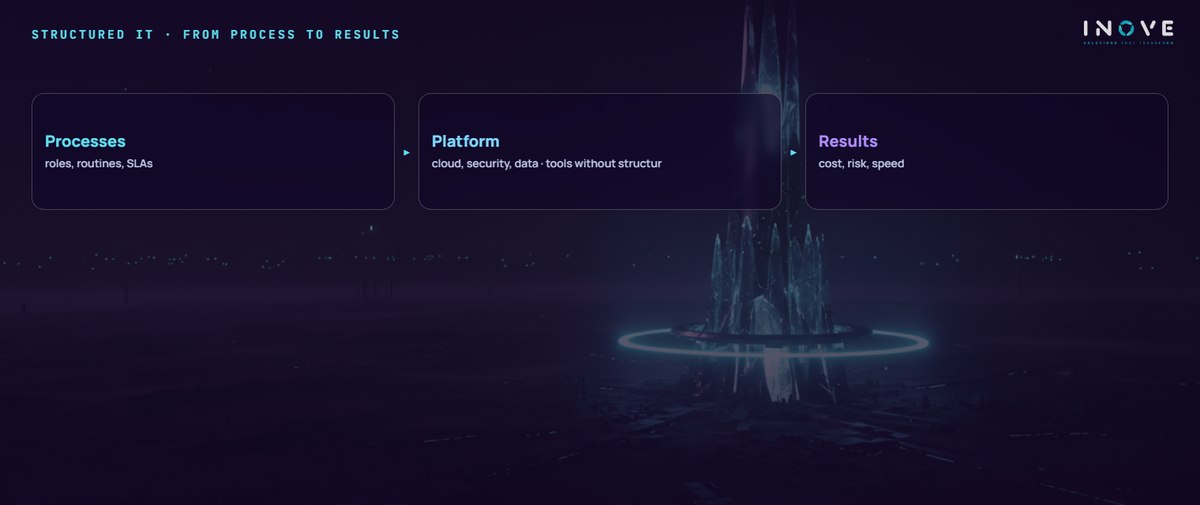
- Processes and owners — define routines, SLAs, and who takes care of what.
- Measurement — finally, track indicators and adjust every quarter.
Structuring IT is not a one-off project — it is a way of operating. Companies that build this foundation first reap the five benefits above in compound form: every dollar invested in technology starts to yield more, with less risk and more speed for the business.