



Which technologies can boost credit unions?

Credit unions are living through a rare moment: members want the same digital experience a big bank offers, without giving up the closeness only a credit union provides. The good news is that the technology to deliver both has matured. Generative AI, well-organized data, cloud, and Pix (Brazil’s instant-payment system) are no longer promises — they are everyday parts of the Brazilian financial system.
That is why the right question in 2026 is no longer “should we innovate?”. It is “where do we start, with the budget and the team we have?”. In this article, we look at the technologies that actually move the needle for credit unions — and the order that tends to work in practice.
Start with the foundation: processes and data
Every cutting-edge technology depends on a tidy base. Before talking about AI, the credit union needs automated processes and a single, reliable record for each member. Duplicate registrations, parallel spreadsheets, and paper-based approvals stall any digital project.
In practice, automating administrative routines — account opening, document review, reconciliations — is the investment with the fastest payback. It also frees the team for what sets a credit union apart: the relationship with the member.
AI in service and credit analysis
Generative AI has raised the bar for digital service. Today’s virtual assistants understand natural language, resolve simple requests end to end, and hand off to a person when the matter calls for judgment. Members get answers at any hour — and human agents focus on what truly needs them.
Likewise, machine learning remains essential behind the scenes: risk analysis, credit modeling, and fraud prevention. With Pix everywhere and open finance consolidated, the credit union that combines its own data with the data members share decides better and faster than the competition.
One governance point matters here: log AI interactions, keep human review on sensitive decisions, and always offer a channel staffed by real people.
Cloud as the foundation of everything
Cloud infrastructure has stopped being a differentiator and become a prerequisite. It supports the team’s hybrid work, scales during peaks, and cuts the cost of keeping a server in every branch. On top of that, the providers’ data and AI services shorten projects that used to take years.
The caution is to get the math right: poorly sized cloud gets expensive. That is why it pays to manage consumption and contracts with FinOps discipline from day one — a topic we follow closely in our cloud practice.
Security and LGPD: trust is the product
A credit union runs on trust. A breach of member data destroys in days what took decades to build. With the LGPD — the Brazilian data-protection law — now mature and actively enforced, security is no longer just an IT topic: it is a board-level agenda item.
In practice, the basics done well remove most of the risk: strong authentication everywhere, vulnerability management, tested backups, and training against scams — which now use AI to get more convincing. To go further, a structured cybersecurity program covers monitoring and incident response.
A workable path
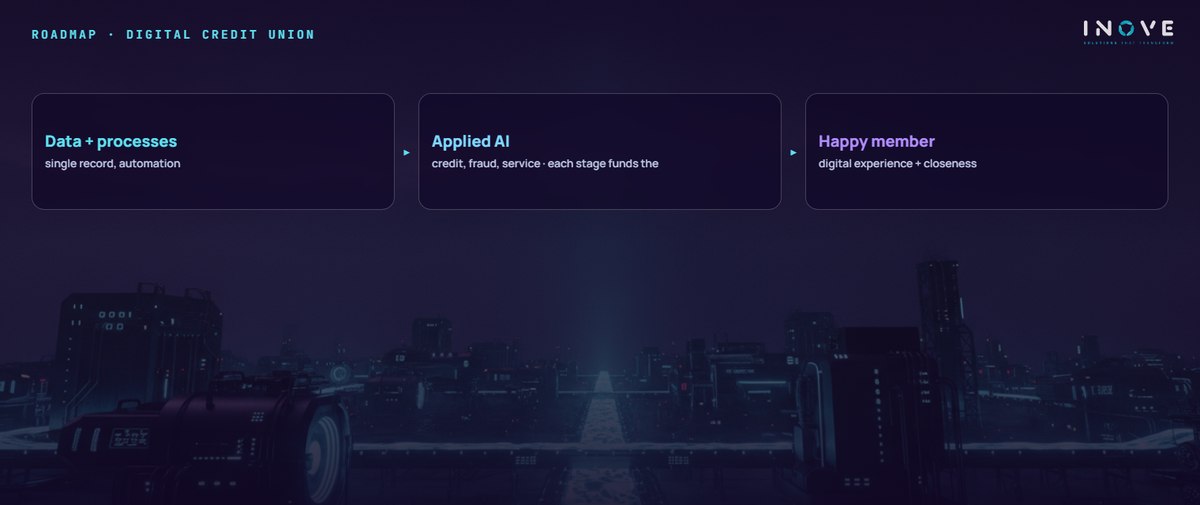
- Diagnosis — processes, systems, and data: what is holding the operation back today.
- Foundation — next, cloud, a single member record, and automation of the repetitive work.
- Experience — then, digital channels and an AI assistant with governance.
- Intelligence — finally, data-driven credit, risk, and fraud prevention.
A credit union does not need to match a big bank’s investment volume. It needs to invest in the right order. We have served credit unions for years, and the lesson repeats itself: those who organize the foundation first go further with the same budget — without losing the closeness that makes a credit union a credit union.